
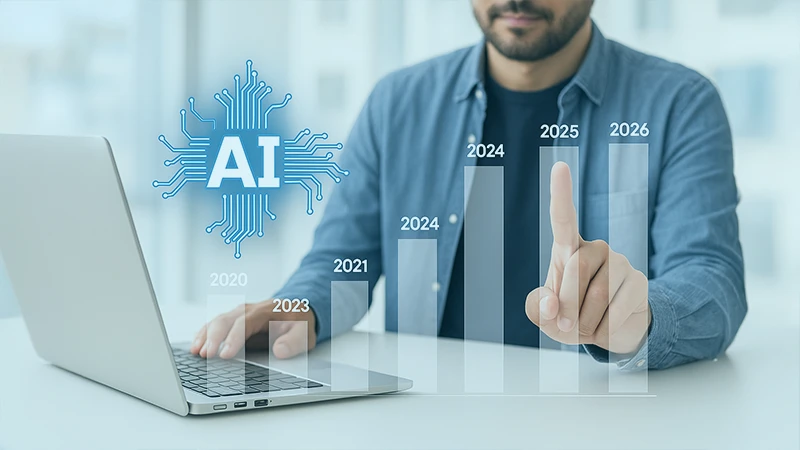

2026 is the inflection point. Agentic AI systems that can reason, plan, coordinate, and act autonomously are moving from pilots into production. This shift is powered by advances in reasoning models, orchestration engines, RAG 2.0 architectures, real-time data pipelines, and tool-using AI components. Together, they create a new operational paradigm where AI behaves less like software and more like a capable digital teammate. Forward-thinking enterprises often partner with an AI agent development company to implement reasoning-driven architectures that ensure reliability at scale.
For CIOs, CTOs, CDOs, and transformation leaders, the real question is no longer “Can AI agents work in our enterprise?” but rather “How fast can we deploy them safely and at scale before competitors do?”
In this article, we explore the Top Strategic Technology Trends Agentic AI that are expected to redefine how intelligent systems automate business workflows and drive enterprise value in 2026.
Why Top Strategic Technology Trends Agentic AI Matter for Enterprise Leaders
For CIOs, CTOs, CDOs, and digital transformation leaders, understanding the Top Strategic Technology Trends Agentic AI is not about tracking innovation for its own sake. These trends directly determine how quickly enterprises can move from static automation to autonomous operations while maintaining governance, reliability, and competitive advantage.
Organizations that align early with these trends gain faster execution, lower operational friction, and greater confidence in deploying AI agents across mission-critical workflows. Those that delay risk being constrained by legacy architectures that cannot scale autonomy safely.
Start your Agentic AI journey
Trend 1 – Reasoning-First AI Models Become Core Infrastructure
The biggest upgrade in 2026 isn’t just that AI models are smarter, it’s that they think differently. Earlier models were fluent, but often shallow in logic. Today’s frontier systems behave more like analysts or strategists: they break down problems, evaluate evidence, critique their own reasoning, and refine decisions before acting.
This structured reasoning is exactly what enterprises need for workflows that involve ambiguity, compliance constraints, or multi-step planning. When an agent handles tasks such as risk scoring, code refactoring, or financial reconciliation, it must reason step by step, not guess.
The payoff is significant. With self-checking logic loops, reasoning-first models deliver far fewer hallucinations and consistently higher task accuracy. In short: reliability becomes predictable rather than situational.
Takeaway: Reasoning-first models form the cognitive backbone for every serious agentic AI strategy in 2026.
Trend 2 – Multi-Agent Ecosystems Move From Experimentation to Production
In previous years, multi-agent architectures were fascinating research demos. In 2026, they will become the enterprise standard for complex automation.
But the enterprise version of multi-agent systems is far more operational than academic. Leaders are assembling agent “pods” that coordinate like small digital teams. A customer operations pod might include:
- A triage agent to interpret inbound queries.
- A classification agent that routes tasks.
- A resolution agent with domain-specific tools.
- A compliance agent validating final actions.
These pods adjust dynamically. Sometimes multiple agents collaborate; sometimes they challenge or review each other’s outputs, especially in high-risk environments. Instead of workflows becoming more rigid, they become more adaptive and resilient. Many companies augment their internal teams with AI developers for hire to architect and fine-tune these multi-agent ecosystems without slowing down innovation.
The real change is cultural: CIOs are no longer asking, “Can one agent do the task?” but “What mix of agents completes the workflow most efficiently?”
Takeaway: Multi-agent systems unlock speed, scale, and resilience turning automation into autonomous operations.
Trend 3 – RAG 2.0 Evolves Into a Live Enterprise Knowledge Engine
RAG 1.0 (retrieve, then generate) helped reduce hallucinations, but it was limited by static embeddings and simplistic retrieval. RAG 2.0 solves this by combining graph-based relationships, policy-aware retrieval, compressed context summaries, and hybrid indexing across structured and unstructured data.
The result is not “better search”; it’s contextual reasoning. When an agent must audit a contract, troubleshoot a system, or analyze a customer’s history, RAG 2.0 feeds it only the most relevant, high-quality knowledge, updated in real time.
This enables use cases such as:
- Dynamic compliance checks.
- Intelligent procurement recommendations.
- On-the-fly policy validation.
- Real-time decision support.
In many enterprises, RAG 2.0 effectively becomes the source of truth for every agentic workflow.
Takeaway: RAG 2.0 is no longer a feature; it’s the intelligence layer that determines whether agents act accurately or recklessly.
Trend 4 – Orchestration Layers Emerge as the New Enterprise OS
Even the most advanced agents cannot operate safely without a unifying control plane. That’s why 2026 sees the rise of agent orchestration platforms systems that coordinate planning, memory, tool permissions, context routing, and governance.
Unlike traditional workflow tools, orchestration platforms behave more like operating systems for autonomous agents. They manage how agents:
- Delegate tasks
- Coordinate across departments
- Share long-term memory
- Trigger APIs and actions
- Escalate exceptions
Some enterprises treat the orchestration layer as a command center, inserting human checkpoints at key decision nodes. Others optimize for autonomy and speed, allowing agents to take action unless a risk threshold is crossed.
This is the quiet revolution: orchestration, not model selection, ultimately determines how far an organization can scale agentic AI.
Takeaway: The orchestration layer becomes the strategic advantage enabling safety, scalability, and enterprise-grade execution.
Trend 5 – Real-Time Data Pipelines Power Autonomous Decision-Making
Agents become exponentially more valuable when connected to live data streams instead of stale databases. With real-time signals, agents can detect anomalies, adjust plans, and take immediate action.
For example, in operations:
A maintenance agent can observe sensor deviations, analyze historical patterns, trigger a diagnostic script, and schedule downtime all autonomously.
In finance:
A fraud detection agent can flag unusual behavior, pull contextual history, apply policy rules, and block the transaction before damage occurs. These are not “alerts” but actions, executed autonomously through API privileges.
Enterprises that combine agentic AI with streaming data infrastructures will advance faster than competitors relying on batch analytics
Trend 6 – Domain-Specific Small Models Become the Workhorses
While frontier models get the headlines, 2026 belongs to specialized small models that excel at narrow tasks. Enterprises are discovering that many workflows, pricing checks, claims triage, logistics planning, order validation do not need massive LLMs.
Instead, they use:
- Industry-specific small models
- On-premise models for sensitive data
- Edge models for latency-critical functions
These models are cheaper, faster, easier to govern, and optimized for precision. LLMs still play a role usually for reasoning or orchestration but execution often comes from these purpose-built systems. The emerging enterprise stack is hybrid, not monolithic.
Takeaway: The winner is not the biggest model, it’s the right model for each agent and each task.
Trend 7 – Governance, Compliance, and Policy-Aware Agents Become Mandatory
As AI becomes more autonomous, enterprises cannot rely on external guardrails or human vigilance. Agents must internalize compliance rules, understanding regulatory boundaries, interpreting policy changes, and enforcing constraints automatically.
Policy-aware agents rely on:
- Embedded governance knowledge bases
- Real-time retrieval of regulations
- Role-specific permission frameworks
- Transparent decision logs
- Automatic exception escalation
Without integrated governance, agentic AI becomes too risky for large-scale rollouts. With it, enterprises gain confidence to automate previously “too sensitive” workflows.
Takeaway: Governance isn’t a layer on top; it’s built into the agent. Safety becomes native, not optional.
Trend 8 – Human-AI Collaboration Workflows Mature
Autonomy does not eliminate human involvement, it elevates it. In 2026, enterprises shift toward hybrid human-agent workflows where people handle judgment, strategy, and oversight while agents handle execution and iteration.
A few examples:
- Engineers let agents generate remediation plans, then validate them
- Analysts review agent-driven risk insights before final approvals.
- Customer teams rely on agents to execute tasks, while humans resolve edge-cases.
Instead of replacing roles, agents reshape them. Employees spend less time navigating systems and more time exercising judgment. The collaboration becomes fluid because agents remember preferences, understand role boundaries, and know when to escalate.
Takeaway: Human-AI workflows unlock scale while keeping control in human hands.
Real-World Adoption: What Agentic AI Looks Like in Practice
Enterprises across industries are already deploying agentic AI in targeted, high-impact workflows.
A Global Bank Automates Compliance Decisions
An agent reviews transactions against policy updates, retrieves relevant regulation excerpts, assesses risk, and generates audit-ready reports. Review time drops from hours to minutes while improving consistency.
A Manufacturing Firm Automates Supplier Negotiations
Multi-agent negotiation pods evaluate bids, optimize pricing, validate supplier credibility, and generate RFQs. Procurement teams shift from tactical work to strategic vendor relationships.
A SaaS Platform Deploys Customer Onboarding Agents
Agents guide customers through implementation steps, create tasks, flag risks, and surface personalized recommendations. Onboarding times shrink while customer satisfaction rises.
Each example demonstrates a central truth: agentic AI is already operational and already driving measurable outcomes.
Related read – Top Agentic AI Companies for Enterprises
A Practical 4-Step Framework for Enterprise Agentic AI Adoption
Identify High-Impact Workflows
Start with processes that are repetitive, rule-heavy, or costly. Areas with high variance or high human dependency are particularly strong candidates.
Define Agent Roles and Capabilities
Clarify what each agent should do:
- Reason?
- Retrieve knowledge?
- Execute actions?
- Collaborate with other agents?
This determines model selection and architecture.
Build the Orchestration & Governance Foundation
This is the strategic investment:
- Memory architecture
- Routing rules
- Permissions and guardrails
- Audit logging
- Human escalation paths
Pilot Small, Prove Value, Then Scale
Start with a narrow workflow. Measure speed, cost savings, and accuracy improvements. Once validated, expand horizontally across adjacent processes. Referring to an enterprise-ready AI agents guide can help define evaluation metrics, monitor agent behavior, and plan safe scaling.
Turn AI Pilots into Production
Readiness Checklist for Leaders Building Agentic AI in 2026
Use this as a quick evaluation tool:
- Do business systems expose APIs for agent access?
- Is your knowledge base indexed for RAG 2.0?
- Can your agents access real-time data streams?
- Are compliance and policy rules documented digitally?
- Do you have observability tools for tracking agent decisions?
- Are model selection guidelines defined for each task type?
If 3 or more answers are “no,” scaling agentic AI will be challenging
Conclusion – The Enterprise Advantage Goes to Early Movers
Agentic AI is not incremental innovation. It transforms how enterprises operate, how teams collaborate, and how decisions get made. The organizations that move now will benefit from:
- Faster operations
- Lower cost-to-serve
- More confident decision-making
- Better customer experience
- Enhanced compliance
- Significant competitive advantage
The organizations that delay will find themselves years behind. 2026 is the year to operationalize agentic AI thoughtfully, securely, and with a clear strategy.
If you’re evaluating how to integrate these trends into your transformation roadmap, now is the ideal time. Connect with our AI experts to explore your agentic AI strategy.



 Contact us