
For decades, senior leaders have known how to evaluate manufacturing investments. You calculate capital expenditure, forecast output, estimate labor savings, and wait patiently for ROI to materialize over years. The math is familiar. The risks are understood. The timelines are long but predictable.
That is why so many leadership teams struggle to answer a seemingly simple question: Is AI actually delivering better ROI than traditional manufacturing systems, or is it just another expensive technology wave?
The issue is not that AI is harder to measure. The issue is that AI changes how value is created, how costs behave, and how work gets done. When leaders evaluate AI using factory-era economics, the conclusions are often misleading and strategically dangerous.
This article explains the real differences between AI-driven business systems and traditional manufacturing systems, focusing on cost structure, ROI dynamics, and workforce impact, without hype or abstractions.
Two Very Different Value Engines: Systems That Produce vs Systems That Decide
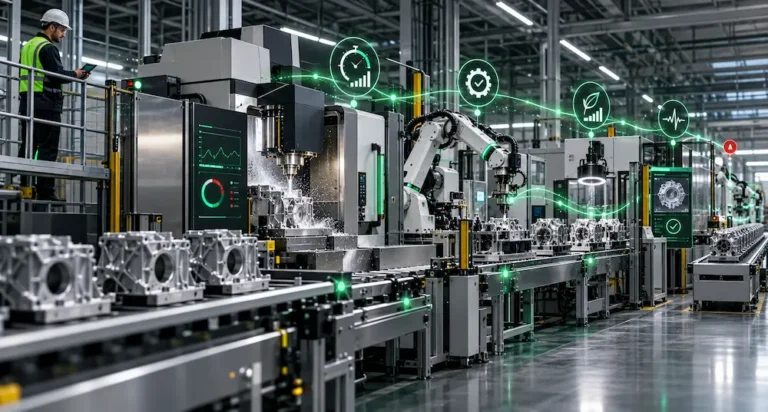
Traditional manufacturing systems create value through mechanical efficiency and process standardization. AI applications create value through adaptive decision-making continuously learning from data and adjusting outputs (forecasts, schedules, quality flags, maintenance alerts) in near real time. Increasingly, that adaptive layer isn’t a single model bolted onto a dashboard it’s agentic AI: a coordinated set of AI agents that can observe conditions, make a decision, take an action (e.g., re-route a purchase order, flag a quality exception, adjust a production schedule), and hand off to a human only when judgment or approval is required. That shift from “AI as an analytics tool” to “AI as an operating layer” is the core reason the cost and ROI math for AI vs traditional manufacturing systems looks so different from a straight equipment-replacement comparison.
AI vs Traditional Manufacturing Systems: Side-by-Side Comparison
| Dimension | Traditional Manufacturing Systems | AI Applications in Business |
|---|---|---|
| Cost Model | CapEx-heavy: Large upfront investments in machinery, tooling, and facilities with depreciation cycles of 7–15 years. | Cost-elastic: Cloud infrastructure and usage-based AI services that scale with business demand. |
| ROI Pattern | Linear returns driven by production throughput, equipment utilization, and uptime. | Nonlinear and compounding returns where improvements in one workflow positively impact multiple downstream operations. |
| Time to Value | Long implementation cycles requiring months or years for commissioning and production ramp-up. | Rapid deployment with AI pilots often moving to production within weeks. |
| Operational Flexibility | Limited flexibility; changing production lines requires significant cost and downtime. | Highly adaptable; AI models and agents can be retrained quickly as business conditions evolve. |
| Workforce Impact | Focus on machine operation, maintenance, and manual quality inspection. | Shifts employees toward exception handling, strategic oversight, and higher-value decision-making with reskilling opportunities. |
| Best Fit | High-volume, standardized production environments with low variability. | Dynamic, decision-intensive processes such as forecasting, predictive maintenance, quality inspection, and workflow automation. |
| Governance Requirements | Mature frameworks covering equipment safety, quality standards, and regulatory compliance. | Requires AI governance, model monitoring, data quality management, security controls, and responsible AI compliance. |
The Real Cost Story: CapEx Gravity vs Cost Elasticity
Manufacturing systems carry heavy CapEx gravity: large upfront capital spend on equipment, facilities, and tooling, with long depreciation cycles. AI systems have cost elasticity: cloud infrastructure, pay-as-you-scale compute, and incremental model development mean costs can flex up or down with usage and business need. This is one of the most important differences in a cost comparison of AI vs traditional manufacturing systems: a manufacturer can start an AI initiative with a scoped pilot for a fraction of the cost of a new production line, then scale spend only as value is proven — a
Traditional Manufacturing Systems: Heavy Assets, Predictable Burn
Manufacturing cost structures are dominated by fixed investments:
- Plants, machinery, tooling, and robotics
- Installation, calibration, and downtime
- Ongoing maintenance and energy consumption
- Skilled labor tied directly to production capacity
Once capacity is built, costs continue regardless of demand fluctuations. Scaling up requires new assets. Scaling down rarely reduces costs proportionally. Depreciation schedules are long, and breakeven is measured in years.
This is not a flaw, it is a design choice optimized for stability.
See AI Transform Manufacturing Operations Today
AI Applications in Business: Modular Spend, Variable Scale
AI-driven business systems behave very differently:
- Initial costs include data preparation, model development, integration, and governance
- Ongoing costs scale with usage, complexity, and model refresh cycles
- Marginal cost per additional prediction, decision, or transaction is low
More importantly, AI agent development costs are elastic. An AI system used across one function can later be extended to multiple workflows without rebuilding the foundation. The same demand forecasting engine can inform procurement, production planning ai agents, pricing, and logistics with minimal incremental investment.
Short example:
Adding a new manufacturing line to support regional demand may require months of planning and millions in capital. Deploying AI-driven demand sensing across regions can often be done in weeks, with costs scaling gradually as adoption grows.
ROI Reality: Why AI ROI Looks “Unclear” Until It Suddenly Isn’t
Manufacturing ROI: Linear, Measurable, Slow
Manufacturing ROI is typically:
- Tied to output volume, yield improvement, or labor substitution
- Measured per asset or per line
- Predictable once steady-state operations are reached
Returns accrue steadily, but rarely accelerate.
AI ROI: Nonlinear, Compounding, Often Underestimated
AI ROI behaves differently and this is where many projects are prematurely judged as failures.
Early AI deployments often show modest gains:
- A few percentage points improvement in forecast accuracy
- Reduced manual effort in planning or reconciliation
- Faster response times in customer-facing processes
Individually, these gains can look underwhelming. Collectively, they compound.
As models learn, adoption spreads, and trust increases, AI-driven systems begin influencing multiple decisions simultaneously. Value spills over into adjacent functions without proportional cost increases.
This compounding effect is why AI ROI often appears slow for the first 6–12 months and then accelerates rapidly.
Workforce Impact: Automation Fear vs Role Recomposition
Traditional Manufacturing Workforce Dynamics
Manufacturing workforces have historically evolved through:
- Skill specialization around machinery and processes
- Incremental automation focused on efficiency and safety
- Headcount growth closely aligned with production volume
Automation typically reduces manual effort but does not fundamentally change decision ownership.
AI Impact on Manufacturing and Business Workforces
AI changes who decides, not just who executes.
In AI-enabled environments:
- Routine decisions are automated or augmented
- Humans focus on exceptions, judgment, and optimization
- New hybrid roles emerge combining domain expertise and AI fluency
Short use case:
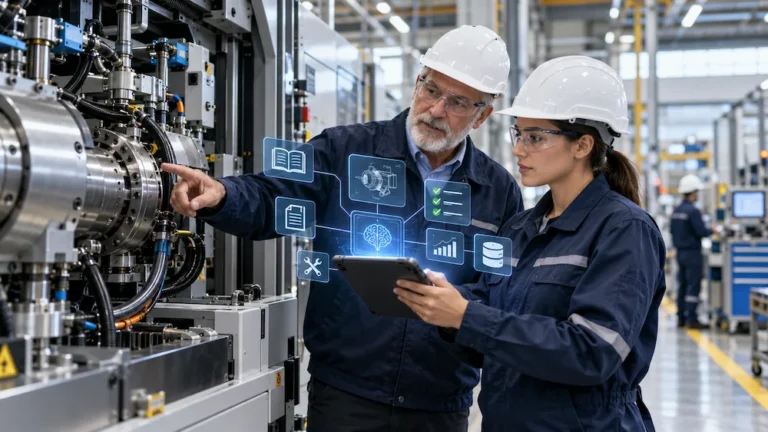
A plant operations team deploys AI agents to monitor equipment health, flag anomalies, and recommend maintenance schedules. Technicians no longer spend hours reviewing sensor data; they intervene only when the system identifies risk. Productivity improves without reducing safety or quality.
Rather than eliminating jobs, AI agent development services often reshape roles, increasing output per employee without proportional workforce expansion.
Operational Flexibility: Where AI Quietly Wins
Manufacturing systems excel at repeatability. AI systems excel at variability.
When markets are stable, traditional systems perform exceptionally well. When conditions change, AI-driven systems respond faster.
Examples include:
- Sudden demand spikes or drops
- Supply chain disruptions
- Regulatory or compliance changes
- Product mix shifts
AI applications can recalibrate forecasts, schedules, and priorities in near real time. Manufacturing systems, constrained by physical assets, adapt more slowly.
This difference in response speed increasingly separates resilient organizations from rigid ones.
Automate Decisions, Boost ROI With AI
A Simple Comparison Test: Scale, Speed, and Spillover
Instead of complex evaluation frameworks, leaders can apply a simple lens.
Scale:
Can value increase without adding physical assets?
Speed:
How quickly can the system adapt to new information?
Spillover:
Does value extend beyond the original use case?
Traditional manufacturing systems score high on scale efficiency once built, but low on speed and spillover. AI applications score high on speed and spillover, with scale improving over time as adoption increases.
This is why AI is most powerful when layered onto existing manufacturing systems not positioned as a replacement.
When Traditional Manufacturing Systems Still Win
AI is not universally superior. Traditional systems remain essential where:
- Physical precision and safety are paramount
- Deterministic outcomes are required
- Regulatory environments demand strict control
High-volume, low-variance production will always depend on robust manufacturing infrastructure.
The strategic advantage comes from augmenting these systems with AI not competing with them.
When AI Applications in Business Deliver Outsized Returns
AI consistently outperforms in areas involving:
- Forecasting and planning
- Scheduling and optimization
- Pricing and demand shaping
- Customer engagement and service
- Cross-functional coordination
These are domains where uncertainty is high and decisions are frequent exactly where AI’s learning capability compounds value.
Organizations that see sustained ROI from AI treat it as an operating layer, not a standalone tool. A short assessment can quickly identify where AI will compound value fastest within your existing systems.
Also check – Why Enterprises Are Investing in AI Business Solutions in 2026
Leadership Mistakes That Kill AI ROI
Many AI initiatives underperform for predictable reasons:
- Expecting manufacturing-style certainty from probabilistic systems
- Underinvesting in data readiness and change management
- Measuring ROI too narrowly or too early
- Treating AI as an IT expense rather than business leverage
Avoiding these mistakes often matters more than model selection.
The Future Operating Model: Hybrid by Design
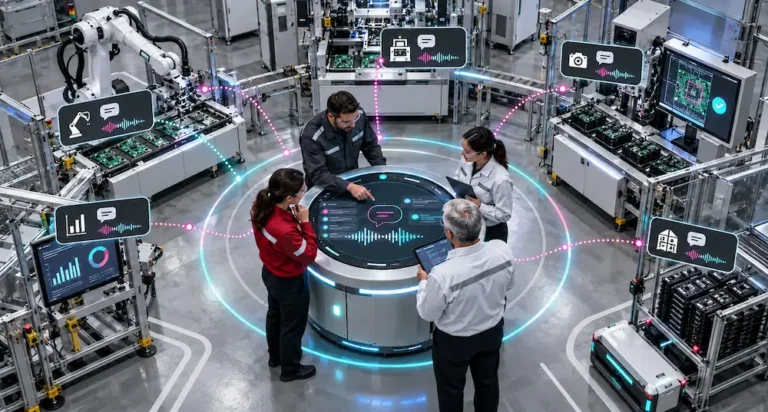
The winning model for most manufacturers is hybrid — traditional systems handle high-volume, stable physical production, while AI agents handle forecasting, quality assurance, exception handling, and continuous optimization layered on top. In practice, this hybrid model increasingly relies on multiple specialized agents working together (a forecasting agent, a quality-inspection agent, an exception-handling agent) coordinated as a system rather than a single monolithic AI tool — which is why manufacturers evaluating this shift are increasingly asking about AI agent developmentand enterprise AI strategy, not just “which AI software should we buy.
Conclusion: Rethinking Cost, ROI, and Work in the AI Era
AI applications in business do not replace traditional manufacturing systems. They change the economics around them. Costs become more elastic. ROI becomes compounding rather than linear. Work shifts from execution to decision-making.
Leaders who recalibrate their evaluation models early gain a structural advantage that compounds year after year.
If you are evaluating AI alongside existing manufacturing systems and want a realistic view of cost, ROI, and workforce impact, connect with our AI experts for a focused consultation.
FAQs
The main difference lies in decision-making. Traditional manufacturing systems follow predefined, stable processes, while AI applications continuously learn from data to adapt decisions in real time. AI systems optimize outcomes under changing conditions rather than repeating fixed workflows.
AI applications are often more cost-effective over time because they reduce waste, improve forecasting accuracy, and lower the cost of operational change. Traditional manufacturing systems rely on fixed capital investments, whereas AI shifts spending toward scalable, outcome-driven intelligence.
ROI from traditional manufacturing systems typically plateaus after efficiency improvements are realized. AI-driven systems deliver compounding ROI because models improve with experience, enabling better decisions, reduced errors, and increasing value without proportional increases in cost.
AI does not primarily replace jobs; it changes how work is performed. AI automates repetitive analysis and monitoring tasks, allowing employees to focus on supervision, decision-making, and optimization. Most workforce impact comes through role evolution and reskilling, not elimination.
AI delivers the most impact in decision-intensive areas such as demand planning, supply chain management, operations scheduling, financial forecasting, and customer service. These functions benefit from real-time insights and adaptive decision-making that traditional systems cannot provide efficiently.
Yes. AI is commonly deployed as an intelligence layer on top of existing manufacturing systems. This hybrid approach enhances planning, forecasting, and coordination without replacing physical infrastructure, allowing organizations to improve performance while minimizing risk.