
Automotive organizations that have moved past AI experimentation and into enterprise-scale AI deployment are discovering that the generic enterprise AI org structure does not fit the automotive operating environment. A Head of AI at a software company manages recommendation models and fraud detection systems. A Head of AI at an OEM or tier-1 supplier manages AI in braking systems, driver monitoring cameras, real-time chassis control, connected vehicle telematics, and hundred-plant manufacturing operations simultaneously. The scope is different, the regulatory exposure is different, and the consequences of model failure are categorically different.
The automotive industry is investing accordingly. McKinsey estimates that automotive companies globally will spend over $60 billion annually on AI-related initiatives by 2030, with the majority going into autonomous and assisted driving, manufacturing optimization, and connected services. Building the leadership structure to govern that investment productively with the right roles, the right accountabilities, and the right interfaces between them is one of the most consequential organizational design decisions an automotive enterprise makes right now.
This guide covers the core automotive AI leadership roles, what each owns, how they interact, and what differentiates automotive AI leadership from the AI leadership structures that work in other industries. It also explores how AI Services for Optimizing Automotive Manufacturing Processes support these leaders by improving production efficiency, quality control, predictive maintenance, and intelligent factory operations through enterprise AI solutions.
Why Automotive AI Leadership Is Structurally Different
Before mapping individual roles, it is worth understanding the three factors that make automotive AI leadership structurally distinct from AI leadership in retail, financial services, or technology companies.
Functional safety standards govern AI in vehicle systems. ISO 26262 is the international standard for functional safety in road vehicles. ISO 21448 (SOTIF, Safety of the Intended Functionality) specifically addresses the safety risks that arise when AI systems behave correctly according to their specification but still cause harm which is the most relevant standard for machine learning models in ADAS. AI leaders in automotive who are accountable for in-vehicle AI systems are operating under regulatory frameworks that have no direct equivalent in enterprise software AI. A model that degrades in production is an operational problem in most industries. In automotive, it is potentially a safety event with regulatory and liability implications.
OEM-to-supplier AI coordination is a leadership problem, not a technology problem. Tier-1 suppliers often develop the AI systems camera perception stacks, radar fusion algorithms, battery management AI that OEMs integrate into their vehicles. The AI governance questions that arise at this boundary (who owns the model validation, who is accountable when a supplier AI system fails in production at the OEM level, how do model updates flow through the supply chain) require dedicated leadership attention that most generic AI governance frameworks do not address.
The EU AI Act creates compliance obligations that are now an executive accountability. The Act classifies AI systems in vehicles, including ADAS above a certain automation level and AI used in safety-critical vehicle functions, as high-risk AI systems subject to conformity assessments, technical documentation requirements, and ongoing monitoring obligations. This is a leadership-level compliance responsibility, not an engineering checkbox.
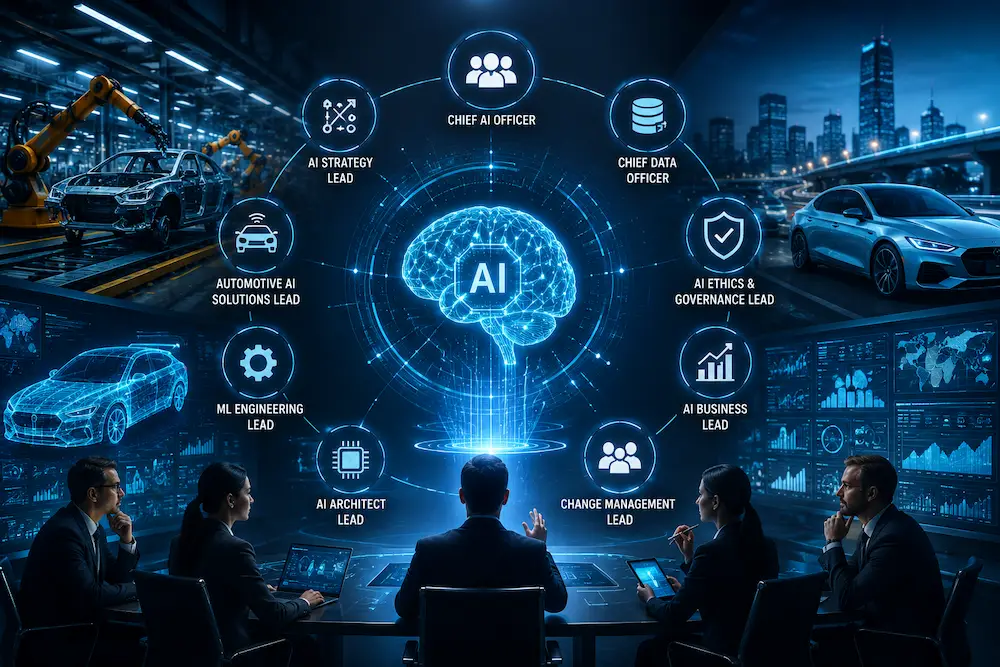
The 7 Core Automotive AI Leadership Roles
1. Chief AI Officer (CAO) or VP of Artificial Intelligence
Scope: Enterprise-wide AI strategy, investment prioritization, AI governance framework, and executive accountability for AI outcomes.
The Chief AI Officer in an automotive organization is responsible for the AI investment portfolio across all domains — vehicle systems, manufacturing, connected services, and enterprise operations — and for ensuring that AI development across these domains is coherent, governed, and aligned with business strategy. This role typically reports to the CEO or CTO and sits on the executive leadership team.
The responsibilities that distinguish this role in automotive from the equivalent role in other industries are the safety governance dimension and the regulatory posture. The CAO owns the organization’s response to the EU AI Act for vehicle AI systems, oversees the functional safety integration framework for AI in vehicle development programs, and is the executive accountable to the board for AI-related risk. In organizations deploying AI in safety-critical vehicle systems, this is not primarily a technology role — it is a risk and strategy role that requires credibility in both dimensions.
2. Head of Autonomous and ADAS AI
Scope: AI systems for advanced driver assistance, autonomous driving functionality, perception, prediction, and decision-making in vehicle systems.
This is the role with the most direct exposure to ISO 26262 and SOTIF requirements. The Head of Autonomous Systems AI owns the development, validation, and lifecycle governance of the AI models that run in ADAS and autonomy stacks camera and radar perception models, object classification, path prediction, behavior planning, and the sensor fusion layers that combine inputs from multiple modalities.
Key responsibilities include defining the AI development methodology that satisfies ASPICE (Automotive SPICE) process requirements, establishing the model validation framework that maps to SOTIF’s operational design domain requirements, managing the dataset governance for perception model training, and overseeing the model update process for over-the-air (OTA) AI system updates in production vehicles. This last responsibility is increasingly important as OEMs deploy software-defined vehicles that receive AI model updates post-delivery and need a governance process that ensures updated models are validated to the same functional safety standard as the original deployment.
3. Head of Connected Vehicle Data and Analytics
Scope: Telematics data platform, fleet AI analytics, V2X data strategy, customer data governance, and in-vehicle intelligence services.
Modern vehicles generate between 25 and 100 GB of sensor data per hour. Most of it never leaves the vehicle. The portion that does telematics, usage patterns, driver behavior signals, error logs feeds a growing set of connected services: predictive maintenance for fleet operators, personalized insurance products, over-the-air diagnostics, and customer experience analytics.
The Head of Connected Vehicle Data owns the infrastructure that collects, processes, and governs this data, and the AI services that run on it. This includes fleet analytics products sold to commercial customers, internal analytics that feed engineering and product development decisions, and the data monetization strategy that turns vehicle-generated data into business value. The regulatory dimension is significant: GDPR and CCPA compliance for driver and passenger data, the EU’s Data Act requirements for vehicle data access, and OEM policies on data sharing with suppliers and third parties all fall within this role’s governance accountability.
4. AI Engineering Director
Scope: AI and ML model development platform, engineering team structure, MLOps infrastructure, model deployment and monitoring.
The AI Engineering Director owns the technical capability that all other AI leadership roles depend on: the teams, tools, and processes that build, test, deploy, and operate AI models across the organization. This role is responsible for the ML platform the feature stores, training infrastructure, model registry, and deployment pipelines as well as for the engineering practices that ensure models built across different teams meet consistent quality, documentation, and governance standards.
In automotive, the AI Engineering Director’s scope includes both IT-side AI engineering (enterprise AI applications, manufacturing analytics models, customer-facing AI products) and the engineering processes that interface with vehicle software development (where AI model artifacts need to be packaged, versioned, and validated in compliance with automotive software development standards). Managing the boundary between these two development cultures agile enterprise AI development and structured automotive software development is one of the most important practical challenges in this role.
5. Head of Manufacturing AI and Industry 4.0
Scope: Plant floor AI programs, predictive maintenance, quality inspection AI, supply chain AI, and connected manufacturing operations.
Automotive manufacturing is one of the most data-intensive industrial environments in the world. Hundreds of assembly stations, thousands of sensors, continuous quality inspection, complex supply chains, and just-in-time production schedules create both the need for AI and the data to support it. The Head of Manufacturing AI owns the AI programs that make this environment smarter: predictive maintenance systems that prevent unplanned line stoppages, computer vision quality inspection that catches defects at production speeds, supply chain exception management agents, and energy optimization systems across manufacturing facilities.
This role interfaces heavily with plant operations leadership, supply chain leadership, and the ERP and MES systems that run manufacturing operations.
For manufacturers building this capability in practice, the AI in production planning decision framework covers how AI connects demand signals, machine capacity, materials, and changeover constraints into a continuously adaptive scheduling environment.
Agentic AI strategy for manufacturing building autonomous agents that coordinate across procurement, production planning, and quality systems without manual orchestration at each step is increasingly part of this role’s mandate as automotive manufacturers invest in autonomous operations capability.
6. AI Ethics, Safety and Governance Lead
Scope: AI risk framework, EU AI Act compliance program, model ethics and bias governance, AI audit and documentation standards, supplier AI governance.
This role is newer than the others but increasingly non-negotiable at OEMs and large tier-1 suppliers. The AI Ethics and Governance Lead is responsible for the organization’s AI risk framework: how AI systems are classified by risk level, what governance requirements apply at each level, how model performance is monitored for safety and fairness, and how the organization documents AI systems to satisfy regulatory requirements.
The EU AI Act is the primary driver for formalizing this role at European OEMs and at global OEMs selling into European markets. High-risk AI systems under the Act require technical documentation, human oversight mechanisms, transparency disclosures, and post-market monitoring — all of which need an organizational owner. Beyond regulatory compliance, this role governs the supplier AI accountability framework: what AI governance requirements flow down to tier-1 and tier-2 suppliers, how supplier AI systems are audited, and what the OEM’s liability posture is when a supplier AI system fails in a production vehicle. Enterprise AI security and compliance solutions frameworks are foundational to how this role structures its governance architecture.
7. Head of AI Operations (AgentOps and MLOps)
Scope: Production AI monitoring, model performance governance, retraining programs, incident response for AI systems, and operational reliability of AI services.
This role owns what happens to AI systems after deployment which, in a vehicle fleet context, means after the vehicles are in the hands of customers. Model drift, performance degradation, edge case failures, and the operational incidents that arise when AI systems behave unexpectedly in production all fall within the Head of AI Operations’ accountability.
In automotive, the operational monitoring challenge is distinctive because production AI systems are running on devices vehicles that are geographically dispersed, software-update constrained, and operating in highly variable real-world conditions that may differ significantly from training data. The retraining and update pipeline for in-vehicle AI systems has to operate within OTA update governance, requires validation before deployment to the fleet, and must maintain backward compatibility across model generations. The AgentOps practice that governs enterprise AI agents in business operations has a direct analog in automotive AI fleet governance, and the organizations building dedicated capability in this area are outperforming those that treat post-deployment monitoring as an engineering afterthought.
How These Roles Interact
The Chief AI Officer sets the investment strategy and governance framework within which all other roles operate. The Head of Autonomous Systems AI and the AI Ethics and Governance Lead have the tightest working relationship, given the functional safety and regulatory compliance dimensions of vehicle AI.
The Head of Manufacturing AI and the Head of Connected Vehicle Data are often the two largest sources of AI ROI in the near term and compete for engineering resources from the AI Engineering Director’s team. The Head of AI Operations cuts across all domains — every AI system deployed anywhere in the organization is eventually their problem if it fails in production.
Building out your automotive AI organization or scaling an existing AI program?
How Intellectyx Supports Automotive AI Leadership Teams
Automotive AI leadership teams at OEMs and tier-1 suppliers turn to Intellectyx when they need a development partner who understands both enterprise AI execution and the automotive operating context. Our custom AI agent development practice builds the production AI systems that automotive AI leaders are accountable for delivering: manufacturing intelligence agents, supply chain optimization systems, connected vehicle analytics platforms, and the agentic workflows that automate complex operational decisions across automotive enterprises.
Our AI adoption strategy practice supports automotive AI leaders who are structuring their programs and need an experienced outside perspective on investment sequencing, build-vs-buy decisions, and the organizational design choices that determine whether AI programs deliver sustained value or stall after the pilot phase. And our AgentOps capability provides the post-deployment operational governance that automotive AI operations leaders need to maintain AI system performrance over the vehicle and program lifecycle.
FAQs
A fully structured automotive AI leadership organization typically includes a Chief AI Officer or VP of AI at the enterprise level, a Head of Autonomous Systems AI for vehicle AI programs, a Head of Connected Vehicle Data and Analytics, an AI Engineering Director, a Head of Manufacturing AI and Industry 4.0, an AI Ethics and Governance Lead, and a Head of AI Operations. Smaller organizations or those earlier in AI maturity may combine some of these into fewer roles, but the functional accountabilities remain the same regardless of how they are organized.
Automotive AI leadership operates under functional safety standards (ISO 26262, SOTIF, ASPICE) that have no direct equivalent in enterprise software AI. AI systems in vehicles are safety-critical in ways that most enterprise AI is not, creating governance requirements, validation standards, and regulatory obligations that require dedicated leadership capability. The OEM-to-supplier AI coordination dimension, the over-the-air update governance for in-vehicle AI, and the EU AI Act’s high-risk classification of advanced ADAS systems all add layers of accountability that technology sector AI leadership does not typically manage.
Senior automotive AI leadership roles typically require a combination of AI and machine learning expertise, automotive domain experience, and — for roles with vehicle system accountability — familiarity with functional safety standards and automotive software development processes (ASPICE). The Chief AI Officer and AI Governance roles increasingly require regulatory fluency with the EU AI Act. Manufacturing AI and connected vehicle roles benefit from experience with industrial IoT data platforms and automotive ERP and MES systems. Pure AI technical depth without automotive operational context is rarely sufficient for director-level and above roles at OEMs.
OEMs are increasingly defining AI governance requirements that flow down to tier-1 and tier-2 suppliers, mirroring how functional safety requirements are managed through the supply chain today. This includes requirements for model documentation standards, validation evidence for supplier AI systems, notification protocols for model updates, and liability allocation frameworks for AI system failures. The AI Ethics and Governance Lead typically owns this supplier AI governance framework, working with procurement and legal to embed AI requirements into supplier contracts and audit processes.
SOTIF (Safety of the Intended Functionality), formalized as ISO 21448, addresses safety risks that arise when an AI or automated system functions correctly according to its specification but still causes harm — for example, an ADAS perception system that correctly identifies what it sees but fails in a scenario type it was not trained for. For automotive AI leaders accountable for ADAS and autonomous systems programs, SOTIF defines the methodology for identifying unknown unsafe scenarios, managing the operational design domain, and demonstrating that the AI system’s performance is acceptable under real-world conditions beyond the test dataset.