
Manufacturing environments combine workers, heavy machinery, vehicles, materials, and fast-moving processes. Even when a factory has established safety procedures, hazards can develop between scheduled inspections or outside a supervisor’s immediate view. A forklift may approach a blind intersection, a worker may enter a restricted zone, or an equipment anomaly may go unnoticed until it becomes a safety risk.
When manufacturers evaluate manufacturing safety issues and solutions using AI, the goal should not be to remove people from safety decisions. The practical value of AI lies in helping safety teams identify risks earlier, monitor conditions more consistently, investigate incidents faster, and make better-informed decisions.
Why Manufacturing Safety Problems Are Difficult to Prevent
Factory safety risks are distributed across people, equipment, processes, and physical environments. A single facility may contain moving machinery, forklifts, automated vehicles, loading docks, restricted areas, elevated temperatures, hazardous substances, and high-noise work zones.
Common manufacturing safety issues include:
- Workers operating without required personal protective equipment
- Unsafe interaction between pedestrians and forklifts
- Entry into restricted or hazardous zones
- Fatigue or unsafe worker behavior
- Equipment deterioration and mechanical failure
- Excessive heat, smoke, gas, noise, or poor air quality
- Delayed identification of spills, obstructions, or damaged infrastructure
- Inconsistent safety practices across shifts or facilities
Manual inspections and direct supervision remain essential, but they offer only periodic visibility. A safety manager cannot continuously observe every production line, camera, machine condition, environmental sensor, and vehicle movement. Important warning signals can therefore appear between inspections or across systems that are not reviewed together.
How AI Improves Safety Monitoring in Manufacturing
AI safety monitoring combines multiple technologies to create a more continuous view of factory conditions.
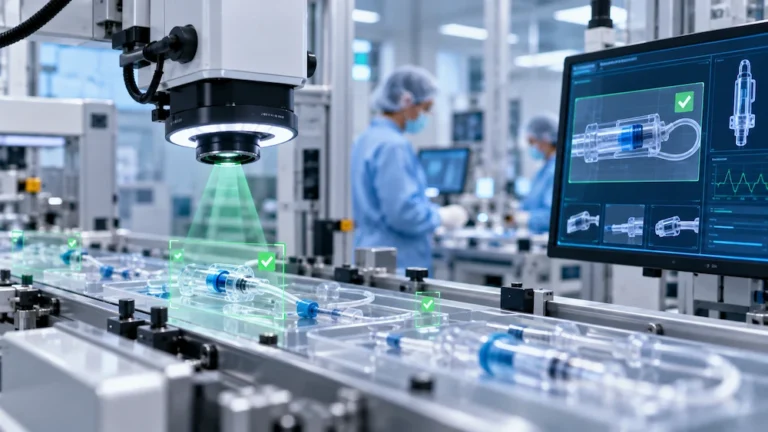
Computer vision analyzes camera feeds for visible events, such as missing PPE, restricted-zone entry, unsafe proximity, blocked exits, smoke, spills, or obstacles. IoT sensors provide readings for vibration, temperature, gas, pressure, noise, air quality, and other environmental or equipment conditions.
Machine-learning models can establish normal operating patterns and flag deviations. Predictive analytics can assess whether combinations of equipment, environmental, and operational conditions indicate elevated risk.
AI agents can add context after an issue is detected. An agent may retrieve the relevant safety procedure, equipment service history, maintenance work orders, previous incident reports, or operating instructions. This information helps safety professionals understand the event and determine an appropriate response.
The main advantage is not that AI possesses better judgment than a safety professional. It is that AI can monitor more signals continuously than people can realistically observe across an entire facility.
These capabilities can form part of a broader agentic AI for manufacturing strategy that connects plant data, operational workflows, and human decision-making.
AI Use Cases for Manufacturing Safety
PPE Detection and Compliance Monitoring
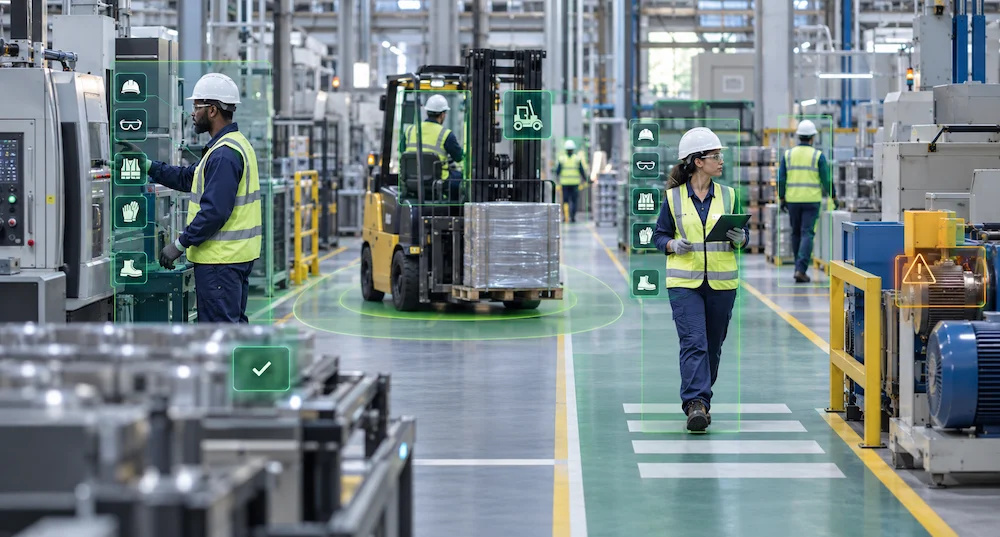
Computer vision can check whether workers entering designated areas are wearing required helmets, safety glasses, high-visibility clothing, gloves, or other visible protective equipment.
If the system detects a possible violation, it can alert a supervisor or record the event for review. Repeated findings may reveal where additional training, signage, equipment availability, or procedural changes are needed.
PPE detection has limitations. Camera angle, lighting, distance, occlusion, and differences in PPE design can affect accuracy. Some protective equipment cannot be verified reliably through conventional cameras. Alerts should therefore be treated as observations requiring appropriate review.
Hazardous-Zone and Proximity Monitoring
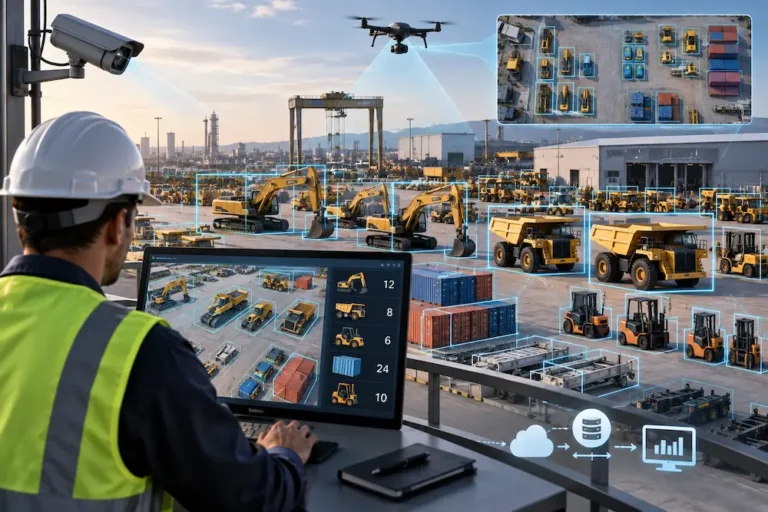
AI can monitor when workers enter restricted areas or move too close to machinery, forklifts, automated guided vehicles, or other mobile equipment.
Camera analytics, location sensors, and proximity devices can identify developing collision risks or repeated unsafe interactions at particular factory locations. A system might reveal, for example, that workers and forklifts regularly cross paths near a blind intersection during shift changes.
Depending on the risk level and approved safety design, the system may notify a supervisor, send an alert to a vehicle operator, or escalate the situation to a control room. Any automated equipment intervention should be independently engineered, validated, and authorized.
Unsafe Behavior and Hazard Detection
Computer vision can identify predefined unsafe conditions such as blocked emergency exits, workers crossing safety barriers, people climbing in prohibited areas, objects left in walkways, smoke, or liquid spills.
However, human behavior is highly contextual. A maintenance technician performing an authorized task may visually resemble a worker violating a safety rule. AI systems should therefore consider work permits, worker roles, schedules, and operational context where available.
False alarms must also be managed carefully. If workers and supervisors receive too many irrelevant notifications, they may begin to ignore legitimate warnings. Manufacturers can combine safety monitoring with AI-powered quality inspection to identify process, equipment, and product conditions that require human review.
Equipment Condition and Failure Monitoring
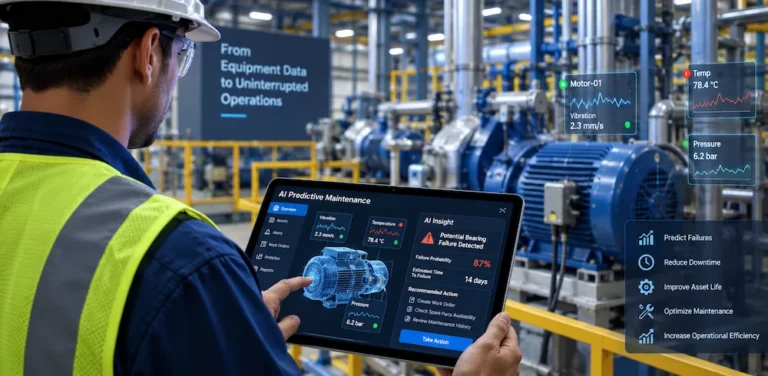
Equipment problems can expose operators and maintenance teams to safety risks. AI can analyze vibration, pressure, electrical signals, temperature, lubrication data, and operating behavior to identify possible deterioration.
A rising bearing temperature combined with unusual vibration, for example, may justify an inspection before the equipment creates an unsafe operating condition. Connecting the detection system with maintenance history and work orders gives teams the information needed to prioritize action.
Condition monitoring does not replace preventive maintenance, lockout/tagout procedures, machine guarding, or qualified inspection. It provides an additional source of early warning. Predictive maintenance AI agents can identify equipment deterioration before it creates unsafe operating conditions for workers.
Predictive Safety Analytics
Predictive models can analyze historical incidents, near misses, maintenance records, production schedules, equipment conditions, environmental readings, and operational patterns.
These models look for combinations of factors that have previously been associated with increased risk. A facility may discover that safety events are more likely when specific equipment anomalies, maintenance delays, environmental conditions, and production pressures occur together.
A prediction indicates elevated risk, not certainty. The purpose is to help safety teams prioritize inspections and preventive controls, not to declare that an accident will or will not happen.
Environmental Safety Monitoring
Connected sensors can continuously monitor temperature, gas concentrations, smoke, air quality, noise, humidity, and other facility-specific conditions.
AI can identify gradual deterioration, unusual combinations of readings, or changes that differ from normal operations. These findings may help teams address ventilation problems, overheating equipment, gas exposure, or other environmental hazards earlier.
AI analytics must complement certified safety devices and established emergency procedures. General-purpose AI should never replace legally required alarms, detectors, or shutdown systems.
Incident Investigation and Root-Cause Analysis
After an incident or near miss, investigators may need to examine camera events, sensor readings, maintenance history, production data, safety procedures, and previous incident reports.
AI can bring this information together, organize it into a timeline, and surface related events. Natural-language processing can also help classify incident narratives and identify recurring contributing factors across departments or facilities.
AI accelerates evidence collection. Qualified investigators must still determine causation, accountability, and corrective action.
From Safety Monitoring to AI-Assisted Intervention
A well-designed AI safety process begins with detection. The system identifies a possible hazard or abnormal condition and sends an alert to the appropriate team.
Safety personnel then investigate the situation. AI agents may support them by retrieving procedures, equipment history, incident records, maintenance information, work permits, and relevant operational context. Based on this information, the system may recommend an inspection, maintenance action, temporary restriction, or escalation.
A qualified person evaluates the evidence and decides what action is appropriate. This separation between recommendation and action is especially important when an intervention could stop machinery, interrupt production, restrict a worker, or affect an emergency response.
Human Oversight Remains Critical for Industrial AI Safety
Would You Trust AI to Manage Factory-Floor Safety Protocols Without Human Oversight?
AI should not independently manage critical factory-floor safety protocols without appropriate human oversight.
An AI model can generate false positives, which incorrectly flag safe conditions, and false negatives, which fail to identify real hazards. Cameras may lose visibility, sensors can malfunction, and production layouts may change. A model trained on one facility or operating condition may not perform equally well in another.
Unexpected events are another concern. Emergency situations often require contextual judgment, communication, leadership, and adaptation. These are responsibilities that should remain with qualified people.
Worker privacy and accountability must also be addressed. Manufacturers should define what data is collected, why it is required, who can access it, how long it is retained, and how incorrect system findings can be challenged.
AI agents for shop-floor monitoring can analyze machine events, sensor readings, and operational activity to improve real-time situational awareness.
Make Manufacturing Safety More Proactive With AI
Why AI Safety Monitoring Has Not Been Widely Adopted
What Is the Biggest Reason AI Safety Monitoring Has Not Been Widely Adopted in Factories and Warehouses?
There is no single reason. Adoption is limited by a combination of technical, operational, financial, governance, and workforce challenges.
Many factories operate with legacy machinery and fragmented information. Safety data may be distributed across EHS platforms, manufacturing execution systems, maintenance applications, ERP platforms, spreadsheets, cameras, and local plant databases. Integrating these systems without interrupting production can be difficult.
Camera and sensor coverage may also be insufficient. Existing cameras might have been installed for security rather than analytics, leaving blind spots or unsuitable viewing angles. Sensors may use different formats, operate at different frequencies, or lack reliable historical records.
Additional barriers include:
- Excessive false alarms
- Limited representative training data
- Privacy and employee-surveillance concerns
- Cybersecurity risks involving connected plant systems
- Uncertain return on investment
- Lack of internal AI expertise
- Workforce resistance or limited trust
- Weak governance and accountability
- Difficulty maintaining models after deployment
AI for Workplace Safety and Risk Management
Has Anyone Used AI in Workplace Safety to Identify Hazards or Improve Risk Management?
Rather than relying on unverified anecdotes, manufacturers should examine practical applications that can be measured in their own operating environments.
AI can support hazard identification by monitoring visible conditions, equipment signals, and environmental readings. Near-miss analysis can reveal repeated high-risk interactions that do not result in reportable incidents but still require attention.
Manufacturers can also use AI to:
- Prioritize safety inspections
- Classify safety observations and incident reports
- Identify recurring hazard patterns
- Calculate facility or task-level risk indicators
- Analyze trends across shifts and production lines
- Support incident investigations
- Trigger proactive inspection or maintenance
- Recommend relevant procedures after an alert
For example, AI may detect repeated pedestrian-forklift interactions in one area, even if no collision has occurred. Safety teams can use that evidence to change traffic flow, add barriers, improve signage, or revise operating procedures.
Can AI Provide Better Safety Oversight Than Human Supervisors?
AI can provide continuous monitoring and process more signals than a human supervisor can observe simultaneously. It may also identify patterns across large datasets that would be difficult to find through manual review.
However, AI cannot guarantee “Zero Loss of Life,” and manufacturers should not present it as inherently superior to trained safety professionals.
Human supervisors understand workplace context, communicate with workers, evaluate unusual situations, and assume responsibility for decisions. AI performance depends on the quality of its cameras, sensors, training data, configuration, integrations, and ongoing monitoring.
The strongest safety model combines:
AI monitoring + trained safety professionals + operational controls + safety culture
AI extends visibility. People provide judgment, leadership, communication, and accountability.
Predictive AI for Industrial Worker Safety
How Is Predictive AI Improving Safety Protocols for Industrial Workers?
Predictive AI evaluates multiple signals to identify when the likelihood of a safety problem may be increasing. These signals can include:
- Equipment temperature, vibration, and pressure
- Gas, smoke, noise, and air-quality readings
- Unusual operating patterns
- Incident and near-miss history
- Maintenance records and overdue work orders
- Production schedules and workload
- Location or proximity information where appropriate
Suppose a machine displays abnormal vibration while maintenance is overdue and production demand is unusually high. A predictive model may classify the condition as elevated risk and recommend inspection.
The original question sometimes uses the phrase “resource workers.” If the topic covers factory employees generally, industrial workers is the clearer term. “Resource workers” is better suited to mining, forestry, oil and gas, and other natural-resource industries.
Predictive results should always be interpreted as risk indicators, not guarantees. Models can help prioritize attention, but safety teams must validate the actual condition.
Measuring the Business and Safety Benefits of AI
Manufacturers should establish baseline measurements before implementing AI. This makes it possible to determine whether the technology is improving safety rather than merely generating more data.
Relevant outcomes include:
- Earlier identification of hazards
- Faster acknowledgement and investigation of alerts
- Improved PPE compliance visibility
- Better detection and reporting of near misses
- Reduced manual video-review workload
- Shorter incident-investigation time
- Fewer unplanned equipment-related hazards
- More consistent monitoring across shifts
- Better prioritization of inspections and maintenance
Accuracy should not be the only metric. Teams should also monitor false-positive and false-negative rates, alert response time, system availability, worker feedback, and the percentage of alerts that result in useful corrective action.
Limitations of AI Safety Monitoring
AI-powered monitoring can be affected by camera blind spots, poor lighting, obstructed views, unusual worker behavior, damaged sensors, network interruptions, and changing facility layouts.
Models can also drift over time. Changes in PPE, uniforms, machinery, workflows, lighting, or production configurations may reduce accuracy. Continuous testing is therefore necessary after deployment.
Other limitations include worker privacy, cybersecurity exposure, system-integration complexity, and overreliance on automation. A dashboard can create a false sense of security if teams assume that unreported hazards do not exist.
AI should complement established engineering controls, protective equipment, machine guarding, training, inspections, operating procedures, and qualified safety professionals. It should not be used to weaken proven controls or transfer accountability to an algorithm.
How Manufacturers Should Start With AI Safety
Manufacturers should begin with one clearly defined, high-risk use case. PPE detection in a controlled zone, forklift-pedestrian monitoring at a known hotspot, or equipment-condition monitoring for a critical machine may provide a manageable starting point.
The organization should first establish its current safety baseline. It should then assess available cameras, sensors, operational data, system integrations, and environmental constraints.
Before development, teams must define what the AI is permitted to detect, recommend, and act upon. Safety professionals, plant leaders, IT and OT teams, workers, and legal or privacy representatives should participate in this process.
A controlled pilot should be tested under real operating conditions. False positives and false negatives must be measured across different shifts, lighting conditions, worker positions, and production scenarios.
Human escalation paths, access controls, cybersecurity protections, and model-monitoring responsibilities should be established before deployment. The solution should scale only after it demonstrates measurable safety and operational value.
Manufacturers may need enterprise AI development services to turn a limited safety-monitoring pilot into a secure, integrated production solution.
How Intellectyx Helps Manufacturers Build AI-Powered Safety Solutions
Intellectyx is an Enterprise Agentic AI innovation and delivery partner. We design, build, and operate production AI that delivers measurable business outcomes.
For manufacturing safety, Intellectyx can combine computer vision, predictive analytics, equipment monitoring, enterprise knowledge AI, and AI agents within governed human-in-the-loop workflows.
These solutions can monitor defined factory conditions, retrieve plant procedures, interpret equipment signals, organize incident evidence, and deliver contextual alerts to safety and operations teams.
Intellectyx can integrate AI with existing ERP, MES, CMMS or EAM platforms, plant systems, cameras, sensors, and enterprise data. Manufacturers can build on their existing technology investments without an unnecessary rip-and-replace program.
The implementation approach includes AI governance, monitoring, evaluation, security, and controlled escalation so manufacturers can assess performance and reliability after deployment.
Conclusion
AI solutions for manufacturing safety can make risk management more proactive by continuously identifying hazards, equipment anomalies, unsafe conditions, and emerging patterns. AI can also improve near-miss visibility, accelerate investigations, and help teams focus their attention on higher-risk situations.
The right approach to manufacturing safety issues and solutions using AI is not AI instead of people. It is AI providing continuous operational intelligence while trained safety professionals maintain oversight, judgment, and accountability.
Explore how Intellectyx can help you build a governed AI safety solution around your facility, systems, and operational priorities.
FAQs
AI can detect visible and sensor-based hazards in near real time when camera coverage, sensor quality, connectivity, and model performance are sufficient. Examples include missing PPE, restricted-zone entry, proximity risks, smoke, gas, spills, and abnormal equipment conditions.
AI can identify combinations of conditions associated with elevated risk, but it cannot predict every incident with certainty. Predictive models analyze equipment, environmental, operational, maintenance, incident, and near-miss data to support preventive action.
No. AI cannot replace professional judgment, accountability, contextual understanding, emergency leadership, or worker communication. It should provide continuous monitoring and decision support while qualified safety professionals remain responsible for critical decisions.
Computer vision analyzes camera feeds for defined events such as missing PPE, entry into restricted areas, unsafe proximity, blocked exits, spills, or smoke. Its effectiveness depends on visibility, lighting, camera placement, training data, and human review.
Predictive AI combines equipment conditions, operating patterns, environmental signals, maintenance records, near misses, and incident history to identify elevated risk. Safety teams can use these findings to prioritize inspections, preventive maintenance, and additional controls.
Manufacturers should assess the use case, infrastructure, camera and sensor coverage, data quality, integrations, cybersecurity, privacy, worker acceptance, false-alarm risk, escalation procedures, and measurable success criteria before deploying AI.