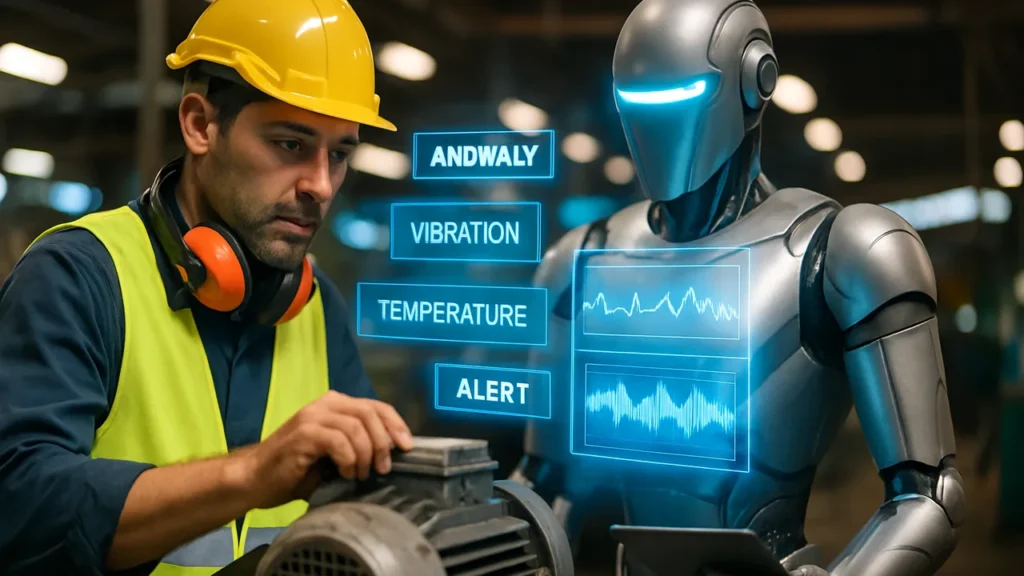

AI agents can analyze large-scale machine sensor data by combining industrial data ingestion, edge computing, streaming analytics, time-series storage, machine learning, and automated workflow coordination.
The quickest results usually come from a hybrid architecture. Edge systems filter and analyze time-sensitive signals close to the machine, while cloud systems perform fleet-level analysis, model training, historical comparisons, and long-term optimization.
The AI agent adds an operational layer above these components. It interprets detected conditions, retrieves equipment context, evaluates business impact, recommends a response, initiates approved workflows, and monitors the outcome.
Successful deployment depends on more than selecting an AI model. Manufacturers must address sensor quality, data synchronization, legacy-system integration, latency, cybersecurity, false alerts, human approvals, and continuous monitoring.
Why Is Large-Scale Machine Sensor Data Difficult to Analyze?
Industrial machines can generate continuous streams of vibration, temperature, pressure, current, acoustic, flow, speed, torque, humidity, and position data.
Analyzing these signals becomes difficult when an organization operates hundreds or thousands of assets across production lines, plants, and geographic locations.
Common challenges include:
- High-frequency data arriving continuously
- Different sensor formats and communication protocols
- Missing, duplicated, delayed, or inaccurate readings
- Unsynchronized timestamps
- Limited connectivity in remote locations
- Changing operating conditions
- Different equipment configurations
- Large volumes of normal operating data
- Limited examples of actual equipment failures
- Difficulty connecting sensor patterns with maintenance outcomes
Traditional dashboards can display machine data, but they still require employees to interpret signals and decide what to do. Fixed alert thresholds can also create excessive notifications because a value that is abnormal for one machine may be acceptable for another.
AI agents can help close the gap between identifying a signal and coordinating an operational response.
What Are AI Agents for Machine Sensor Data Analysis?
AI agents for machine sensor data analysis are intelligent software systems that monitor industrial data, interpret equipment conditions, retrieve operational context, and coordinate actions within defined boundaries.
They can combine:
- Streaming sensor information
- Machine-learning predictions
- Equipment specifications
- Maintenance records
- Work-order history
- Operating conditions
- Production schedules
- Spare-parts availability
- Standard operating procedures
- Human feedback
An anomaly-detection model may identify unusual vibration. The AI agent can then determine which asset produced the signal, retrieve its maintenance history, assess the production impact, check whether similar events occurred previously, and recommend the appropriate next step.
Depending on its authorization level, the agent may:
- Notify an operator.
- Create an inspection request.
- Recommend a maintenance window.
- Check technician and spare-parts availability.
- Generate a draft work order.
- Escalate the event for engineering review.
- Track whether the issue was resolved.
The predictive model identifies a pattern. The agent turns that information into a governed operational workflow.
How Do AI Agents Analyze Large-Scale Machine Sensor Data?
1. Collect machine and environmental signals
Data is collected from sensors, programmable logic controllers, industrial gateways, SCADA systems, historians, industrial IoT platforms, and connected equipment.
The deployment team must identify which signals are relevant to the intended decision. Collecting every available data point can increase cost without improving results.
2. Clean and synchronize the data
Sensor data may contain gaps, spikes, duplicated readings, inconsistent units, calibration errors, and timestamp differences.
The data-processing layer can:
- Normalize measurement units
- Align timestamps
- Remove duplicates
- Identify missing readings
- Smooth noisy signals
- Apply equipment-specific validation rules
- Add asset and operating metadata
This step is critical because an AI model can mistake a sensor fault for a machine fault.
3. Process time-sensitive data at the edge
Edge processing moves selected analytics closer to the machines generating the data.
Microsoft explains that Azure IoT Edge can analyze device data locally, reduce the amount sent to the cloud, react to events quickly, and continue operating offline.
Edge processing can be useful when:
- Millisecond or second-level responses are required
- Connectivity is unreliable
- Sending raw data to the cloud is expensive
- Sensitive operational data should remain on-site
- Machines need to continue operating during network interruptions
4. Detect anomalies and degradation patterns
Machine-learning models can analyze single signals or relationships across multiple signals.
For example, a bearing issue may not be identifiable from temperature alone. The model may need to evaluate vibration frequency, motor current, rotational speed, load, lubrication conditions, and historical maintenance data together.
Common analytical techniques include:
- Threshold and rule-based detection
- Statistical process monitoring
- Supervised classification
- Unsupervised anomaly detection
- Time-series forecasting
- Remaining-useful-life estimation
- Change-point detection
- Multivariate pattern analysis
The selected method should match the available data, failure history, equipment criticality, and required response time.
5. Add operational context
A sensor anomaly does not automatically indicate that maintenance should stop production.
The agent may need to consider:
- Which machine generated the event
- The machine’s current operating mode
- Product or batch being processed
- Current production schedule
- Asset criticality
- Previous failures
- Existing work orders
- Maintenance availability
- Spare-parts inventory
- Safety requirements
- Expected financial impact
This context helps the agent distinguish between a low-risk irregularity and an event requiring immediate attention.
6. Recommend or initiate an approved action
The agent can translate analytical output into a specific operational recommendation.
For example:
Motor M-204 shows a sustained vibration increase under normal load. The pattern resembles two previously confirmed bearing faults. Inspect the drive-end bearing within the next eight operating hours. Replacement bearing B-72 is available in the maintenance storeroom.
The agent should provide the evidence behind the recommendation, including relevant signals, time periods, model confidence, maintenance records, and applicable procedures.
7. Monitor the result
The agent should track whether the recommended action occurred and whether machine conditions improved afterward.
This creates a feedback loop:
- Detect the condition.
- Recommend an action.
- Record the human decision.
- Monitor the machine response.
- Capture the maintenance finding.
- Improve future detection and prioritization.
Without this feedback loop, the system may continue generating alerts without learning which events were operationally important.
Reference Architecture for Industrial Sensor AI Agents
| Architecture Layer | Primary Responsibility | Typical Components |
|---|---|---|
| Machine Layer | Generate operational signals | Sensors, PLCs, CNC machines, robots, and connected equipment |
| Edge Layer | Filter and process local data | Industrial gateways, edge computers, and local inference models |
| Ingestion Layer | Move data reliably | MQTT, OPC UA, event brokers, and streaming services |
| Data Layer | Store current and historical information | Time-series databases, historians, data lakes, and feature stores |
| AI Layer | Detect patterns and predict conditions | Anomaly detection, forecasting, and remaining-useful-life models |
| Agent Layer | Interpret findings and coordinate workflows | Agent orchestration, tools, business rules, and enterprise knowledge |
| Integration Layer | Connect operational systems | MES, SCADA, CMMS, EAM, ERP, and inventory systems |
| Governance Layer | Control access and actions | Identity, permissions, approvals, audit logs, and cybersecurity controls |
| Operations Layer | Monitor the solution | AgentOps, model monitoring, observability, and incident management |
The architecture should separate detection, reasoning, and action. A model may detect an anomaly, but the agent should not automatically shut down equipment unless that action has been explicitly engineered, validated, secured, and approved.
Edge AI Agents vs. Cloud AI Agents
| Area | Edge AI Agents | Cloud AI Agents |
|---|---|---|
| Response Time | Lower latency | Depends on network and cloud connectivity |
| Data Processing | Processes selected data near the machine | Supports centralized processing across assets and plants |
| Bandwidth Use | Can filter data before transmission | May require more data transmission |
| Connectivity | Can operate during network interruptions | Usually requires stable connectivity |
| Computing Capacity | Limited by edge hardware | Greater scalable computing capacity |
| Data Scope | Machine or production-line context | Enterprise and fleet-level context |
| Model Training | Limited on most edge devices | Better suited to large-scale training |
| Best Use | Immediate detection and local response | Historical analysis, optimization, and coordination |
For many manufacturers, the best choice is not edge or cloud. It is a hybrid approach.
The edge handles immediate signal processing. The cloud supports centralized model management, cross-asset learning, historical analysis, and enterprise workflow orchestration.
Manufacturing Use Cases for Machine Sensor AI Agents
Predictive maintenance
Predictive maintenance AI agents can combine real-time sensor data with maintenance history, work orders, and environmental conditions to identify equipment at elevated risk.
The agent can prioritize inspections, recommend maintenance windows, and coordinate work-order creation.
Abnormal vibration detection
Vibration patterns can reveal imbalance, looseness, misalignment, bearing wear, cavitation, and other mechanical problems.
An agent can compare current vibration signatures with equipment baselines and previous confirmed failures before notifying the maintenance team.
Temperature and pressure monitoring
Agents can detect combinations of temperature, pressure, flow, and load that indicate abnormal operating conditions.
Instead of reporting every threshold violation separately, the agent can group related events and provide a single contextual recommendation.
Tool-wear monitoring
Machining operations can use acoustic, force, vibration, and power-consumption data to estimate tool condition.
An agent can recommend inspection or replacement before tool degradation causes defects or unplanned downtime.
Quality-drift detection
Sensor data can show that a process is moving away from its validated operating range before finished-product inspections reveal a problem.
The agent can connect the process deviation with product, batch, material, machine, and environmental information.
Energy optimization
AI agents can identify inefficient equipment states, excessive idle consumption, compressed-air leaks, abnormal motor loads, and energy peaks.
Recommendations should consider production requirements so that energy savings do not reduce throughput or product quality.
Safety-condition monitoring
Agents can monitor gas, temperature, pressure, proximity, equipment-status, and environmental sensors for elevated risk.
AI should support qualified safety teams rather than replace professional judgment or emergency procedures.
Root-cause investigation
When downtime occurs, an agent can assemble the preceding sensor patterns, alarms, operator notes, maintenance records, production changes, and similar historical events.
This reduces the time engineers spend gathering information from separate systems.
How Can Manufacturers Achieve Quick Turnaround?
Quick turnaround means reducing the time between a machine condition emerging and the appropriate person or system responding.
Process only relevant data
Not every raw reading needs to be stored or transmitted. Edge systems can aggregate, compress, filter, or extract features from high-frequency streams.
Use event-driven processing
Instead of waiting for scheduled batch analysis, the architecture can trigger evaluation when selected conditions change.
Deploy lightweight models at the edge
Compact models can support rapid inference on industrial hardware. More computationally intensive analysis can remain in the cloud.
Maintain machine-specific baselines
Different assets may operate normally at different temperatures, loads, speeds, or vibration levels. Equipment-specific baselines can reduce false alarms.
Prioritize alerts by business impact
An anomaly on a redundant, noncritical asset may be less urgent than a smaller anomaly on a production bottleneck.
The agent should consider criticality, safety, production impact, repair time, and failure probability.
Predefine response workflows
Quick detection provides little value if the organization has not established who should respond, which system should be updated, or which approvals are required.
Cache essential context locally
Equipment limits, procedures, model configurations, and escalation rules may need to remain available during network interruptions.
Monitor latency across the complete workflow
Model inference is only one component. Measure ingestion delay, processing time, agent reasoning time, system-integration latency, notification time, and human response time.
What Are the Main Deployment Challenges?
Poor sensor quality
Old, incorrectly installed, poorly calibrated, or failing sensors can produce unreliable data.
Start with sensor validation and critical-signal assessment before developing complex models.
Too many false alarms
An agent that repeatedly produces low-value alerts will lose operator trust.
Use equipment context, persistence rules, multivariate analysis, severity levels, and human feedback to improve prioritization.
Limited failure examples
Industrial failures may be rare, which is operationally positive but difficult for supervised model training.
Teams can use anomaly detection, engineering rules, simulated conditions, maintenance records, and expert labeling where appropriate.
Changing operating conditions
Models may degrade when production recipes, materials, machines, sensors, or operating practices change.
Continuous evaluation and drift monitoring are therefore necessary.
Legacy equipment integration
Older machines may not provide modern APIs or consistent digital data.
Industrial gateways, protocol translation, historian integration, and additional sensors may be required.
Cybersecurity and OT risk
Connecting industrial environments increases the importance of identity, segmentation, secure communications, least-privilege access, software updates, and audit logging.
Excessive autonomy
An AI agent should not receive unrestricted control over industrial equipment.
A safer initial deployment is read-only monitoring and decision support. Automated actions should be introduced only after appropriate engineering analysis, cybersecurity review, validation, safeguards, and approval.
A Phased Deployment Roadmap
Phase 1: Select a bounded use case
Choose one critical asset, failure mode, production line, or operational decision.
Define the business outcome, such as reducing diagnostic time or increasing prediction lead time.
Phase 2: Assess sensor and system readiness
Review sensor availability, sampling rates, calibration, connectivity, historian coverage, maintenance records, and integration options.
Phase 3: Establish a baseline
Measure current downtime, false-alert rates, inspection time, maintenance cost, response time, and production impact.
Phase 4: Build the data pipeline
Create reliable ingestion, synchronization, validation, storage, and equipment-context processes.
Phase 5: Develop and validate the models
Test anomaly-detection or prediction models using historical data and engineering knowledge.
Evaluate performance across normal operation, startup, shutdown, maintenance, product changes, and environmental variation.
Phase 6: Deploy the agent in read-only mode
Allow the agent to monitor conditions and generate recommendations without creating work orders or taking equipment actions.
Phase 7: Run in shadow mode
Compare agent recommendations with the decisions of operators, engineers, and maintenance teams.
Record disagreements and determine whether the problem came from data, the model, missing context, or workflow rules.
Phase 8: Integrate approved workflows
Connect the agent with CMMS, EAM, MES, inventory, notification, and approval systems.
Begin with draft actions or approval-based execution.
Phase 9: Monitor through AgentOps
Track the agent’s reasoning, data access, tool calls, recommendations, approvals, outcomes, latency, and costs.
Phase 10: Expand carefully
Scale to additional assets only after the initial deployment meets agreed technical, operational, security, and business criteria.
How Should Performance Be Measured?
| Metric | What It Measures |
|---|---|
| Detection Latency | Time from condition emergence to detection |
| End-to-End Response Time | Time from sensor event to operational action |
| Precision | Percentage of alerts that represent relevant conditions |
| Recall | Percentage of relevant conditions successfully identified |
| False-Positive Rate | Frequency of unnecessary alerts |
| Prediction Lead Time | Advance warning before failure or intervention |
| Mean Time to Acknowledge | Time before the responsible person reviews the alert |
| Mean Time to Repair | Time required to restore equipment |
| Unplanned Downtime | Reduction in unexpected equipment outages |
| Maintenance Cost | Change in labor, parts, and service costs |
| Recommendation Acceptance | Percentage of recommendations accepted by users |
| Outcome Accuracy | Whether the recommended action produced the expected result |
Do not evaluate the system only by model accuracy. A technically accurate model may still fail if recommendations arrive too late, lack context, or do not fit maintenance workflows.
How Intellectyx Helps Deploy Industrial AI Agents
Intellectyx is an Enterprise Agentic AI innovation and delivery partner. We design, build, and operate production AI that delivers measurable business outcomes.
Our AI agent development services help industrial organizations connect machine data with real operational workflows.
Relevant capabilities include:
- Industrial sensor and IoT data engineering
- Edge and cloud AI architecture
- Time-series analytics
- Predictive maintenance models
- Custom AI agent development
- Enterprise knowledge integration
- MES, SCADA, CMMS, EAM, and ERP integration
- Human approval workflows
- AI security and governance
- Production deployment and AgentOps services
The objective is not simply to create another machine-health dashboard. It is to help operations, maintenance, and engineering teams detect important conditions faster and coordinate an appropriate response with evidence and control.
Explore Your AI Opportunity: Talk to Intellectyx about deploying AI agents for large-scale machine sensor data analysis.
Conclusion
Deploying AI agents to analyze large-scale machine sensor data can reduce the time required to detect anomalies, investigate problems, and coordinate maintenance or operational responses.
However, quick turnaround does not come from the AI model alone. It depends on reliable sensors, synchronized data, edge processing, scalable cloud analytics, operational context, system integration, clear approval rules, and continuous monitoring.
Manufacturers should begin with a bounded, measurable use case. Deploy the agent in read-only and shadow modes, validate its recommendations with experienced personnel, and introduce automation gradually.
When implemented with the right architecture and governance, AI agents can turn continuous machine signals into timely, contextual, and actionable operational intelligence.

![How to Build an Enterprise Knowledge Base for AI Agents [5-Step Guide]](https://www.intellectyx.com/wp-content/uploads/2026/09/enterprise-knowledge-base-methodology-ai-agents-768x432.webp)
![Top 10 AI Agent Development Companies in USA [2026]](https://www.intellectyx.com/wp-content/uploads/2025/12/Top-AI-Agent-Development-Companies-in-USA-768x432.webp)