
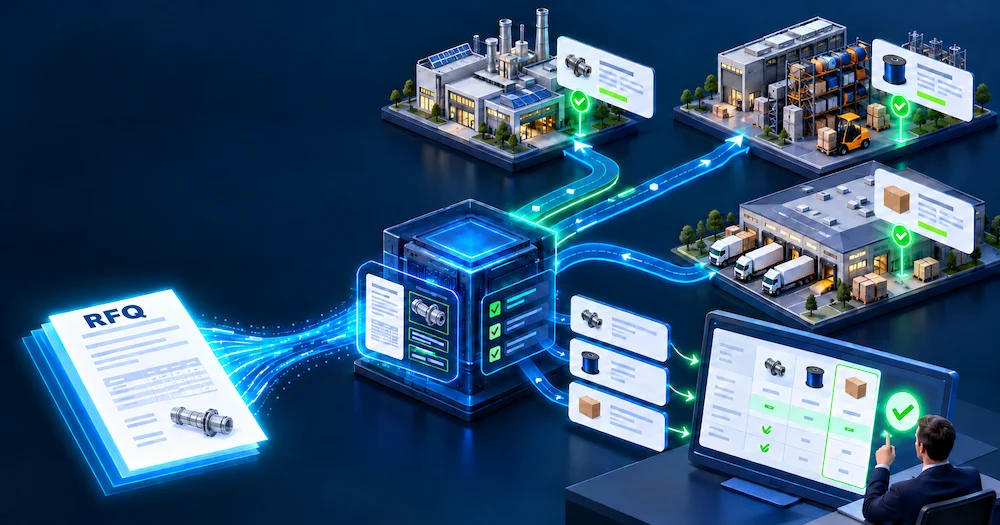

Requests for quotation are essential to procurement, manufacturing, distribution, logistics, construction, and other industries that purchase products or services from external suppliers. However, RFQ workflows are often slowed by emails, spreadsheets, PDF documents, disconnected supplier information, manual follow-ups, and inconsistent quotation formats.
Using AI in the RFQ process can reduce the administrative work involved in creating quotation requests, finding suitable suppliers, processing responses, comparing commercial terms, and managing follow-ups.
AI can also help suppliers process incoming RFQs. It can extract requested products, match them with catalogs, check availability, identify missing information, and prepare quotation drafts for employee review.
The goal is not to remove procurement professionals from supplier decisions. It is to give them faster access to structured, verified, and comparable information.
How Can AI Automate the RFQ Process?
AI can automate the RFQ process by extracting requirements from emails, documents, purchase requisitions, drawings, and procurement systems; generating structured RFQ packages; identifying qualified suppliers; broadcasting approved requests; tracking responses; processing quotations; and highlighting price, delivery, compliance, and contractual differences.
AI agents can coordinate these activities across procurement, ERP, supplier, inventory, and document systems. However, authorized employees should remain responsible for approving suppliers, prices, technical substitutions, commercial terms, contracts, and high-risk purchasing decisions.
What Is AI in the RFQ Process?
AI in the RFQ process refers to using machine learning, document intelligence, generative AI, natural language processing, and AI agents to support request-for-quotation workflows.
It can be applied to two sides of the process.
Buyer-side RFQ automation
The buyer uses AI to:
- Collect purchasing requirements
- Generate RFQ documents
- Find qualified suppliers
- Distribute quotation requests
- Track responses and deadlines
- Extract information from quotations
- Compare supplier proposals
- Identify exceptions
- Support supplier selection
Supplier-side RFQ processing
The supplier uses AI to:
- Read incoming RFQs
- Extract requested products or services
- Match items with its catalog
- Check inventory and availability
- Identify approved alternatives
- Calculate pricing
- Estimate delivery dates
- Prepare a quotation draft
- Route exceptions for review
A complete RFQ automation strategy should determine which side of the workflow the organization wants to improve. A manufacturer issuing supplier RFQs has different requirements from an electrical distributor processing hundreds of quotation requests from customers.
How to Automate RFQ Processing With AI
The RFQ process can be divided into several stages. AI can support each stage while retaining human approval at defined decision points.
1. Capture and Structure RFQ Requirements
RFQ information may arrive through:
- Purchase requisitions
- Emails
- PDF documents
- Spreadsheets
- Product catalogs
- Bills of materials
- Engineering drawings
- Statements of work
- Procurement platforms
- ERP systems
- Supplier portals
Document AI can extract relevant information and convert it into structured fields.
Depending on the industry, these fields may include:
- Product or service description
- Manufacturer part number
- Internal item code
- Quantity
- Material
- Dimensions
- Tolerances
- Technical specifications
- Certifications
- Delivery location
- Required date
- Payment terms
- Shipping requirements
- Quality requirements
- Quote deadline
The system can also identify missing or contradictory information. For example, it may detect that an RFQ contains a part number but no quantity, or that the stated delivery date conflicts with the project schedule.
The procurement or engineering team should review these issues before the RFQ is distributed.
2. Generate RFQ Documents
AI can use approved templates to create a structured RFQ package from the extracted requirements.
The generated document may include:
- Buyer information
- RFQ number
- Scope of supply
- Products or services requested
- Technical specifications
- Required quantities
- Delivery conditions
- Quality documentation
- Commercial terms
- Response format
- Submission deadline
- Evaluation criteria
- Contact and clarification instructions
Generative AI can assist with drafting descriptions and instructions, but it should not invent technical requirements or commercial terms.
The system should generate content only from approved data sources and templates. Human review remains especially important for engineered products, regulated materials, capital equipment, and high-value purchases.
3. Match RFQs With Qualified Suppliers
AI supplier matching can compare RFQ requirements with supplier information maintained across procurement, ERP, supplier-management, and external data systems.
Matching criteria may include:
- Product and service categories
- Manufacturing capabilities
- Geographic location
- Available capacity
- Certifications
- Previous performance
- Delivery reliability
- Quality history
- Contract status
- Approved supplier classification
- Production technology
- Minimum order quantity
- Sustainability requirements
- Risk indicators
The AI system can generate a shortlist of suppliers and explain the reason each supplier was selected.
For example, it may identify a supplier because it has the required machining capabilities, a valid quality certification, previous experience with similar parts, and acceptable delivery performance.
Supplier recommendations should not be approved automatically. Procurement teams need to consider sourcing strategy, contractual obligations, risk, conflicts of interest, and current supplier relationships.
4. Use an RFQ Broadcast AI Agent
An RFQ broadcast AI agent is a controlled software agent that coordinates RFQ distribution, response tracking, and follow-up activities.
A typical workflow could be:
- Retrieve the approved RFQ package.
- Review the authorized supplier list.
- Apply supplier qualification rules.
- Recommend a distribution list.
- Request buyer approval.
- Send the RFQ through an approved channel.
- Record the communication.
- Track supplier acknowledgments.
- Monitor the response deadline.
- Prepare follow-up messages.
- Escalate missing or incomplete responses.
- Store received quotations.
The agent should not send an RFQ to every supplier it discovers. It should operate within approved supplier lists, procurement policies, communication rules, and authorization limits.
Every action should be logged so procurement teams can see:
- Which suppliers were selected
- Why they were selected
- Who approved the distribution
- When the RFQ was sent
- Whether suppliers responded
- Which follow-ups were issued
- What information was received
This audit trail is particularly important when the AI agent interacts directly with external suppliers.
5. Process Incoming Supplier Quotations
Supplier quotations may arrive as PDFs, spreadsheets, emails, portal submissions, or scanned documents. They can use different terminology, formats, currencies, units, and commercial structures.
AI can extract and normalize information such as:
- Unit price
- Total price
- Currency
- Quantity breaks
- Minimum order quantity
- Lead time
- Delivery date
- Shipping terms
- Payment terms
- Warranty
- Quote validity
- Tooling charges
- Setup fees
- Taxes
- Discounts
- Exclusions
- Technical deviations
The extracted data can be presented in a standardized quotation-comparison table.
This reduces the need for buyers to copy information manually from multiple supplier documents into a spreadsheet.
However, the system should display the original source for every extracted field. Buyers should be able to verify the value against the supplier’s submitted quotation.
6. Compare Supplier Quotes
AI can help procurement teams compare proposals across commercial, technical, operational, and risk considerations.
A comparison may include:
| Evaluation Area | Examples |
|---|---|
| Price | Unit price, total cost, volume discounts and tooling |
| Delivery | Lead time, required date and shipping terms |
| Technical Compliance | Specifications, materials, tolerances and deviations |
| Quality | Certifications, inspection requirements and supplier history |
| Commercial Terms | Payment terms, warranty, quotation validity and exclusions |
| Capacity | Production availability and order-volume capability |
| Risk | Location, dependency, supplier status and previous performance |
AI can identify important differences, such as:
- The lowest-priced quotation has the longest lead time.
- One supplier excludes tooling from its total.
- Another supplier proposes a different material.
- A quotation does not meet the required certification.
- Payment terms differ from the organization’s policy.
- A supplier’s delivery commitment conflicts with the requested date.
AI should present these differences as decision support, not automatically choose the winning supplier.
7. Automate Clarifications and Follow-Ups
RFQ responses are frequently delayed because suppliers need clarification or omit required information.
AI agents can identify:
- Unanswered RFQs
- Approaching deadlines
- Missing quotation fields
- Incomplete technical information
- Unconfirmed delivery dates
- Missing certifications
- Commercial deviations
- Questions requiring internal input
The system can draft a clarification or follow-up message. Depending on the organization’s policy, an employee may approve the message before it is sent.
For repetitive and low-risk follow-ups, limited automation may be appropriate if the agent operates within approved templates and escalation rules.
8. Support Supplier Selection
After quotations have been normalized, the AI system can summarize the available options.
It may calculate or display:
- Total quoted cost
- Landed cost
- Delivery feasibility
- Technical compliance
- Supplier performance
- Quality history
- Risk factors
- Commercial exceptions
- Weighted evaluation scores
The procurement team should review how the score is calculated. Weighting rules should be documented, approved, and monitored for unintended bias.
AI should not hide a supplier simply because it received a lower model-generated score. Buyers need access to all eligible responses and the evidence behind each recommendation.
How AI Supports Manufacturing RFQ Generation
Manufacturing RFQ generation is more complex than creating a standard request for office supplies. Manufacturers may need to communicate detailed engineering, quality, material, tooling, and production requirements.
A manufacturing RFQ can contain:
- Bill of materials
- Part numbers
- Engineering drawings
- CAD references
- Material specifications
- Dimensions and tolerances
- Surface finishes
- Manufacturing processes
- Tooling requirements
- Production quantities
- Sample requirements
- Inspection plans
- Required certifications
- Packaging instructions
- Delivery schedules
AI can extract this information from approved engineering and procurement systems and organize it into a supplier-ready RFQ package.
Manufacturers can extend RFQ automation across the wider sourcing lifecycle using multi-agent procurement platforms in manufacturing that coordinate material demand, inventory availability, supplier evaluation, risk analysis, approvals, and purchasing workflows.
Identifying incomplete requirements
Before distributing the RFQ, AI can check whether essential information is missing.
For example, it can flag:
- A drawing without a revision number
- A material specification without an approved grade
- A part without the required quantity
- Conflicting tolerance requirements
- Missing quality-documentation requirements
- A delivery date that is earlier than the expected tooling period
These checks can reduce clarification cycles between procurement, engineering, and suppliers.
Connecting manufacturing systems
Manufacturing RFQ automation may require integration with:
- ERP
- MES
- PLM
- QMS
- Supplier-management systems
- Document repositories
- Engineering databases
- Inventory systems
- Maintenance systems
- Production-planning applications
Organizations developing manufacturing procurement agents can connect RFQ automation with broader AI solutions for manufacturing, including planning, inventory, supplier, quality, and production workflows.
AI-Powered RFQ Automation for Electrical Supply Companies
Electrical supply companies frequently receive RFQs containing large numbers of line items. Product descriptions may be incomplete, abbreviated, or inconsistent with the distributor’s catalog.
The request may include:
- Manufacturer part numbers
- Electrical ratings
- Product families
- Required brands
- Quantities
- Approved substitutes
- Industry standards
- Delivery locations
- Required dates
- Packaging quantities
- Customer-specific pricing
An AI-powered RFQ automation system can:
- Extract each line item.
- Identify manufacturer and product information.
- Match requests with catalog records.
- Check product availability.
- Find approved substitutes.
- Retrieve customer-specific pricing.
- Calculate quantity-based pricing.
- Estimate delivery dates.
- Identify products requiring manual review.
- Create a draft quotation.
Product substitution controls
AI should not automatically substitute electrical products based only on text similarity.
Substitutions may require evaluation of:
- Voltage
- Current
- Load
- Size
- Material
- Compatibility
- Safety certification
- Environmental rating
- Manufacturer approval
- Customer requirements
A qualified employee should approve technical substitutions before the quotation is sent.
AI-Powered Warehouse Matching and RFQ-Driven Warehousing Sourcing
Warehouse and 3PL sourcing is another application of AI-supported RFQ automation.
A company seeking warehouse capacity may provide requirements such as:
- Preferred location
- Required square footage
- Pallet positions
- Product category
- Temperature range
- Hazardous-material requirements
- Handling equipment
- Transportation access
- Inventory-management capabilities
- WMS integration
- Certifications
- Contract duration
- Expected inbound and outbound volume
An AI-powered warehouse matching system can compare these requirements with the capabilities of available logistics providers.
It can then:
- Identify potentially suitable facilities
- Exclude incompatible warehouses
- Rank locations based on defined criteria
- Generate an RFQ
- Distribute the request to approved providers
- Normalize the responses
- Compare capacity, rates, service levels, and contract terms
AI-Powered Warehouse Matching Platforms vs RFQ Workflows for 3PL
AI-powered warehouse matching and traditional RFQ sourcing solve related but different problems.
| Area | Warehouse-Matching Platform | RFQ-Driven Sourcing Workflow |
|---|---|---|
| Primary Purpose | Identify suitable warehouse capacity | Request formal supplier proposals |
| Speed | Potentially faster for standardized requirements | Requires supplier response and evaluation |
| Pricing | May use platform-managed or published rates | Suppliers provide requirement-specific quotations |
| Customization | Depends on the fields and services supported by the platform | Can accommodate detailed and unusual requirements |
| Supplier Coverage | Usually limited to participating providers | Can include the organization’s approved supplier network |
| Commercial Negotiation | May follow standardized terms | Supports customized commercial and contractual terms |
| Best Suited For | Faster sourcing with common requirements | Complex, strategic or contract-heavy sourcing |
A hybrid approach may work best. AI can identify suitable facilities and then generate RFQs for the shortlisted 3PL providers.
Which Systems Can an AI RFQ Solution Connect With?
An AI RFQ solution may connect with:
ERP
Provides purchase requisitions, supplier records, item data, orders, budgets, and financial information.
Procurement platforms
Provides sourcing events, supplier qualifications, approval rules, and purchasing workflows.
Supplier portals
Supports quotation distribution, document submission, clarifications, and response tracking.
CRM
Helps suppliers process customer RFQs, retrieve account information, and create sales opportunities.
Product catalogs
Supports part-number matching, product selection, specifications, and substitutions.
Inventory and warehouse systems
Provides stock availability, location, allocated inventory, and expected replenishment.
MES and PLM
Provides manufacturing, engineering, product, drawing, and specification information.
Contract repositories
Provides negotiated pricing, approved terms, warranties, obligations, and supplier agreements.
Email and document systems
Allows the solution to process RFQs and quotations arriving through existing communication channels.
Integration should use controlled APIs, identity permissions, audit logging, and approved access policies.
Recommended RFQ Automation Architecture
A production RFQ automation solution can include several connected layers.
| Architecture Layer | Function |
|---|---|
| Source Systems | ERP, CRM, procurement, PLM, MES, WMS, product catalogs, email and documents |
| Document Intelligence | Extracts requirements, line items, prices, terms and technical specifications |
| Knowledge Layer | Provides supplier, product, policy, contract and technical information |
| AI Layer | Performs classification, extraction, matching, summarization and comparison |
| Agent Layer | Coordinates RFQ generation, distribution, response tracking and escalation |
| Integration Layer | Connects enterprise applications, APIs, databases, event streams and external portals |
| Governance Layer | Controls identity, permissions, approvals, policies and audit logs |
| Operations Layer | Monitors accuracy, workflow completion, cost, performance and exceptions |
An experienced AI agent development company can customize these layers around the organization’s procurement rules, enterprise systems, approval process, and supplier network.
Benefits of Using AI in the RFQ Process
Potential benefits include:
Faster RFQ preparation
AI can collect and structure requirements from multiple systems rather than requiring buyers to assemble every field manually.
Reduced data entry
Document intelligence can extract quotation details and populate comparison fields automatically.
More consistent RFQs
Approved templates, validation rules, and data sources can improve consistency across quotation requests.
Better supplier matching
AI can search supplier records more thoroughly and explain which suppliers meet the stated requirements.
Faster quote comparison
Supplier responses can be normalized into a consistent format, making commercial and technical differences easier to identify.
Fewer missing requirements
AI can flag incomplete quantities, specifications, dates, certifications, and commercial terms before distribution.
Improved sourcing visibility
Procurement leaders can monitor RFQ status, supplier-response rates, cycle times, exceptions, and evaluation progress. Similar capabilities can support industry-specific sourcing requirements, as explained in this guide to the use of AI in procurement, including supplier analysis, sourcing automation, risk assessment, demand planning, and contract management.
Better auditability
The system can record generated content, approvals, communications, recommendations, user overrides, and supplier responses.
These benefits depend on data quality, system integration, user adoption, governance, and the suitability of the selected workflow.
Risks and Challenges of AI RFQ Automation
Incorrect information extraction
Complex tables, scanned documents, handwritten notes, and poor-quality files can reduce extraction accuracy.
Hallucinated requirements
Generative AI may create unsupported information if it is not restricted to approved sources and templates.
Poor supplier master data
Outdated certifications, classifications, contact information, or performance records can produce incorrect supplier recommendations.
Confidential information exposure
RFQs may contain technical drawings, intellectual property, pricing, and sensitive commercial information.
Unauthorized communication
An AI agent could contact an unapproved supplier or send incomplete information if permissions are not properly configured.
Incorrect substitutions
Product matching based only on descriptions may recommend items that are not technically compatible.
Biased supplier recommendations
Historical sourcing patterns can influence recommendations and unintentionally disadvantage qualified suppliers.
Integration failures
Failures involving ERP, inventory, catalogs, supplier portals, or email can create incomplete or duplicated transactions.
Lack of human oversight
High-value and consequential sourcing decisions require accountable human review.
What Should Remain Under Human Control?
AI can automate administrative and analytical work, but organizations should establish clear approval points.
People should remain responsible for:
- Approving the RFQ scope
- Verifying technical specifications
- Approving the supplier shortlist
- Authorizing external distribution
- Reviewing product substitutions
- Approving pricing commitments
- Assessing contractual terms
- Handling policy exceptions
- Evaluating supplier risk
- Selecting the awarded supplier
- Approving purchase commitments
- Managing supplier relationships
The level of automation should reflect the transaction’s value, risk, complexity, and regulatory significance.
How to Pilot AI RFQ Automation
Step 1: Select a bounded RFQ category
Choose one product family, customer segment, supplier group, facility, or RFQ type.
Step 2: Establish the baseline
Measure:
- RFQ preparation time
- Quote turnaround time
- Manual data-entry effort
- Supplier-response rate
- Number of clarification cycles
- Missing information
- Buyer corrections
- Sourcing cycle time
Step 3: Map the current workflow
Document the systems, data sources, employee roles, approval points, and exceptions.
Step 4: Prepare the data
Review supplier records, product catalogs, previous RFQs, quotation responses, contracts, and procurement policies.
Step 5: Run in shadow mode
Allow the AI system to process RFQs without sending communications or making sourcing decisions.
Compare its outputs with the existing process.
Step 6: Review errors
Assess:
- Incorrect extractions
- Missed line items
- Supplier-matching errors
- Incomplete comparisons
- Unsupported recommendations
- Incorrect substitutions
- Policy violations
Step 7: Introduce controlled automation
Begin with draft generation, document extraction, and internal alerts before automating external communications.
Step 8: Monitor operational outcomes
Measure whether the system improves speed and consistency without creating supplier, commercial, security, or quality risks.
Step 9: Expand gradually
Add more categories, suppliers, facilities, and workflows after demonstrating repeatable performance.
How to Measure RFQ Automation Success
| Metric | What It Measures |
|---|---|
| RFQ Creation Time | Time required to prepare and approve an RFQ |
| Quote Turnaround Time | Time between RFQ distribution and completed supplier responses |
| Extraction Accuracy | Accuracy of extracted line items, pricing, terms and dates |
| Touchless Processing Rate | Percentage of RFQs processed without manual data entry |
| Buyer Correction Rate | Frequency of changes made to AI-generated or extracted content |
| Supplier Response Rate | Percentage of invited suppliers submitting quotations |
| Clarification Volume | Number of supplier questions caused by incomplete or unclear RFQs |
| Comparison Time | Time required to normalize and compare supplier quotations |
| Policy Exception Rate | Recommendations or actions requiring additional approval |
| User Adoption | Frequency and consistency of employee use |
| Award Cycle Time | Time from requirement approval to supplier selection |
| Cost per RFQ | Total processing cost for each sourcing event |
Improved extraction accuracy alone is not sufficient. The solution should improve the complete RFQ workflow while preserving technical, commercial, and governance requirements.
Conclusion
AI in the RFQ process can automate requirement extraction, RFQ generation, supplier matching, quotation distribution, response tracking, quote comparison, and procurement follow-ups.
The strongest implementations connect AI with ERP, procurement, supplier, product, engineering, inventory, warehouse, and contract systems. They also maintain human approval for supplier selection, technical substitutions, pricing, contractual terms, and purchasing commitments.
Organizations should begin with a clearly defined RFQ category, establish a performance baseline, run the system in shadow mode, and introduce automation gradually.
The objective is not to remove procurement professionals. It is to reduce repetitive administrative work and provide better information for faster, more consistent sourcing decisions.
Ready to Reduce Quote Turnaround Time?
Schedule a ConsultationFAQs
AI can extract line items and specifications from documents, generate structured RFQs, identify qualified suppliers, track responses, extract quotation data, compare supplier terms, and prepare follow-up communications.
Yes. AI can collect information from bills of materials, engineering documents, PLM, ERP, MES, QMS, and approved templates to prepare a manufacturing RFQ draft. Engineering and procurement professionals should verify the final package.
An RFQ broadcast AI agent coordinates the approved distribution of quotation requests. It can recommend suppliers, send approved RFQs, track acknowledgments, monitor deadlines, prepare reminders, and escalate incomplete responses.
Yes. AI can extract and normalize pricing, lead times, quantities, payment terms, warranties, shipping conditions, and technical deviations. Procurement professionals should verify the extracted information and approve supplier decisions.
AI can extract electrical product requirements, match part numbers with catalogs, check availability, retrieve pricing, identify possible substitutes, and generate quotation drafts. Qualified employees should approve technical substitutions and final pricing.
AI can match warehouse requirements with available facilities, shortlist suitable providers, generate RFQs, process proposals, and compare capacity, rates, service levels, locations, and contractual terms.
No. AI reduces administrative work and supports analysis. Procurement professionals remain responsible for supplier relationships, negotiation, risk, exceptions, contractual commitments, and final sourcing decisions.



![10 Agencies That Build Custom AI Software for Manufacturing [2026 Guide]](https://www.intellectyx.com/wp-content/uploads/2026/09/agencies-custom-ai-software-manufacturing-768x432.webp)