
How to Choose an AI Development Agency: An Enterprise Buyer’s Guide

“The first 10% of an AI project proves what’s possible; the remaining 90% determines whether it delivers real business value”.
One of the more surprising trends of the AI boom is that AI projects are proving this old tech axiom true. Most teams can quickly create an AI proof of concept (PoC). The challenges arise when it comes time to deploy the AI application to production and derive business value from it. Achieving value requires enterprises to design a scalable architecture, integrate AI with existing systems, evaluate reliability and performance, manage security and privacy risks, operate the application once it’s live, and measure business value.
Organizations have several options for designing and implementing a custom AI application. In-house teams can develop AI solutions using commercial models and development tools when they have the necessary engineering expertise and capacity.
Freelancers can support well-defined projects or fill specialized skills gaps, while large systems integrators, such as Accenture and IBM, are suited to broad enterprise transformation programs.
For mid-sized enterprises that lack the resources to manage an internal project and ongoing operations, or cannot afford large systems integrators, there is the option to hire a specialized AI development agency that offers custom AI engineering, enterprise integration, and production support.
In this article, we will describe the criteria for selecting an agency that can deliver a project on time and on budget.
What enterprise buyers should look for in an AI development agency
Selecting an AI development agency requires evaluating more than technical expertise or the ability to build a working prototype. Enterprise buyers should assess whether a potential partner can connect AI initiatives to measurable business outcomes, integrate solutions with existing systems, manage security and operational risks, and support long-term production requirements.
The following eight criteria provide a framework for comparing agencies, identifying the right questions to ask, and requesting evidence of their capabilities:
| Evaluation criteria | Why it matters to enterprise buyers | Questions to ask the agency | Evidence or deliverables to request |
|---|---|---|---|
| AI strategy and use-case validation | Reduces the risk of investing in low-value or infeasible AI initiatives. | How do you assess business value, feasibility, and expected ROI? | Discovery assessment, prioritized roadmap, business case, and success metrics. |
| Reusable AI engineering foundation | Supports consistent delivery, maintainability, and reuse across AI initiatives to accelerate time to value. | What reusable components do you provide, and what requires custom development? | Reference architecture, reusable component examples, and deployment options. |
| Custom AI development and enterprise integration | Ensures AI solutions work with existing business processes, data, and systems. | How do you integrate AI with ERP, CRM, legacy applications, and proprietary workflows? | Relevant production case studies, integration architecture, and implementation examples. |
| AI evaluation and reliability engineering | Helps establish whether AI systems meet business requirements before and after deployment. | How do you test accuracy, reliability, and failure handling? | Evaluation plans, acceptance criteria, test results, and regression reports. |
| Security, governance, and human oversight | Protects enterprise data, manages risk, and controls sensitive AI actions. | How do you enforce data protection, access controls, governance, and human approvals? | Security documentation, relevant assurance reports, governance procedures, and audit evidence. |
| Production deployment and AI operations | Ensures ongoing reliability, support, and improvement after launch. | Who monitors, maintains, and supports the solution in production? | Monitoring examples, incident procedures, support agreements, SLAs. |
| Ownership, scaling, and value measurement | Protects long-term investment and enables measurable business outcomes. | What will we own, how can we scale, and how will ROI be measured? | IP and ownership terms, handover plan, scaling approach, KPI framework. |
| Vertical specialization | Industry expertise helps address specialized workflows, operational constraints, and regulatory requirements. | What comparable solutions have you delivered in our industry? | Relevant production case studies, industry-specific architectures, customer references. |

Fast, reliable, and competitively-priced custom agentic AI implementations
-

Rapid agentic AI project delivery with reusable AI foundation
-

Pre-built vertical functionality for manufacturing and finance industries
-

Production AI lifecycle: Build + Integrate + Govern + Operate + Measure


AI strategy and use-case validation
Before proposing an AI solution, a development agency should assess the organization’s existing business workflows, operational challenges, available data, and technical constraints. This includes identifying process bottlenecks, evaluating data quality and accessibility, and understanding dependencies on enterprise systems. The assessment should also determine whether AI is necessary or whether conventional automation could address the problem more efficiently.
Agencies should prioritize potential AI use cases based on business value, technical feasibility, implementation complexity, and operational risk. A high-value opportunity may not be the best starting point if it requires extensive data preparation, complex integrations, or significant operational changes. Enterprise buyers should expect a prioritized roadmap that explains these trade-offs and identifies suitable initial projects.
Before development begins, the agency and business stakeholders should establish baseline metrics, expected ROI, and measurable success criteria. For example, an AI-assisted invoice processing project might track processing time, error rates, and manual review effort. ROI estimates should account for implementation and ongoing operating costs. Business stakeholders should own the outcome metrics, while the agency remains accountable for agreed technical deliverables.
A discovery engagement should produce an AI readiness assessment, a prioritized use-case roadmap, a preliminary architecture, an implementation effort estimate, and a business case. Where technical or business feasibility remains uncertain, a proof of concept (PoC) or pilot should validate critical assumptions against predefined success criteria. Its results should inform a documented go/no-go decision before committing to full production development.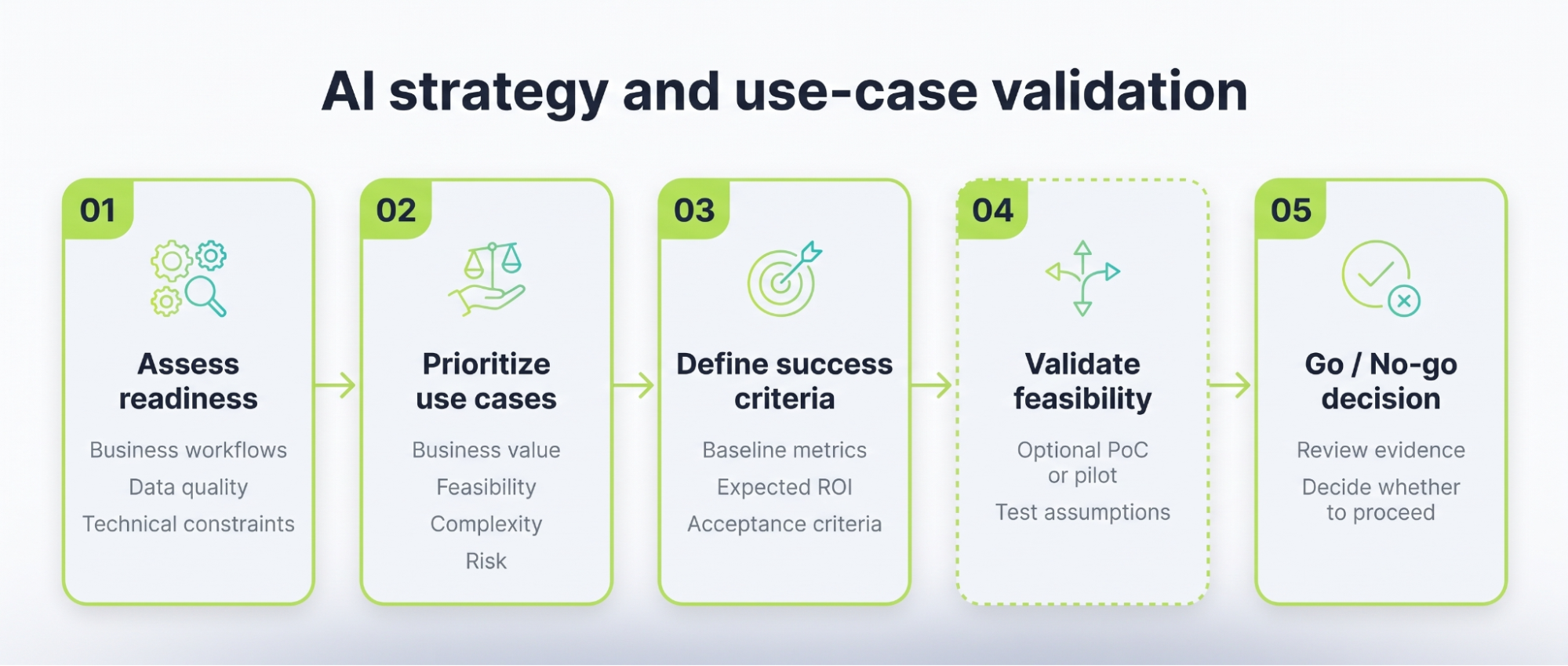
Five steps for assessing enterprise AI readiness, validating use cases, and making an informed investment decision.
Reusable AI engineering foundation
An enterprise AI development agency should have a reusable engineering foundation that supports multiple AI applications without recreating common technical components for each project. Common examples of reusable components AI development agencies provide include:
- Model access
- Agent and workflow orchestration
- Enterprise integration patterns
- Evaluation tools
- Security controls
- Monitoring
- Deployment templates
Reusing these components can improve development consistency, maintainability, and delivery efficiency.
However, reusable technology does not eliminate the need for custom engineering. Each organization has unique business workflows, data structures, access permissions, integration requirements, and operational constraints. Agencies should explain which components are reusable, which require configuration, and which must be developed specifically for the customer. For example, a shared document-processing capability may support multiple applications, while validation rules and approval workflows must reflect each organization’s business requirements.
A well-designed foundation should also support modularity and reduce model lock-in. Separating model access from application logic can make it easier to evaluate or replace AI models without rebuilding entire applications. However, model changes still require compatibility checks, regression testing, and quality evaluation. Enterprise buyers should also consider whether the architecture supports their preferred deployment environment, including public cloud, private cloud, on-premises, or hybrid infrastructure.
When evaluating an agency, buyers should request a reference architecture, examples of reusable components, and documentation explaining integration interfaces, deployment options, and ownership arrangements. Buyers should also determine which components run in their environment, which remain proprietary to the agency, and whether the delivered application can be maintained and deployed without ongoing access to the agency’s development tools.
Intellectyx’s IX AI Foundry illustrates this approach through reusable engineering components that support custom enterprise AI development. IX AI Studio is Intellectyx’s engineering and development environment, not a standalone SaaS product sold to customers. Intellectyx uses the Foundry to build customer-specific AI applications. Customers own their delivered solutions and source code, while Intellectyx retains its proprietary development technology, subject to the applicable contractual terms.
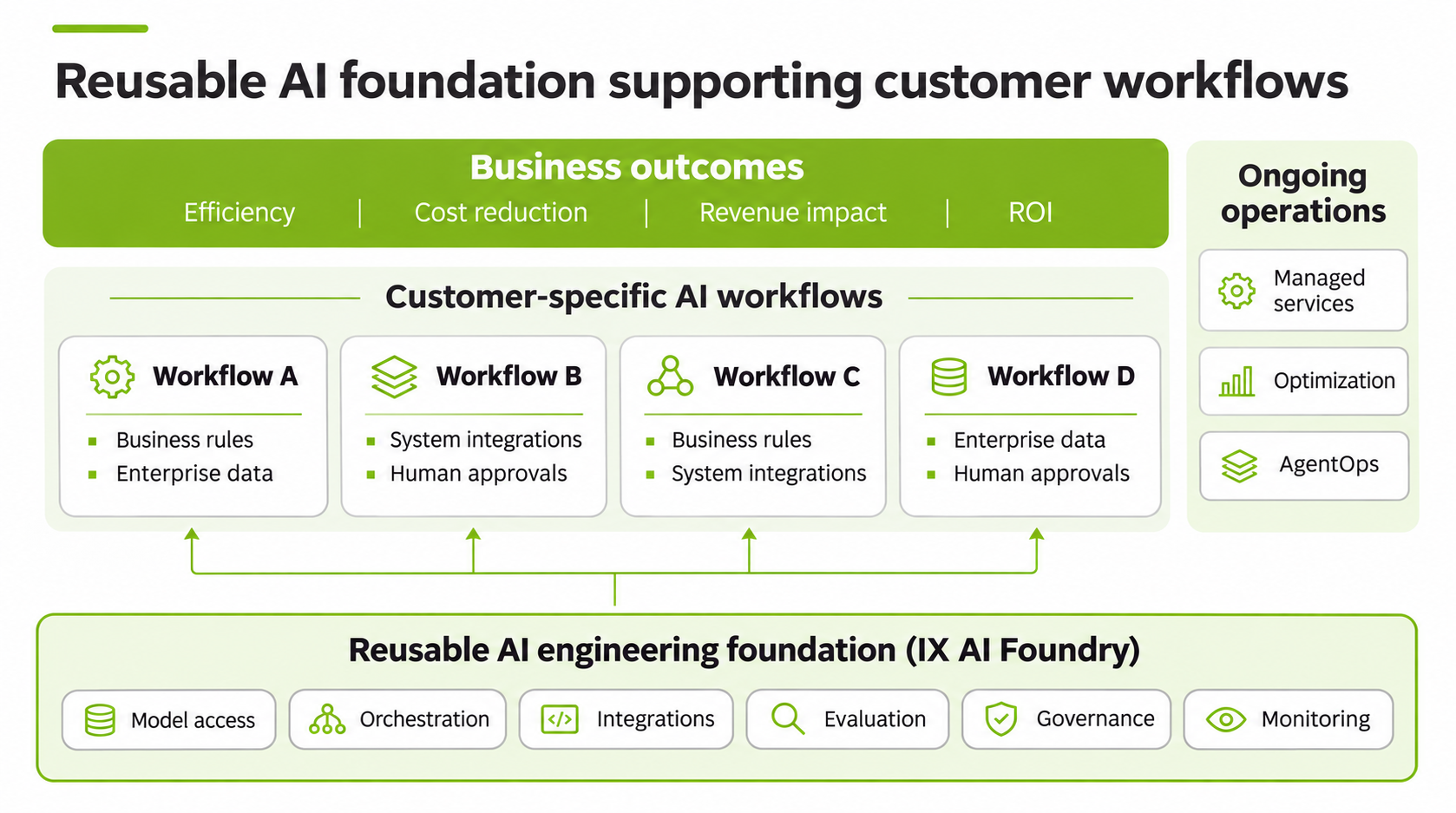
A reusable AI engineering foundation provides shared capabilities for model access, orchestration, enterprise integration, evaluation, governance, and monitoring across multiple customer-specific workflows. The diagram is illustrative and does not represent a specific customer deployment.
Custom AI development and enterprise integration
Custom AI development is often justified when off-the-shelf AI tools cannot adequately support an organization’s proprietary workflows, complex enterprise integrations, or industry-specific business rules. This includes embedding AI into existing applications, connecting multiple enterprise systems, and building agentic workflows that coordinate tasks across departments. The goal is not simply to introduce AI capabilities but to make them work within established business processes.
Depending on the use case, agencies may implement retrieval-augmented generation (RAG) to ground responses in enterprise knowledge, document intelligence to extract information from unstructured files, or predictive models to support forecasting and risk assessment. More complex solutions may combine AI-assisted recommendations, tool-using agents, and multi-step workflow orchestration. Buyers should expect agencies to explain why a particular approach fits their requirements rather than recommending agentic AI for every problem.
To assess enterprise integration experience, ask agencies to demonstrate how an AI workflow interacts with existing ERP, CRM, databases, or legacy applications. Relevant production case studies and architecture diagrams should show how data moves between systems, how access permissions are enforced, and how integration failures are handled. They should also distinguish between AI that recommends an action and AI that executes one. For example, recommending a pricing adjustment is different from updating a price in an ERP system, which requires appropriate authorization, validation, and potentially human approval.
Reliable enterprise workflows typically combine AI models, conventional application code, orchestration, and deterministic business rules. AI may extract information or recommend decisions, while conventional code validates data formats, pricing thresholds, and other explicit requirements. Workflow orchestration coordinates system interactions, maintains execution state, and routes exceptions for review. Agencies should demonstrate integration testing, permission enforcement, error handling, and recovery mechanisms before allowing AI-driven workflows to modify business records.
In its published Dealer Credit & Pricing Intelligence case study, Intellectyx describes a global construction equipment manufacturer that relied on emails, invoices, dealer worksheets, AWS S3, Snowflake, ERP, and dealer management systems to validate dealer credit requests and pricing claims. Manual extraction, reconciliation, and eligibility checks delayed approvals and increased the risk of pricing errors.
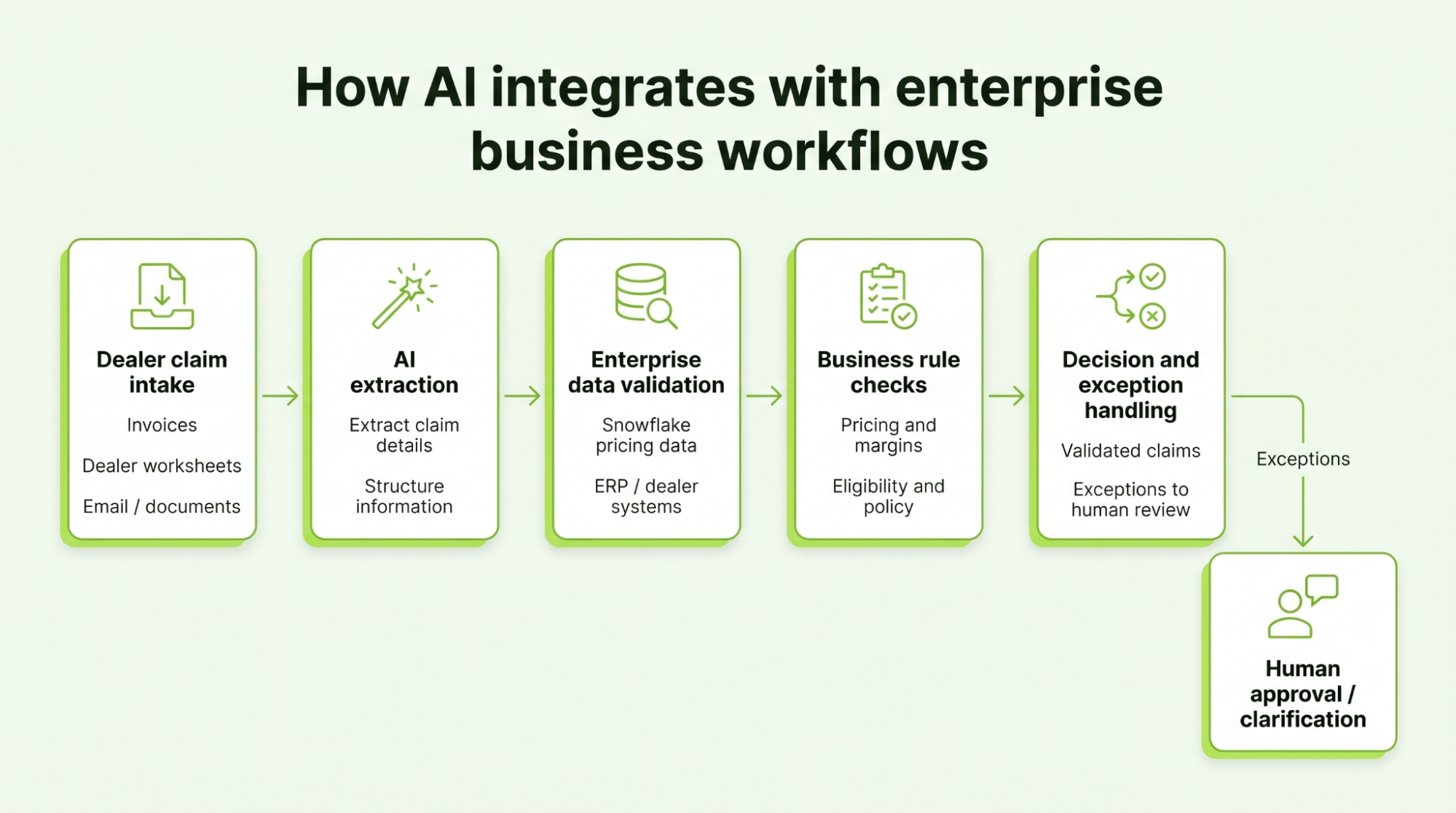
AI-powered dealer credit and pricing validation workflow, connecting document extraction, enterprise data, business rules, and human approval. Illustration based on Intellectyx’s published Dealer Credit & Pricing Intelligence case study.
Intellectyx developed a multi-agent workflow to extract claim information, reconcile it with enterprise pricing data, validate pricing and margin rules, and route exceptions for human review. The company reports an 80% reduction in manual validation and reconciliation effort. This example illustrates the value of combining AI-powered extraction with enterprise data validation, deterministic business rules, and human approval. The result is an integrated business workflow, not a standalone AI model.
AI evaluation and reliability engineering
Traditional software can often be tested against predefined expected outputs, while generative AI systems may produce different responses to similar inputs. Enterprise buyers should therefore expect agencies to combine traditional software testing with AI-specific evaluation. Testing an API or database integration confirms that it functions as designed, but it does not establish whether an AI-generated answer is accurate, a recommendation is appropriate, or an agent can consistently complete a business task.
Evaluation should begin with measurable acceptance criteria and representative test datasets. Depending on the application, agencies should assess answer groundedness, document-extraction accuracy, task-completion rates, tool-call correctness, response latency, and failure recovery. For example, an AI-powered invoice processing solution should be evaluated on its ability to extract the correct fields, apply the required validation rules, and handle incomplete documents. Agencies should define separate acceptance thresholds for critical requirements, such as extraction accuracy, task completion, and error handling. A high overall evaluation score should not conceal failures in high-risk scenarios.
Buyers should also require end-to-end workflow testing, not just individual model benchmarks. Tests should cover realistic scenarios involving missing or contradictory data, invalid tool responses, prompt injection attempts, integration failures, and service interruptions. Agencies should demonstrate how the complete workflow behaves when these problems occur, including whether the system preserves execution state, prevents unauthorized actions, and follows defined exception-handling procedures.
When an AI system cannot complete a task safely, it should follow a defined fallback process rather than produce an unsupported result or execute an uncertain action. Depending on the business risk, the system may safely retry an operation, request clarification, escalate to a human reviewer, or stop the workflow. Retries that modify business records must include safeguards against duplicate or unintended actions. Buyers should request documented test results, failure scenarios, and evidence that these safeguards work as intended before production deployment.
Reliability evaluation must continue after deployment. Changes to models, prompts, enterprise data, or workflow logic can affect system behavior. Agencies should maintain representative regression test sets, monitor production quality, and evaluate changes before release.
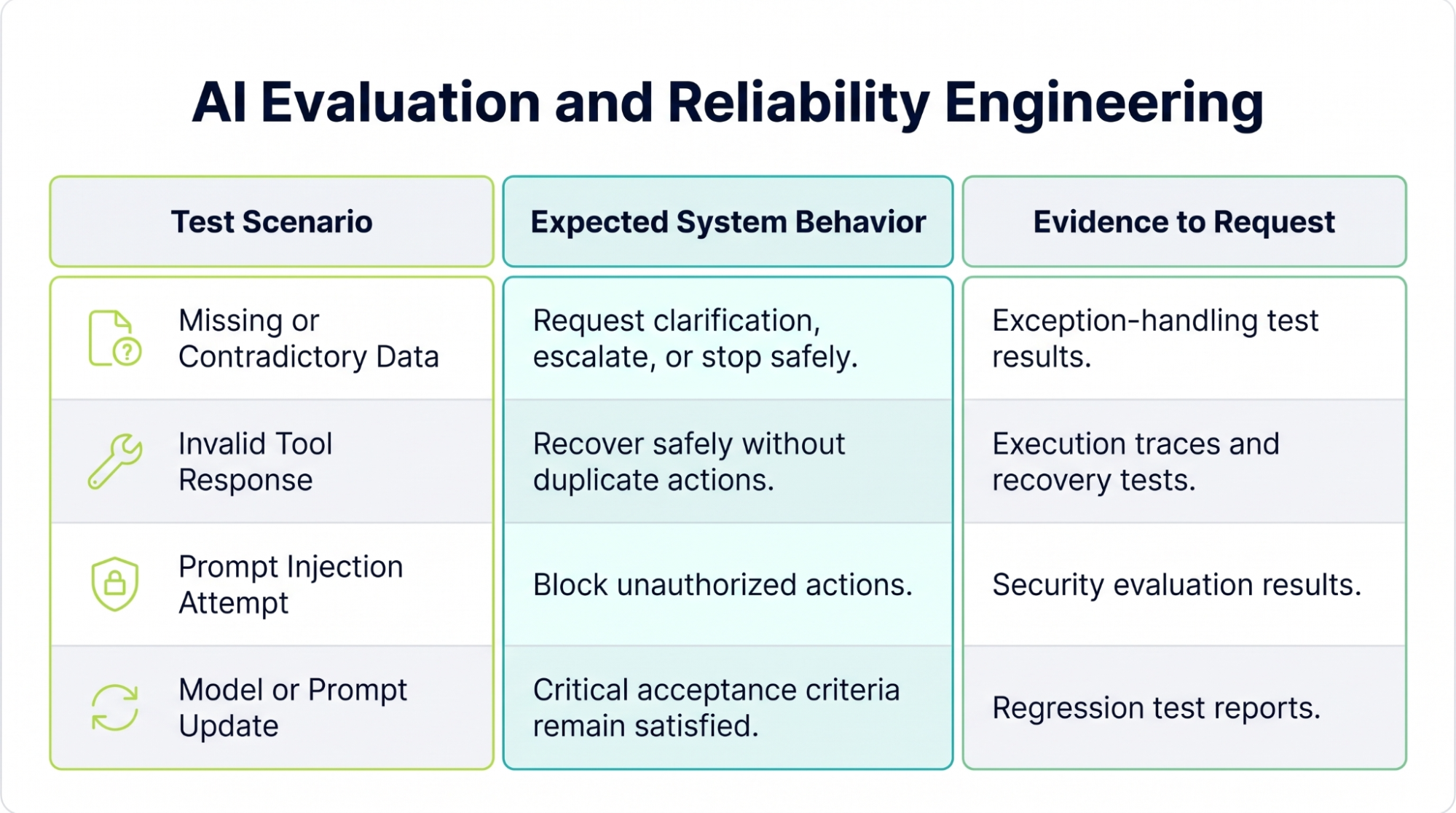
Example AI evaluation scenarios, expected system behavior, and supporting evidence enterprise buyers should request.
How to evaluate an AI development agency’s enterprise security and governance capabilities
Enterprise AI systems typically access sensitive business data and interact with applications that control important business processes. Buyers should evaluate how an agency protects this information and prevents unauthorized actions. Security controls should cover not only employees and applications but also AI agents and the tools they use. Agencies should demonstrate how users, AI agents, and connected tools are authenticated and authorized. Role-based access controls (RBAC) and least-privilege permissions should restrict access to the data and actions each workflow requires.
Data privacy and intellectual property protection are equally important. Buyers should understand where enterprise data is stored, how AI model providers process it, and whether they may retain prompts or outputs or use them for model training. Agencies should explain their data-handling policies and the deployment options they support, including public cloud, private cloud, on-premises, and hybrid environments. These choices should align with the organization’s security policies, data residency requirements, and existing infrastructure.
Effective AI governance should also control changes to models, agents, workflows, and configurations. For high-impact actions, such as authorizing payments or modifying customer records, agencies should define approval requirements based on business risk and the organization’s policies. Buyers should verify that the application and its connected tools enforce these controls, rather than relying solely on instructions given to the AI agent.
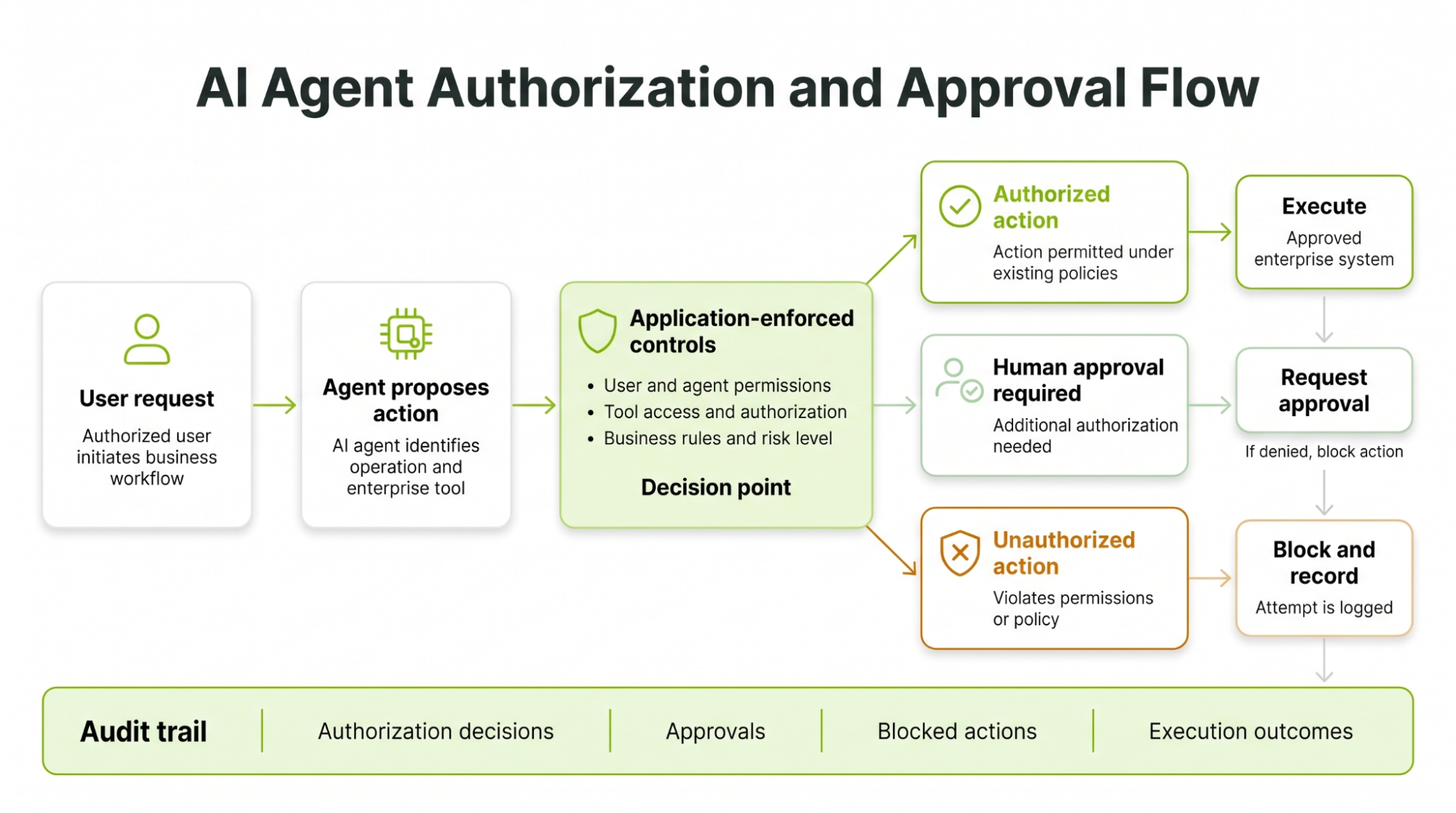
Conceptual authorization and approval flow for enterprise AI agents, showing application-enforced permissions, human oversight, blocked actions, and audit logging.
Agencies should implement both preventive and monitoring controls. Preventive controls, such as access restrictions, data masking, and approval requirements, help stop unauthorized activity. Monitoring and audit logs help organizations detect unusual behavior, investigate incidents, and establish accountability. Buyers should request demonstrations of access controls, audit logging, and safeguards against prompt injection. These demonstrations should show how the system handles untrusted inputs and prevents AI agents from performing unauthorized actions.
Finally, enterprise buyers should assess whether an agency can address relevant industry regulations and organizational compliance requirements. This does not mean assuming that a solution automatically meets every regulatory standard. Buyers should request security architecture documentation, data-handling policies, governance procedures, incident response documentation, and relevant independent assurance reports where available. They should also clarify which security and compliance responsibilities belong to the agency and which remain with the customer.
Production deployment and AI operations
Deploying an AI solution involves more than moving a working prototype into production. The agency must prepare the application for real users, enterprise data, and changing business requirements. A production-ready deployment process should include continuous integration and continuous delivery (CI/CD), separate development and production environments, controlled releases, and rollback procedures. Changes to models, prompts, or agent workflows should pass predefined evaluation and approval requirements before release. Buyers should request evidence of how the agency tests, approves, deploys, and, when necessary, rolls back production changes.
After deployment, operational observability helps teams understand how AI applications behave across complete workflows. Important measures include request latency, error rates, model and tool performance, workflow completion rates, token consumption, and operating costs. Execution traces are particularly valuable for agentic systems because they show which tools an agent called, how individual steps performed, and where failures occurred. This visibility helps teams investigate problems involving both AI components and enterprise integrations.
Technical monitoring alone cannot establish whether an AI system continues to meet business requirements. For example, an AI-powered customer service agent might respond quickly and complete its workflows while recommending incorrect refunds. Production evaluation should therefore track output quality and task completion against agreed criteria, identify recurring failures, and trigger investigation when performance deteriorates. Corrective changes to models, prompts, or workflows should undergo regression testing before deployment.
Operating costs also require ongoing attention. Model inference, cloud infrastructure, external tools, and growing request volumes can make an otherwise successful application expensive to maintain. Tracking cost per completed workflow, alongside latency and quality metrics, helps organizations evaluate operational efficiency. Depending on the workload, model routing, caching, and capacity planning may reduce costs, provided these changes do not compromise accuracy, security, or reliability.
Production support requires a clear division of responsibilities between the agency and the customer’s internal teams. Support agreements and service-level agreements (SLAs) should specify who monitors the system, responds to incidents, investigates integration failures, maintains AI components, and approves production changes. They should also define support coverage, escalation paths, response and recovery expectations, and ongoing maintenance obligations. Buyers should request sample monitoring dashboards, incident response procedures, operational runbooks, and a responsibility matrix before committing to long-term support arrangements.
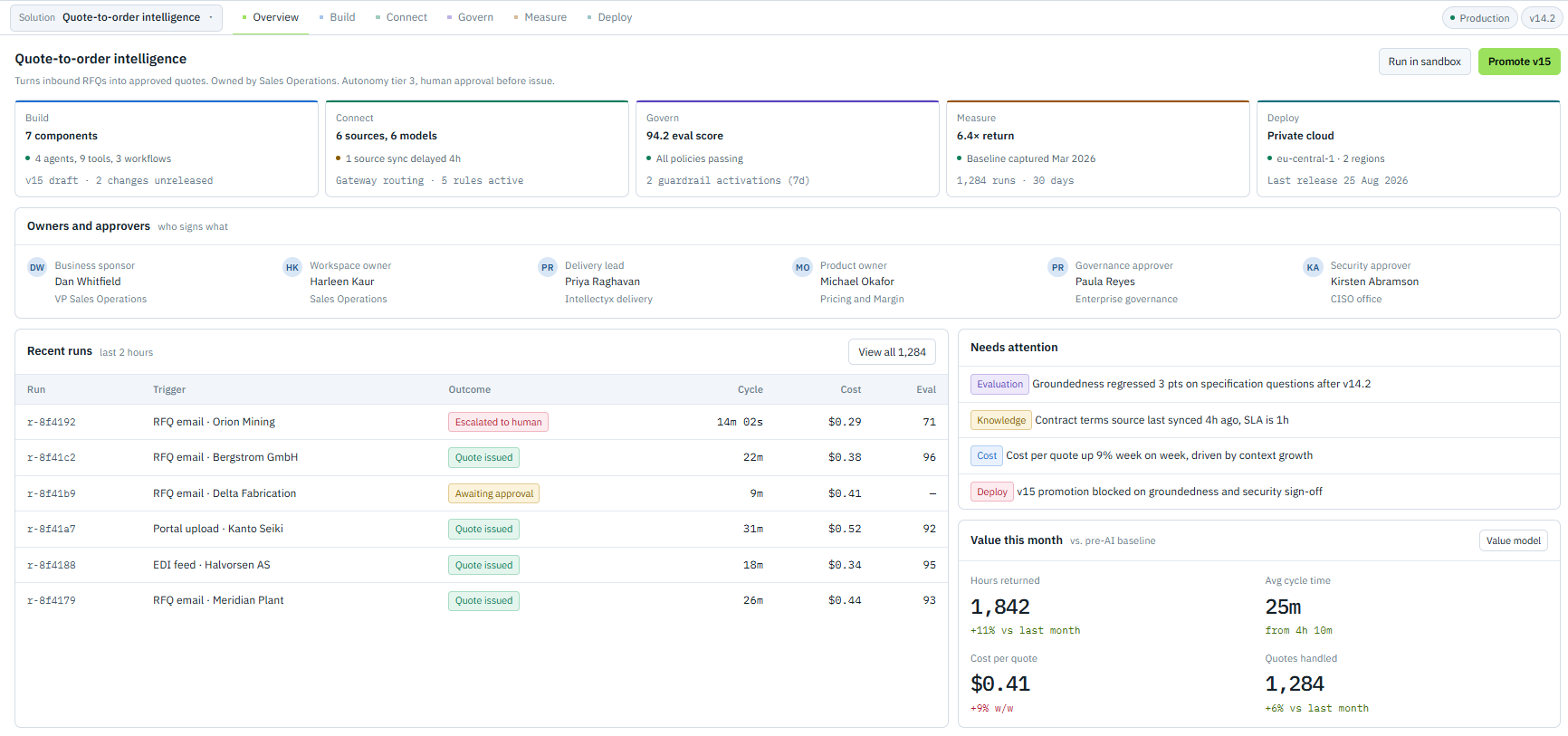
Illustrative IX AI Studio dashboard showing workflow execution, performance metrics, and operational alerts. Source: Intellectyx (simulated demo data).
Ownership, scaling, and value measurement
Before committing to an AI development agency, organizations need to establish what they will own after delivery. Contracts should clearly identify ownership of custom application code, business data, AI configurations, documentation, and intellectual property. They should also distinguish these deliverables from any proprietary frameworks or reusable components that the agency retains or licenses. For example, Intellectyx’s delivery model distinguishes customer-owned applications and source code from the IX AI Studio development environment, which Intellectyx owns.
Ownership alone does not guarantee that a solution can be maintained independently. A customer may own its application but still depend on the original agency for deployment, configuration changes, or troubleshooting. A complete handover should include source code, architecture documentation, deployment configurations, software dependencies and licensing information, operational runbooks, administrator training, and documentation for maintaining enterprise integrations. Organizations should also confirm whether another provider or their internal engineering team could operate and extend the solution without relying on undocumented processes or restricted tool.
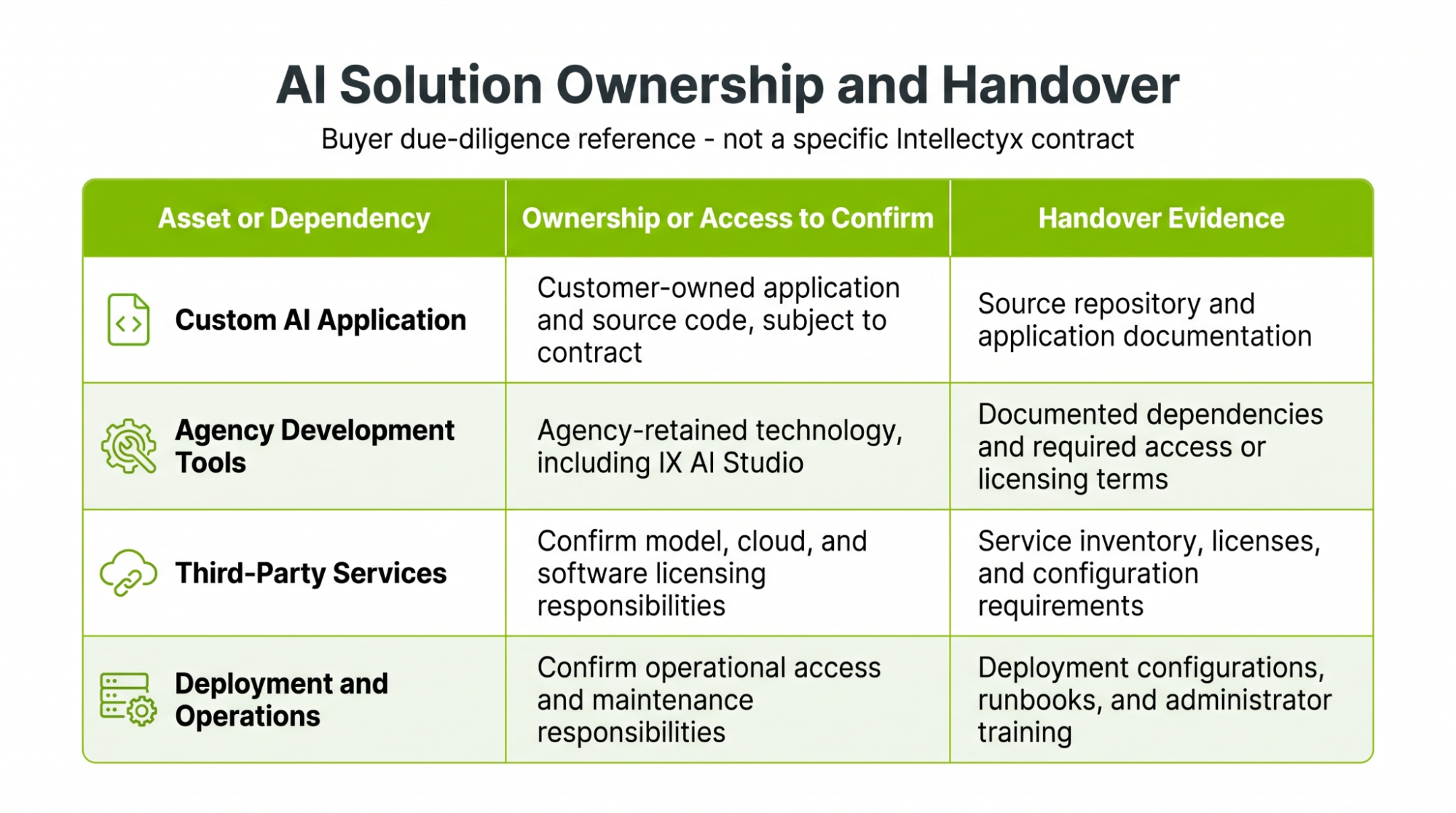
Key ownership, licensing, and handover considerations enterprise buyers should clarify before engaging an AI development agency.
Long-term agreements need to address maintenance and future changes. The scope should define how new requirements are estimated and approved, who maintains integrations and AI components, and how support responsibilities change when a solution expands or moves to another provider. Reusable infrastructure, integration patterns, and prior implementation experience may make it easier to introduce additional AI workflows. However, each new use case still requires assessing its data, business rules, security requirements, and technical dependencies.
Teams should measure financial performance against a baseline established before development. Useful metrics include processing time, manual effort, error rates, operating costs, and margin improvement. For example, an AI-assisted order-processing workflow might reduce manual review time but introduce additional model inference and infrastructure expenses. Reduced manual effort does not automatically translate into direct cost savings.
Financial benefits depend on whether the organization reduces expenses, increases productive capacity, or uses the recovered time for other valuable work. Measuring the business impact requires comparing the observed improvements with the full cost of operating the solution, including AI services, cloud infrastructure, third-party tools, support, and maintenance.
Reports should distinguish measured results from projected savings and business targets. Improvements may also come from redesigned workflows, better data quality, or staffing changes rather than AI alone. The evaluation process should account for these factors instead of attributing every improvement to the AI system. To that end, Intellectyx’s IX Value Engine provides a framework for comparing operational performance against pre-AI baselines and tracking AI operating costs.
Of course, demonstrating realized ROI also requires evidence that measured improvements produced financial or operational value. Regardless of the framework used, organizations should require transparent calculations, agreed performance indicators, and regular reviews to determine whether the solution continues to deliver business value.
Vertical specialization
Industry experience matters when AI must support specialized business processes, legacy systems, and regulatory requirements. An agency familiar with an organization’s industry is more likely to recognize common integration challenges, operational risks, and approval requirements during discovery. However, industry expertise should be demonstrated through relevant implementations, not simply a list of industries served.
In manufacturing, AI applications often span supply chain planning, pricing intelligence, dealer operations, inventory management, sales, and production workflows. These processes depend on information spread across enterprise resource planning (ERP), dealer management, product lifecycle management, and plant systems. For example, an AI solution that recommends inventory replenishment must account for supplier lead times, stock availability, and business rules before its recommendations can support purchasing decisions. Experience with these systems and workflows can reduce discovery effort and help identify integration risks earlier.
In financial services, applications include lending, anti-money laundering (AML) investigations, account reconciliation, risk management, and decision support. These workflows often involve sensitive customer information, strict access controls, and decisions that must be documented and explained.
For example, an agency developing AI for loan processing needs to understand credit policies, document verification, exception handling, and human approval requirements. Intellectyx’s published Intra-Suspense Account Reconciliation case study illustrates this approach. AI agents identify reconciliation breaks, validate information across trading and clearing systems, and recommend resolutions using supporting transaction and fail-report data.
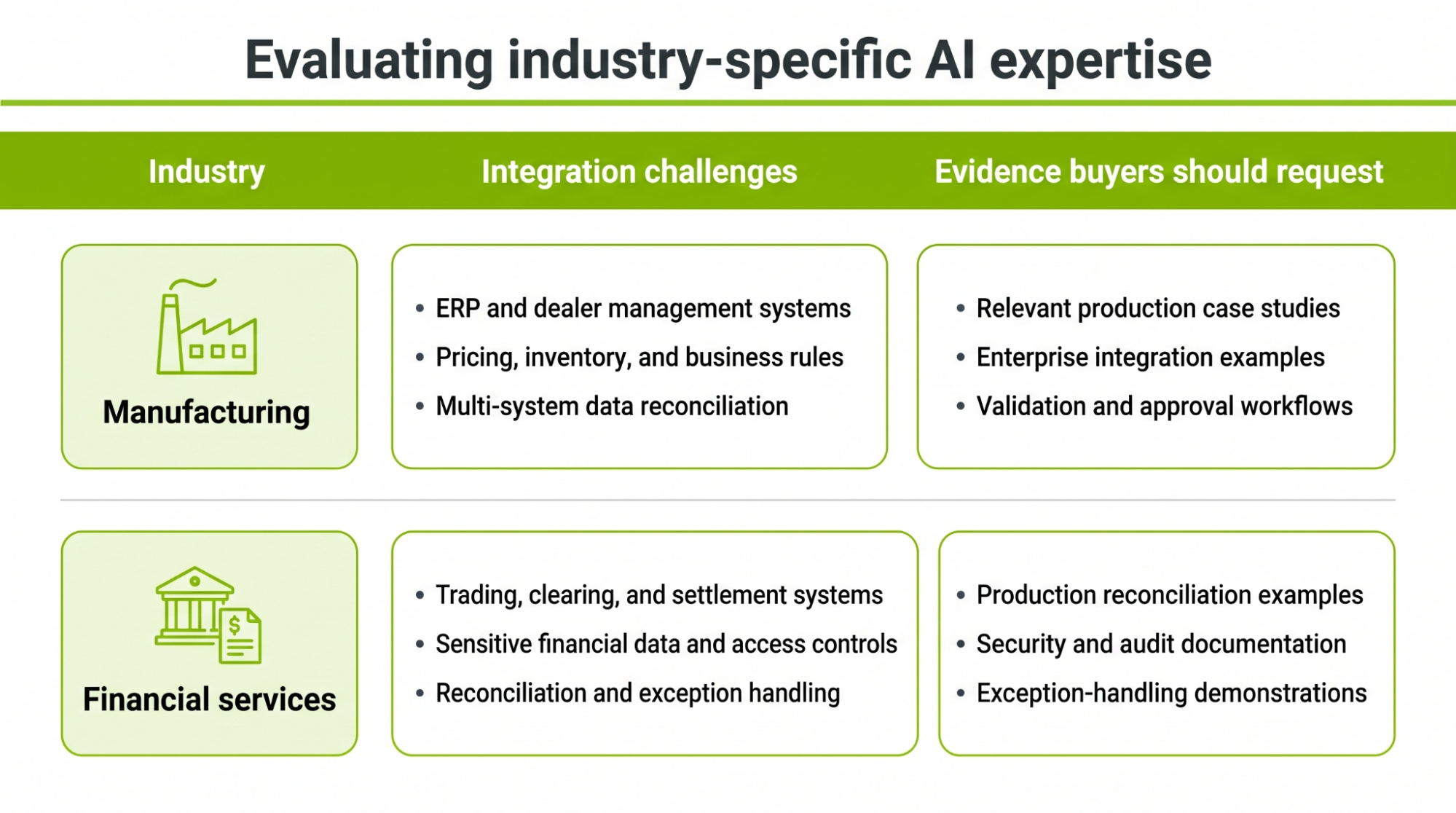
Manufacturing and financial services integration challenges, with examples of the implementation evidence enterprise buyers should request.
Industry-specific experience can also lead to reusable solution patterns. Rather than building every workflow from scratch, agencies may reuse agent designs, integration patterns, validation logic, and governance controls developed for similar business problems. Intellectyx applies this approach through its Manufacturing and Financial Services AI Solution Packs, which combine reusable industry-specific workflow patterns and components with the IX AI Foundry‘s engineering foundation. Each implementation still requires customization for the customer’s systems, data, policies, and operational requirements.
To verify an agency’s industry expertise, buyers should examine completed projects with comparable workflows and technical constraints. Buyers should ask which capabilities were deployed in production, which enterprise systems were integrated, and what outcomes were measured. Where confidentiality permits, request customer references or demonstrations of actual production workflows. It is particularly important to distinguish capabilities already deployed for customers from prototypes, pilot projects, and solutions still under development. A reusable industry framework may provide a useful starting point, but it does not guarantee that every advertised capability has been tested in production.
AI development costs and engagement models
The cost of hiring an AI development agency depends on the project’s scope, technical complexity, and production requirements. A simple proof of concept (PoC) that tests one workflow costs considerably less than an enterprise AI system connected to multiple applications and data sources.
The average cost of a custom AI application implementation by large systems integrators such as IBM or Accenture ranges from $250,000 (for a proof of concept) to over $2,000,000 (for a single production deployment), with full enterprise-wide rollouts and multi-system transformations frequently extending into the $5,000,000 to $10,000,000+ range, which is why mid-sized enterprises with limited resources usually opt to work with a specialized agency.
AI development projects delivered by agencies typically cost $10,000 to $50,000 for assessment and proof of concept, while the reported average overall project cost is $180,000 to $500,000. These figures cover different types of AI projects and should not be treated as standard pricing for enterprise AI implementations.
The table below provides estimates teams can use as a starting point for budgeting different AI project stages.
| Project stage | Published cost estimates | Typical scope |
|---|---|---|
| AI discovery and readiness assessment | $8,000 – $15,000 for one business unit; $15,000 $25,000 for an organization-wide assessment | Workflow assessment, data readiness, use-case prioritization, and implementation planning |
| Proof of concept (PoC) | $45,000 – $75,000 for a focused PoC | Testing one AI approach against defined requirements, usually without full production infrastructure |
| AI minimum viable product (MVP) | $90,000 – $150,000 median in one provider’s 25-project dataset | Initial functional application with defined features, integrations, and evaluation requirements |
| Complex enterprise AI implementation | $180,000 – ~$1,000,000 for multi-agent enterprise platforms | Multiple integrations, orchestration, identity management, security controls, monitoring, and production deployment |
| Ongoing operations | $5,000 to $25,000 per month | The cost depends on the implementation scope and whether it includes level-1, 2, or 3 support. |
Note: These are rough guidelines. Actual costs vary by scope, region, and contractual terms.
Several factors explain the differences. Projects may require substantial data preparation, custom models, integration with ERP or CRM systems, specialized security controls, and extensive testing. Moving from a PoC to production adds work for deployment infrastructure, performance evaluation, governance, monitoring, and support. These requirements often have a greater impact on total cost than the choice of AI model alone.
Common AI development engagement models
Organizations can structure an agency engagement around their requirements and the maturity of their AI initiative.
- Discovery and advisory: A short engagement to assess readiness, prioritize use cases, define technical requirements, and prepare an implementation roadmap. This is useful when the business problem or solution approach is unclear.
- Fixed-scope PoC or MVP: A project with agreed deliverables, milestones, costs, and acceptance criteria. It works best when the organization needs to validate a specific use case before approving a larger investment.
- Custom development or dedicated AI teams: An engineering engagement for complex integrations, evolving requirements, or multiple AI initiatives. Dedicated-team arrangements, such as Intellectyx’s AI Innovation POD, allow organizations to work through a development backlog with a multidisciplinary team.
- Managed services: Ongoing support after deployment, including monitoring, incident response, maintenance, evaluation, and optimization. This model suits organizations that need external operational expertise.
The right engagement model depends on how clearly the requirements are defined, the available budget, integration complexity, and internal engineering capacity. A fixed-price PoC offers clearer cost boundaries for a limited experiment, while a dedicated team provides more flexibility when requirements change. Managed services can complement either approach when the solution enters production.
Comparing proposals and long-term costs
Enterprises should evaluate agency proposals on total cost of ownership, not development fees alone. A comparable proposal needs to identify deliverables, project milestones, implementation timelines, acceptance criteria, technical assumptions, and change-request procedures. It should also distinguish work included in the quoted price from additional services or third-party expenses.
Production AI systems incur recurring costs for model inference, cloud hosting, data storage, monitoring, maintenance, support, and future updates. Usage growth can increase these expenses even when the application itself remains unchanged. A realistic budget therefore includes expected operating volumes, ongoing support requirements, and the cost of improving or extending the solution.
Before selecting a provider, organizations should compare the complete financial commitment, including implementation, ownership terms, operating expenses, and future maintenance. The lowest initial quote is not necessarily the lowest-cost option over the solution’s lifetime.
How to evaluate and shortlist AI development agencies
Before shortlisting agencies, define the business workflow, required integrations, security constraints, and success criteria. Use these requirements to identify agencies with relevant production experience rather than relying on broad service descriptions. For example, a manufacturer developing an AI-powered pricing workflow should prioritize agencies with experience integrating enterprise data, applying complex business rules, and supporting operational approval processes.
Ask each agency to walk through a comparable production deployment, including the business problem, systems integrated, evaluation results, and operational responsibilities. A relevant case study should document measurable outcomes, while customer references can validate delivery quality and post-launch support. Distinguish this evidence from prototype demonstrations or simulated data.
Give every shortlisted agency the same requirements brief that covers the workflow, integrations, deployment environment, expected usage, acceptance criteria, and support needs. Request proposals that separate implementation deliverables and milestones from recurring operating costs and post-launch responsibilities. This makes it easier to identify differences in technical approaches and pricing assumptions. For example, one proposal may include enterprise integration testing and production monitoring, while another treats these as additional services.
Certain warning signs deserve closer examination. Unsupported ROI claims, limited enterprise integration experience, unclear intellectual property ownership, insufficient security documentation, and missing production support commitments can indicate delivery risks. Agencies that cannot explain how they evaluate AI performance, manage failures, or maintain solutions after deployment may lack the experience required for complex enterprise projects.
Use a consistent decision matrix to compare production evidence, integration fit, AI evaluation and security practices, ownership and handover terms, and total cost of ownership. Record any non-negotiable gaps separately, rather than allowing a low price or a polished demonstration to offset them. Select the agency whose evidence, contract terms, and operating model best match the project’s requirements.
IX AI Foundry: Reusable enterprise AI technology foundation
Conclusion
The right AI development agency should demonstrate that it can deliver more than a successful prototype. Enterprise buyers need evidence of production experience, reliable integrations, effective security controls, and the ability to support AI systems after deployment.
Before making a final decision, use this checklist to ask if the AI development agency offers:
- Relevant experience: Proven enterprise implementations, industry expertise, and customer references.
- Technical excellence: Enterprise integration, AI evaluation, security controls, governance, and human oversight.
- Clear agreements: Defined project scope, pricing, acceptance criteria, intellectual property ownership, and support responsibilities.
- Long-term value: Measurable success criteria, realistic operating costs, production monitoring, and ongoing maintenance.
Use these criteria to compare shortlisted agencies against the same requirements, verify claims with production evidence, and identify gaps in ownership, security, or support commitments. Before signing an agreement, confirm that the proposed solution meets your technical and business requirements and that responsibilities remain clear after deployment. Evaluating a custom enterprise AI initiative? Explore Intellectyx’s custom AI development services to learn how its teams design, integrate, and deploy AI solutions for enterprise workflows.