
US manufacturers are under constant pressure to produce more with less margin for error. Demand changes faster, product mixes are more complex, labor availability is inconsistent, and supply disruptions can invalidate a production schedule in hours.
That is why AI in production planning is becoming more valuable than traditional planning approaches built around static forecasts and manual schedule updates.
The real advantage of AI is not simply generating a better forecast. It is creating a more responsive planning environment that continuously connects demand, inventory, materials, equipment capacity, labor, and changeover requirements. When one of those variables changes, AI can help planners evaluate the impact and recommend a more practical production response.
For manufacturers trying to improve schedule adherence, reduce changeover losses, or respond faster to real-time demand signals, AI can turn production planning from a periodic exercise into a continuously adaptive process.
What Is AI in Production Planning?
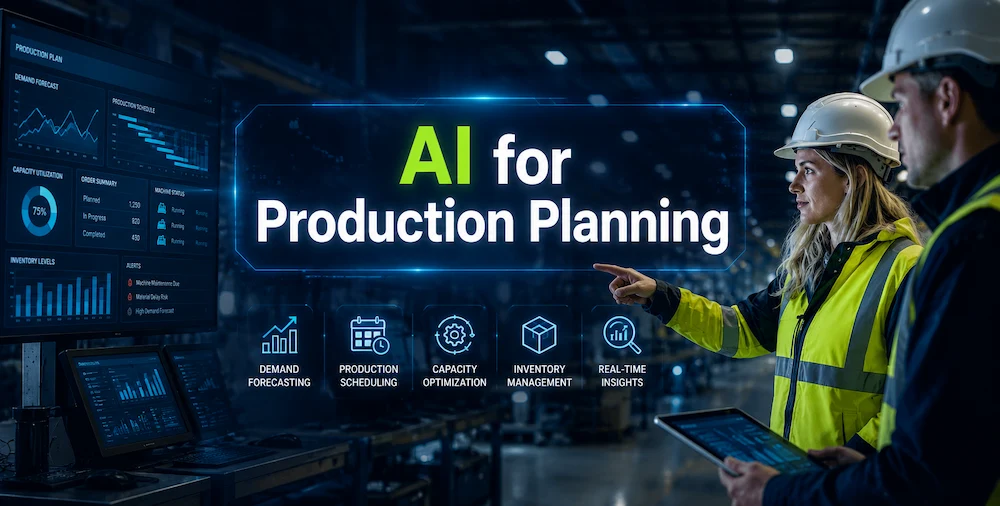
AI in production planning uses machine learning, optimization, predictive analytics, and real-time operational data to improve production forecasting, capacity planning, sequencing, and scheduling.
Instead of relying solely on historical averages or fixed planning rules, AI can evaluate multiple variables at the same time, including:
- Customer demand
- Existing inventory
- Raw material availability
- Machine capacity
- Maintenance schedules
- Labor availability
- Production priorities
- Changeover requirements
The result is a production plan that can adapt more quickly when conditions change.
For example, if demand suddenly increases for one product while a key production line becomes unavailable, AI can evaluate alternative sequences, available inventory, capacity on other lines, and delivery priorities before recommending a revised schedule.
Why US Manufacturers Are Rethinking Production Planning
Traditional production planning works reasonably well when demand is predictable and production environments are stable. But many US manufacturers operate in a much more dynamic environment.
A schedule created Monday morning may no longer reflect reality by Monday afternoon.
Unexpected events can include:
- Rush customer orders
- Supplier delays
- Equipment failures
- Labor shortages
- Quality holds
- Inventory discrepancies
- Transportation disruptions
- Sudden demand spikes
Manual planning teams often need to review data across ERP systems, MES platforms, spreadsheets, inventory systems, and email before deciding how to respond.
AI helps shorten that decision cycle.
Instead of asking planners to manually rebuild the entire schedule, AI can continuously evaluate current operating conditions and highlight the most viable production options.
How AI Connects Real-Time Demand Signals to Production Scheduling
One of the strongest applications of AI in manufacturing production planning scheduling real-time demand signals is connecting what customers want with what the factory can realistically produce.
The process can be simplified into this flow:
Demand signal → Inventory check → Material availability → Capacity check → Changeover impact → Production sequence → Updated schedule
Suppose a customer increases an order by 30%.
A traditional planning process may require someone to manually determine whether there is enough inventory, whether materials are available, whether the production line has capacity, and whether prioritizing that order will delay other commitments.
With production scheduling AI, those variables can be assessed together.
The system may determine that fulfilling the order immediately would create three additional changeovers and delay another high-priority customer. Instead, it could recommend producing part of the order now and the remainder during the next compatible production run.
That is where AI becomes more than a forecasting tool—it becomes a decision-support system for production operations.
The SIGNAL Framework for AI Production Planning
Manufacturers can think about AI production planning through a simple five-stage framework:
Signal
Collect the operational signals that influence production.
These may include customer orders, demand forecasts, inventory levels, machine status, supplier data, labor availability, and production priorities.
Predict
Use historical and real-time data to estimate what is likely to happen next.
AI can help predict:
- Demand changes
- Material shortages
- Capacity constraints
- Potential equipment downtime
- Delivery risks
Optimize
Evaluate different production scenarios against business constraints.
The goal is not simply to maximize output. A useful schedule must balance customer priority, inventory, capacity, changeover time, and delivery commitments.
Schedule
Generate or recommend a production sequence that aligns available resources with current demand.
Adapt
Continuously reevaluate the schedule as new information becomes available.
This closed-loop approach makes AI particularly useful in manufacturing environments where conditions change frequently.
Key Use Cases of AI in Production Planning
AI-Powered Demand Planning
AI-powered demand planning helps manufacturers analyze historical sales, customer orders, seasonality, channel activity, and other demand signals to produce more responsive forecasts.
The real value comes when those forecasts are directly connected to production decisions.
A demand forecast that is more accurate but never changes the factory schedule has limited operational value. For manufacturers operating distribution and warehouse networks alongside production, AI-powered demand forecasting at the warehouse level provides a downstream signal that makes production plans more responsive to actual consumption rather than projected orders.
Production Scheduling AI
Production scheduling AI helps planners determine what should be produced, on which line, and in what sequence.
It can evaluate:
- Order priority
- Equipment availability
- Labor capacity
- Material availability
- Due dates
- Setup requirements
This can significantly reduce the time planners spend manually comparing schedule alternatives. Purpose-built Production Planning AI agent development for manufacturing creates scheduling agents that evaluate order priority, capacity, materials, and changeover requirements simultaneously — replacing the manual multi-system review that slows most planning teams.
AI for Manufacturing Changeovers
Changeovers are often overlooked when production schedules are optimized.
Yet switching between products may require cleaning equipment, replacing tooling, adjusting settings, or performing quality checks.
AI for manufacturing changeovers can recommend production sequences that group compatible products together, reducing unnecessary setup time.
For example, a food manufacturer producing multiple flavors may sequence similar formulations consecutively to minimize cleaning requirements.
Capacity Planning
AI can help manufacturers understand how much production capacity is actually available rather than relying on theoretical machine capacity.
Actual capacity may depend on maintenance windows, staffing, material availability, and previous process performance.
Material and Inventory Alignment
AI can prevent planners from creating schedules that depend on materials that are unavailable or unlikely to arrive on time.
This reduces last-minute production changes and expediting costs. The same principles driving AI in procurement for supply-intensive industries apply directly to manufacturing materials planning — connecting supplier lead times, purchase order status, and delivery risk into a single view that production planners can act on.
Bottleneck Prediction
By analyzing throughput, queue times, machine utilization, and historical disruptions, AI can identify potential bottlenecks before they impact delivery performance.
Real-World Scenario: High-Mix Manufacturing
Consider a manufacturer producing dozens of SKUs on the same equipment.
Each product requires different materials, settings, and changeover procedures. Planners spend significant time sequencing orders manually to minimize setup losses.
An AI scheduling model could analyze historical run times, product compatibility, changeover duration, available materials, and customer due dates.
Instead of simply prioritizing orders based on due date, the system could recommend a sequence that balances delivery performance with changeover efficiency.
Potential outcomes include:
- Fewer unnecessary changeovers
- Higher equipment utilization
- More stable schedules
- Lower overtime
- Better on-time delivery
Real-World Scenario: Demand Spike with Limited Capacity
Imagine a manufacturer receives an unexpected increase in demand for a high-margin product.
At the same time, one production line is scheduled for maintenance and labor availability is limited.
AI can evaluate multiple scenarios, including:
- Moving production to another line
- Adjusting production sequences
- Prioritizing specific customer orders
- Using available finished-goods inventory
- Scheduling limited overtime
The planner still makes the final decision, but AI reduces the time required to evaluate alternatives.
This human-plus-AI model is often more practical than fully autonomous scheduling.
What Data Does AI Production Planning Need?
AI does not need every piece of manufacturing data before a pilot can begin.
It needs the data relevant to the planning decision being improved.
Typical data sources include:
Demand Data
Customer orders, forecasts, sales history, channel demand, and order priorities.
Production Data
Cycle times, machine availability, downtime, throughput, maintenance schedules, and production history.
Inventory Data
Raw materials, work-in-progress, finished goods, and safety stock.
Supply Data
Supplier lead times, purchase orders, expected deliveries, and shortages.
Capacity Data
Production lines, labor availability, shift patterns, and equipment constraints.
Changeover Data
Setup times, product sequencing rules, cleaning requirements, and tooling changes.
Poor data quality can quickly undermine AI recommendations, so data validation should be part of the implementation process.
How AI Fits with Existing ERP and MES Systems
Manufacturers do not necessarily need to replace their current planning technology to use AI.
In many cases, AI functions as an intelligence layer connecting existing systems.
An ERP may contain orders, inventory, and materials data. An MES may provide production status and machine information. AI can combine these signals to recommend production decisions.
The goal should be augmentation, not unnecessary replacement.
For many manufacturers, this makes adoption significantly less disruptive.
Benefits of AI in Production Planning USA
When implemented around a clearly defined planning problem, AI can improve several operational metrics.
Manufacturers may see improvements in:
- Schedule adherence
- On-time delivery
- Capacity utilization
- Production lead times
- Changeover efficiency
- Inventory management
- Planner productivity
- Throughput
- Expediting costs
The strongest business case usually comes from improving several of these metrics together rather than optimizing one in isolation.
Ready to Bring AI-Driven Scheduling Into Your Plant?
Talk to Our AI TeamHow to Implement AI in Production Planning
Step 1: Select One Planning Problem
Do not begin with “implement AI.”
Begin with a measurable operational problem such as excessive changeovers, frequent schedule revisions, low schedule adherence, or delayed orders.
Step 2: Establish a Baseline
Measure current performance before introducing AI.
Useful metrics may include schedule adherence, planner hours, changeover time, throughput, and on-time delivery.
Step 3: Connect the Required Data
Start with the smallest useful set of data sources.
A scheduling pilot may only require order, machine, material, and changeover data.
Step 4: Run AI Alongside Existing Planning
Allow planners to compare AI recommendations against current schedules.
This builds confidence and makes it easier to understand where the model provides value.
Step 5: Measure Operational Outcomes
Evaluate the impact on factory performance—not only forecast accuracy or model scores.
Step 6: Scale Gradually
Once the pilot produces measurable results, extend AI to additional production lines, plants, or planning decisions.
AI Production Planning Readiness Checklist
Before starting an AI production planning initiative, manufacturers should confirm that production constraints are documented, historical planning data exists, demand and machine data are accessible, changeover rules are understood, current KPIs have a baseline, planners are involved in the design, ERP/MES integration requirements are known, and human override processes are clearly defined.
Need help determining whether your manufacturing data and planning processes are ready for AI? Connect with our AI manufacturing experts for a focused readiness assessment.
Where AI Production Planning Projects Go Wrong
One of the biggest mistakes is optimizing against inaccurate constraints.
If machine capacity, changeover times, or production rules are outdated, AI can generate mathematically strong but operationally unrealistic schedules.
Another mistake is focusing only on forecast accuracy.
A better forecast does not automatically create a feasible production schedule.
Manufacturers should also avoid automating planner decisions too quickly. Production planners often hold operational knowledge that is not documented in existing systems. Their involvement is essential when building and validating AI recommendations.
Most importantly, manufacturers should measure the factory—not the model.
The KPIs that matter are throughput, schedule adherence, delivery performance, inventory, changeover time, and operational cost.
Conclusion
The strongest opportunity for AI in production planning USA is not simply creating better forecasts. It is building a more adaptive decision loop between demand and factory reality.
AI can help manufacturers continuously connect customer orders, AI-powered demand planning, materials, machine capacity, labor, inventory, and changeover constraints. When conditions change, production scheduling AI can help planners evaluate alternatives faster and respond with greater confidence.
The best place to start is not a full production-planning transformation. Start with one costly planning problem, establish a measurable baseline, test AI alongside existing planners, and scale only when the operational results justify it.
For US manufacturers dealing with volatile demand, high product complexity, or frequent schedule changes, that approach can turn AI from an experimental technology into a practical production-planning capability.
Connect with our AI manufacturing experts to identify where AI can improve production scheduling, demand planning, and changeover efficiency across your operations.
Build a Smarter Production Plan With Intellectyx
Start Your AI RoadmapFAQs
AI improves production planning by helping manufacturers analyze demand, inventory, machine capacity, labor availability, and supply constraints together. It enables faster scheduling decisions, better resource utilization, fewer disruptions, and more responsive planning when demand or operating conditions change.
The future of AI in production is likely to center on more adaptive, real-time decision support. AI will increasingly connect demand signals, production schedules, maintenance data, inventory, and quality systems so manufacturers can adjust operations continuously instead of relying on static plans.
No. AI is more likely to augment production engineers than replace them. Engineers will still be needed for process design, safety, troubleshooting, exception handling, and continuous improvement, while AI can assist with scheduling, simulation, optimization, predictive analysis, and repetitive decision-making.
Generative AI can make ERP production planning easier to use by allowing planners to query production data in natural language, summarize constraints, generate planning scenarios, explain schedule changes, and surface relevant insights faster. Its greatest value comes when it works alongside ERP data rather than replacing core planning logic.
Manufacturers should start with one measurable planning problem, such as schedule instability, excessive changeovers, or poor capacity utilization. Then establish baseline KPIs, connect the necessary ERP, MES, inventory, and machine data, test AI recommendations alongside existing planners, measure operational results, and scale gradually after proving value.