
Managing industrial inventory becomes difficult when the assets being counted are not small products sitting neatly on warehouse shelves. Heavy equipment, machinery, trailers, containers, industrial vehicles, large components, pallets, and spare equipment may be spread across plants, warehouses, storage yards, and outdoor facilities.
For many organizations, verifying this inventory still requires employees to physically inspect locations, count equipment, update spreadsheets, and reconcile what they see with ERP or asset-management records. This process becomes slower and more error-prone as inventory volumes and locations grow.
AI object detection for industrial inventory offers a different approach. Computer vision systems can analyze images or video, recognize predefined equipment or material types, count detected objects, and send the resulting information to inventory and enterprise systems.
Research continues to demonstrate the feasibility of this approach. A 2026 study of real-time inventory counting using a fine-tuned YOLO model reported 97% inventory-counting accuracy in its tested warehouse environment, while a separate industrial foundry study reported 97.8% average counting accuracy across its test conditions. These figures should not be treated as universal benchmarks, but they demonstrate what purpose-built systems can achieve under defined conditions.
AI Object Detection for Industrial Inventory
Object detection is a computer vision technique that identifies objects within an image or video and determines where each object appears.
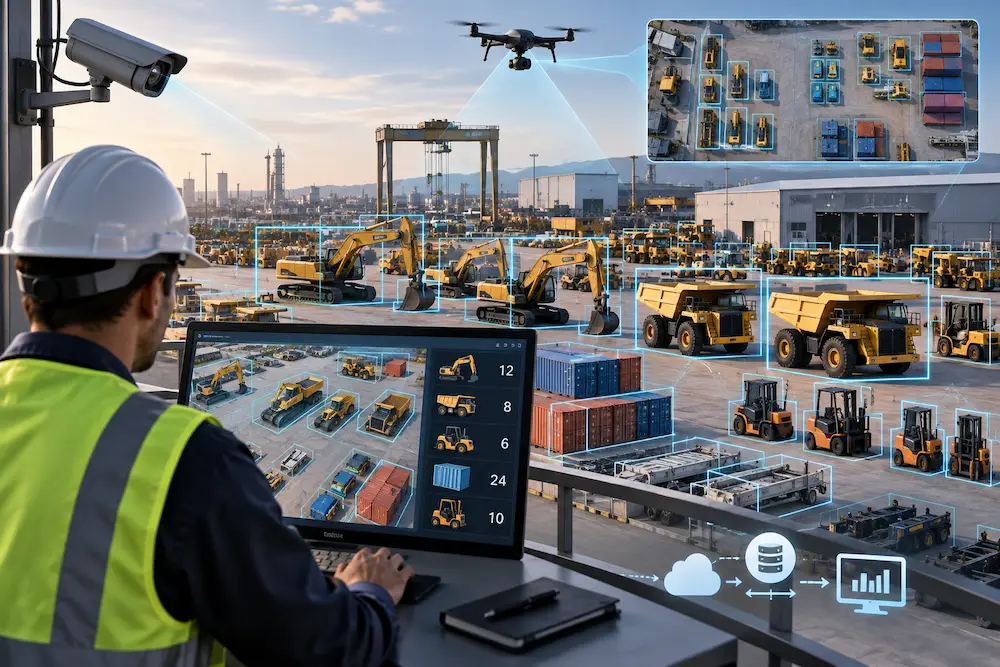
For industrial inventory, a model can be trained to recognize specific equipment, materials, or components. When cameras capture an equipment yard, for example, the model can identify individual forklifts, containers, trailers, machines, or other trained asset classes.
The detections can then feed a counting system that calculates how many objects are present.
Can AI Automatically Count Large Industrial Equipment?
Yes, provided the equipment can be reliably distinguished from the available imagery.
The difficulty varies significantly by environment. Counting clearly separated vehicles in an outdoor yard may be easier than distinguishing similar pieces of equipment stacked closely together.
Object detection therefore provides the visual foundation, while additional tracking, counting, and validation logic turns detections into useful inventory information.
Why Industrial Equipment Inventory Is Difficult to Track
Industrial inventory rarely stays in one predictable location.
Equipment may move between production areas. Machinery can be transferred between facilities. Containers arrive and leave yards. Maintenance teams relocate tools and components. Inventory records may not immediately reflect these physical movements.
Manual inventory checks can therefore become a significant operational task.
A manufacturing study examining metal-sheet inventory described manual material counting and tracking as repetitive activities that consume resources and introduce the possibility of human error. The researchers developed a camera-based computer vision system to automate material counting and inventory updates.
Large equipment introduces additional complications because assets may be partially hidden, viewed from different angles, covered by other objects, or located across very large areas.
Computer vision can reduce some of this burden by providing another source of information about what is physically present. These visibility gaps make AI-powered inventory optimization increasingly valuable for manufacturers that need a more accurate view of equipment, materials, and inventory across operations.
How AI Object Detection and Equipment Counting Work
A practical industrial inventory system usually starts with visual data.
Images or video can come from fixed cameras, existing CCTV systems, mobile devices, inspection vehicles, or drones. The appropriate source depends on the facility and the equipment being counted.
A computer vision model analyzes this imagery and identifies objects it has been trained to recognize. Each detection can contain information such as the equipment category, location within the image, and confidence score.
The counting layer then determines how those detections should affect inventory quantities.
This distinction matters because object detection and object counting are not exactly the same problem.
How Does AI Avoid Counting the Same Equipment Twice?
Suppose a forklift appears in 50 consecutive frames of a video. Counting every detection would incorrectly record 50 forklifts.
A production system therefore needs additional logic to determine whether detections represent new objects or equipment that has already been counted.
Depending on the environment, this can involve object tracking, defined counting zones, timestamps, movement trajectories, camera positions, confidence thresholds, asset identifiers, or image deduplication.
For static images, techniques such as non-maximum suppression can help eliminate overlapping detections of the same object. For video, object tracking can maintain an identity as equipment moves through the scene.
This additional logic is particularly important when inventory is continuously monitored rather than counted from a single image.
Industrial Equipment AI Can Identify and Count
Computer vision can potentially support many types of industrial inventory, including heavy machinery, forklifts, construction equipment, industrial vehicles, trailers, shipping containers, pallets, storage racks, large spare parts, raw materials, manufactured components, and finished products.
The appropriate approach depends on what the organization needs to identify.
If the objective is simply to determine that 25 forklifts are present, object detection may be sufficient.
If the organization needs to know which specific 25 forklifts are present, the system may need additional identification methods.
OCR can extract visible serial numbers or equipment labels. QR codes and barcodes can provide explicit identifiers. RFID, GPS, BLE, or telematics can provide additional location or identity signals.
Computer vision can therefore complement existing asset-tracking technologies rather than necessarily replacing them. Computer vision can also become part of broader AI solutions for manufacturing, helping organizations connect physical asset visibility with production, inventory, quality, and operational workflows.
Cameras, Drones, and Edge AI for Inventory Monitoring
The physical environment determines how visual inventory information should be collected.
Indoor warehouses may benefit from fixed cameras positioned around storage or movement areas. Production lines can use cameras focused on specific material flows. Outdoor facilities may require wider camera coverage or aerial imagery.
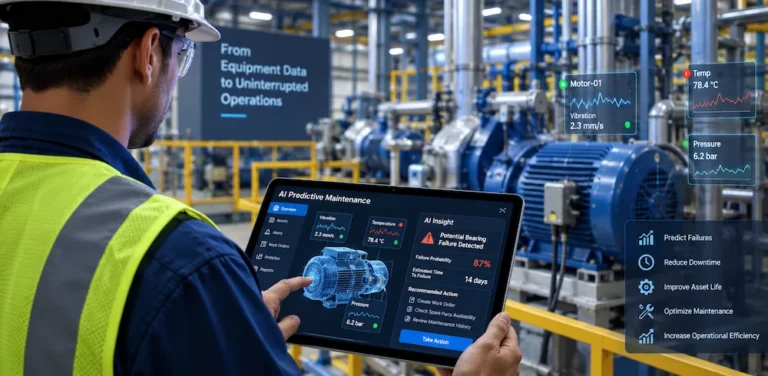
The objective is not simply to install more cameras. It is to capture images where equipment is sufficiently visible and distinguishable for reliable analysis. Equipment data captured through computer vision can also support predictive maintenance AI agents that help manufacturers identify potential maintenance issues before they disrupt operations.
Can Existing Security Cameras Be Used?
Sometimes.
Existing CCTV or IP cameras may provide usable imagery, particularly when equipment already passes through known locations.
However, camera resolution, viewing angle, distance, lighting, frame rate, and obstruction can significantly affect model performance.
Recent research into real-time warehouse inventory counting specifically noted low-resolution CCTV imagery as one of the practical challenges for computer vision inventory systems.
Organizations should therefore evaluate existing camera infrastructure during a pilot rather than assuming it will automatically support AI inventory counting.
Can Drones Count Equipment in Large Industrial Yards?
For large outdoor locations, drones can potentially capture imagery across areas that would otherwise require employees to inspect manually.
This approach can be relevant to equipment rental yards, construction sites, logistics facilities, ports, mining operations, utilities, precast manufacturing yards, and other asset-intensive environments.
A documented precast-concrete inventory implementation, for example, used computer vision to classify units from camera, drone, and mobile imagery and compare AI-generated counts against inventory records to identify discrepancies.
Drone-based counting still needs to account for flight height, camera angle, shadows, equipment overlap, weather, and regulatory requirements.
Improving Inventory Accuracy With Computer Vision
Automated counting becomes more valuable when the resulting information can be compared with the organization’s expected inventory.
Imagine that a physical inventory system detects 142 pieces of equipment in a storage yard, while the ERP or asset-management system indicates that 147 should be present.
The five-unit difference becomes an exception that operations teams can investigate.
This changes the purpose of the system from simply counting objects to identifying discrepancies between physical operations and digital records.
Computer vision systems can also retain image evidence associated with counts. When the model is uncertain, employees can review the relevant image instead of recounting an entire facility.
How Accurate Is AI Equipment Counting?
There is no universal accuracy level for industrial object counting.
Results depend on training data, equipment type, object size, camera placement, resolution, lighting, background conditions, object overlap, viewing angle, and the similarity between equipment categories.
Industrial research illustrates both the potential and the variability. A 2025 study of automated counting in a casting foundry reported 97.8% average counting accuracy in its evaluation, while also highlighting challenges including overlapping products, environmental debris, product variation, and changing operating conditions.
This is why manufacturers should establish their own accuracy requirements and test against manually verified inventory.
Still Counting Equipment Manually?
AI Object Detection vs. Manual Inventory Counting
| Area | Manual Counting | AI Object Detection |
|---|---|---|
| Equipment identification | Employee inspection | Computer vision |
| Counting | Manual recording | Automated counting logic |
| Large-area coverage | Labor intensive | Camera or aerial coverage |
| Frequency | Usually periodic | Can support more frequent monitoring |
| Verification | Physical recount | Image/video evidence |
| Inventory reconciliation | Often manual | Can be system-driven |
| Exceptions | Manual investigation | AI can flag discrepancies |
| Scaling | More labor required | Expand cameras and processing |
Computer vision does not need to eliminate employees from inventory verification. A more practical model is automation with human validation.
High-confidence detections can be processed automatically, while uncertain objects, inventory mismatches, or high-value assets can be routed for employee review.
Connecting Computer Vision With ERP and Asset Management Systems
A computer vision model that produces a count on a screen is useful, but its business value remains limited if employees still have to manually copy the information into other systems.
Integration is therefore an important part of production deployment.
AI-generated inventory information can potentially connect with ERP, WMS, EAM, CMMS, or dedicated asset-management platforms.
For example, physical counts can be compared with system quantities. Discrepancies can trigger alerts. Equipment movements can update location information. Unexpected assets can create review tasks.
Effective enterprise AI integration can connect computer vision outputs with ERP, WMS, EAM, CMMS, and other systems where inventory and operational decisions already happen.
A manufacturing study of automated metal-sheet counting demonstrated this broader concept by using camera-based detection to automatically record material movements, with the resulting information available for production planning and inventory control.
The goal is to make visual information part of the organization’s existing inventory workflow rather than create another isolated dashboard.
Business Benefits of Automated Equipment Counting
The most immediate opportunity is reducing repetitive manual inventory work.
Employees can spend less time walking facilities and manually recording quantities, particularly for routine inventory verification.
More frequent inventory visibility can also help organizations identify discrepancies earlier. That can support better production planning, procurement decisions, equipment utilization, and asset availability.
Visual inventory intelligence can be especially valuable where physical assets are expensive. A small discrepancy involving high-value machinery or industrial components can represent a much larger financial impact than a similar numerical discrepancy involving inexpensive consumer products.
Organizations may also use historical detection data to understand equipment movement and inventory patterns over time.
The business case should ultimately be measured against the existing process: how much time counting consumes, how frequently inventory discrepancies occur, and what those inaccuracies cost the organization.
Limitations and Challenges of AI Object Detection
Computer vision is not a perfect replacement for every inventory technology.
One of the largest challenges is occlusion. If one machine is hidden behind another, a camera cannot detect what it cannot see.
Stacked inventory creates a similar problem. Recent research into automated counting of stacked industrial objects notes that heavy occlusion can make direct visual counting difficult and explores multi-view and 3D approaches to address the issue.
Environmental conditions also matter. Dust, glare, rain, shadows, poor lighting, changing backgrounds, and camera vibration can influence detection quality.
Another challenge is equipment similarity. Two machine models may look almost identical while representing different inventory records.
For these situations, computer vision may need to work alongside OCR, serial-number recognition, RFID, GPS, barcodes, telematics, or other identification technologies.
How to Implement AI Inventory Counting
A successful implementation should begin with a narrow operational problem rather than an ambition to track every asset across every facility.
Start by selecting one equipment category and one location where manual counting currently consumes meaningful time or where inventory discrepancies create operational problems.
Create a manually verified baseline and collect representative imagery. The dataset should reflect real conditions, including different viewing angles, lighting conditions, equipment positions, and partial obstructions.
The computer vision model can then be trained or fine-tuned and evaluated against verified counts.
Importantly, evaluate counting performance, not only model-detection metrics. A model can perform well at recognizing equipment while the overall inventory count remains incorrect because of duplicate detections or tracking errors.
Once the pilot reaches acceptable reliability, the next stage is integration with inventory systems and operational workflows.
From there, the organization can gradually expand to additional equipment categories, locations, and use cases.
How Intellectyx Can Help Build Industrial Computer Vision Solutions
Intellectyx helps enterprises design, build, and operate production AI solutions across manufacturing and industrial workflows.
For industrial inventory, this can include computer vision models, enterprise data integration, AI agents, existing camera infrastructure, edge or cloud processing, ERP connectivity, human validation, monitoring, and governance.
The opportunity extends beyond automated counting.
For example, when computer vision detects a discrepancy between physical equipment and inventory records, an AI agent could investigate related ERP information, asset history, maintenance records, or recent equipment movements. It could then summarize the discrepancy and route it to the appropriate operations team for review. Through Agentic AI development, organizations can build agents that investigate inventory discrepancies, retrieve related asset records, analyze operational context, and route exceptions to the appropriate teams.
This connects visual AI with Agentic AI, turning physical observations into actionable enterprise workflows.
For manufacturers, the objective is not to deploy another standalone AI model. It is to connect intelligence with the systems and processes already running the operation.
Conclusion
AI object detection for industrial inventory can help organizations automate the difficult task of identifying and counting equipment across plants, warehouses, production areas, and industrial yards.
Computer vision provides the ability to recognize physical assets from images and video. Tracking and counting logic helps determine how many unique objects are present. Enterprise integrations can then compare those observations with inventory records and surface discrepancies that require attention.
However, successful implementation depends on much more than selecting an object detection model. Camera coverage, training data, equipment visibility, occlusion, counting logic, environmental conditions, enterprise integration, and human validation all influence production performance.
The strongest starting point is therefore a focused inventory problem with a measurable baseline. Once computer vision can reliably improve that process, organizations can expand the approach across additional equipment, facilities, and industrial workflows.
Stop Losing Hours to Manual Equipment Counts
FAQs
AI object detection uses computer vision models to recognize and locate predefined equipment, materials, or products within images and video. Counting and tracking logic can then convert those detections into inventory information.
Yes, when the equipment is sufficiently visible and the model has been trained to distinguish the relevant categories. Accuracy depends on imagery, camera placement, environmental conditions, equipment similarity, and obstruction.
It can automate significant portions of inventory counting, but human validation may still be appropriate for uncertain detections, high-value equipment, unusual environments, and inventory discrepancies.
Potentially. Existing cameras may be suitable if they provide adequate resolution, coverage, viewing angles, and lighting. A pilot should evaluate actual footage before a larger deployment.
Yes. Detection and counting results can be connected with ERP, WMS, EAM, CMMS, and asset-management systems to compare physical inventory with recorded quantities and identify discrepancies.
Occlusion is a major computer vision challenge. Multiple camera angles, tracking, 3D vision, alternative sensors, or human verification may be necessary when equipment cannot be reliably observed from a single viewpoint.