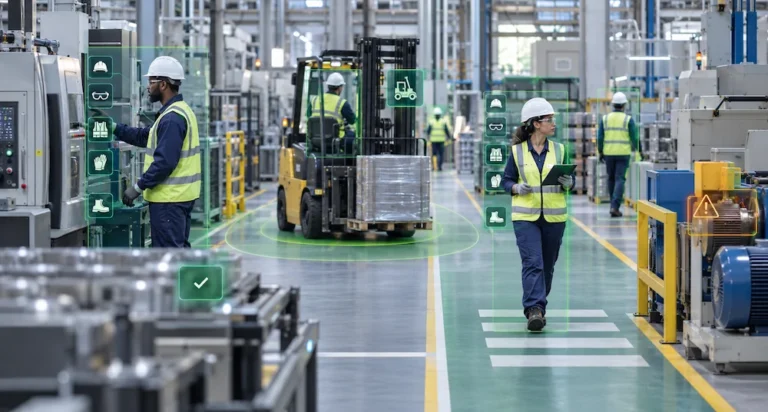

Large chemical manufacturing plants generate continuous streams of information from distributed control systems, laboratory systems, equipment sensors, maintenance platforms, production applications, and operator records. The challenge is rarely a lack of data. It is helping plant teams find the right information, understand what is changing, and respond before a deviation becomes a quality, reliability, safety, or production problem.
Among the most practical AI applications in chemical manufacturing, an AI operations assistant brings plant information together and provides operators, process engineers, maintenance teams, and plant leaders with contextual recommendations.
This does not make the assistant an autonomous plant controller. In safety-critical chemical operations, AI should support established operating discipline, qualified personnel, engineered safeguards, and formal process-safety systems. The strongest deployments begin as decision-support tools with clear limits, traceable evidence, and human approval.
Intellectyx develops agentic AI for manufacturing around real operational workflows, connecting AI assistants with enterprise and plant systems while preserving governance and human oversight.
What Is an AI Operations Assistant for a Chemical Plant?
An AI operations assistant is a software system that monitors authorized plant information, interprets operational context, and helps people complete defined tasks. It may combine time-series analytics, machine learning, retrieval-augmented generation, rules, workflow orchestration, and natural-language interaction.
Unlike a general chatbot, an industrial assistant should understand plant-specific context, including:
- Asset hierarchies and equipment relationships
- Process units, operating modes, products, and grades
- Approved operating procedures and technical documentation
- Process limits, alarm priorities, and escalation paths
- Equipment condition and maintenance history
- Production schedules and material constraints
- Quality specifications and laboratory results
- User roles, permissions, and approval requirements
The assistant can answer questions and recommend actions, but its authority should be bounded. A practical first deployment reads data and supports decisions. It does not directly alter control loops, bypass interlocks, suppress alarms, or change safety-critical settings.
How Does an AI Operations Assistant Work?
The assistant continuously or periodically collects approved data from plant and enterprise systems. It adds operational context, applies analytical models and business rules, and then presents findings through alerts, dashboards, reports, or conversational interfaces.
A typical interaction might follow this sequence:
- The system detects an unexpected change in reactor temperature, pressure, feed composition, or utility consumption.
- It checks whether the change corresponds with a planned grade transition, startup, shutdown, or maintenance activity.
- It compares the current pattern with historical operating periods and known process constraints.
- It retrieves relevant procedures, equipment records, laboratory results, and recent operator notes.
- It presents possible explanations, supporting evidence, confidence, and recommended checks.
- A qualified operator or engineer reviews the recommendation and decides what action is appropriate.
- The final decision and outcome are recorded for auditability and future improvement.
The value comes from reducing the time required to assemble context. The assistant helps people investigate faster without claiming that a statistical correlation is automatically the root cause.
Key AI Applications in Chemical Manufacturing Plants
The leading AI applications in chemical manufacturing include process monitoring, predictive maintenance, alarm investigation, batch-quality prediction, production planning, energy optimization, safety support, and operator knowledge retrieval. An AI operations assistant connects these capabilities through a common decision-support interface.
1. Continuous process monitoring and deviation investigation
Chemical plants operate with interacting variables such as temperature, pressure, flow, composition, residence time, catalyst activity, and utility conditions. An AI operations assistant can monitor patterns across these variables and identify deviations that individual alarms may not explain.
When a deviation occurs, the assistant can assemble recent changes, affected tags, equipment states, production context, and comparable historical events. This gives engineers a structured starting point for investigation.
AI should not replace alarm management or the plant’s control strategy. It can add context around an abnormal condition while the DCS, alarms, interlocks, and safety instrumented systems continue to perform their designed functions.
2. Predictive maintenance and equipment-health support
Pumps, compressors, agitators, heat exchangers, furnaces, motors, and rotating assets can produce measurable signs of degradation. The assistant can analyze vibration, temperature, pressure, electrical, lubrication, process, and maintenance data to identify abnormal behavior.
Instead of providing an isolated health score, it can explain which signals changed, retrieve the asset’s maintenance history, check current operating conditions, and recommend an inspection. It may also prepare a draft work request for human approval.
Manufacturers can extend this capability with predictive maintenance AI agents that connect equipment insights with CMMS, inventory, and maintenance-planning workflows.
3. Shift handover and operational continuity
Shift handovers can involve alarm summaries, production changes, equipment problems, maintenance activity, temporary operating instructions, laboratory results, and unresolved deviations. Important context may be spread across control-room notes, emails, logs, and enterprise systems.
An AI assistant can prepare a structured handover summary containing:
- Current production status
- Active and recurring alarms
- Equipment constraints
- Open maintenance work
- Recent process deviations
- Quality results awaiting review
- Temporary instructions and approvals
- Priority items for the incoming shift
The outgoing operator should validate the summary. AI-generated text should not become the official operating record without review.
4. Alarm investigation and prioritization
During disturbances, operators may receive many related alarms. The assistant can group alarms by equipment, process unit, time, and likely initiating event. It can show the event sequence and retrieve relevant procedures.
This capability is intended to support investigation, not suppress alarms automatically. Alarm configuration, rationalization, priority, and response requirements should remain governed through the plant’s established alarm-management process.
5. Batch monitoring and quality prediction
In batch and specialty chemical manufacturing, quality results may arrive after significant processing time. Machine-learning models can estimate likely product properties from in-process measurements, raw-material data, recipe parameters, and historical outcomes.
The assistant can notify the quality or process team when the predicted result is trending away from specification. It can also identify the variables most associated with the prediction and compare the batch with similar historical runs.
Predicted quality should not automatically replace required laboratory tests, release procedures, or regulatory controls. It is an early-warning and investigation tool.
6. Production planning and schedule coordination
Chemical production schedules must account for equipment capacity, campaign sequencing, cleaning, storage availability, raw materials, maintenance windows, utilities, quality holds, and customer demand.
An assistant can evaluate constraints, identify schedule conflicts, and present alternative sequences. When equipment condition changes, it can help planners understand the effect on downstream production and inventory. Production planning AI agents can support these coordinated planning workflows.
7. Energy and utility optimization
Steam, electricity, cooling water, compressed air, refrigeration, and fuel can materially affect chemical-production economics. AI can compare consumption with throughput, product mix, weather, equipment condition, and operating mode.
The assistant can highlight unusual energy intensity, identify suspected leaks or inefficient equipment, and recommend areas for engineering review. Any proposed operating change should be checked against product quality, asset integrity, environmental limits, and process safety.
8. Process-safety and compliance assistance
An AI operations assistant can help authorized users find current procedures, safety data, equipment records, inspection findings, management-of-change documents, and training material. It can identify incomplete fields, overdue reviews, or conflicting document versions.
It may also help safety teams examine recurring anomalies or leading indicators. However, it does not replace hazard analysis, management of change, mechanical integrity, emergency planning, incident investigation, or other required process-safety activities. OSHA’s Process Safety Management standard remains the governing framework for covered U.S. processes.
For broader applications, see how AI supports manufacturing safety monitoring while keeping qualified professionals responsible for critical decisions.
9. Operator knowledge and procedure retrieval
Experienced operators often know where to look and which questions to ask during unusual conditions. An assistant can make approved knowledge more accessible to less-experienced personnel by retrieving the relevant procedure, manual, troubleshooting guide, or past resolution.
Answers should cite the approved source, display document status and revision, respect user permissions, and direct the user to the authoritative record. The model should not invent a procedure when the required information is absent.
10. Shop-floor and field-work coordination
Field teams may need equipment status, work permits, inspection instructions, maintenance history, or escalation contacts. A mobile or workstation assistant can bring the appropriate information into the workflow and capture structured observations.
When connected to an AI shop-floor monitoring system, the assistant can combine plant conditions with approved workflows while escalating uncertainty or risk to supervisors.
Build an AI Operations Assistant for Your Chemical Plant
Reference Architecture for an AI Operations Assistant
A reliable architecture separates data access, intelligence, workflow execution, and safety-critical control. Deploying these AI applications in chemical manufacturing requires an architecture that connects operational data, enterprise systems, analytical models, workflows, security controls, and human approvals.
| Architecture Layer | Typical Components | Purpose |
|---|---|---|
| Plant and enterprise sources | DCS, SCADA, PLCs, historians, sensors, LIMS, MES, ERP, CMMS, EAM and document repositories | Supply operational, quality, maintenance and business context |
| Connectivity and ingestion | Industrial gateways, APIs, OPC UA, message brokers and batch pipelines | Move authorized data into the assistant environment |
| Context and data services | Asset hierarchy, tag mapping, event alignment, knowledge graph, feature store and document index | Convert disconnected data into plant-specific context |
| Intelligence services | Rules, anomaly detection, forecasting, predictive models, retrieval and language models | Detect patterns, estimate risk and prepare explanations |
| Agent and workflow layer | Task orchestration, role logic, approvals, escalation and system connectors | Coordinate defined tasks across plant and enterprise applications |
| User experience | Control-room dashboard, engineering workspace, mobile application and conversational interface | Deliver evidence, recommendations and next steps |
| Governance and operations | Identity, access control, audit logs, model registry, monitoring, validation and feedback | Keep the system secure, traceable and supportable |
Keep safety-critical control separate
The AI environment should normally remain separated from basic process control and safety instrumented functions. Recommendations can move through controlled interfaces and approval workflows, but the architecture should not give a language model unrestricted write access to the DCS, SIS, PLCs, or other critical OT assets.
NIST’s Guide to Operational Technology Security emphasizes that OT cybersecurity must account for unique performance, reliability, and safety requirements. This means segmentation, least-privilege access, controlled updates, secure remote access, asset inventory, monitoring, and recovery planning must be designed for the plant environment.
What Are the Main Benefits?
Faster operational investigation
The assistant can assemble trends, alarms, maintenance records, procedures, quality results, and production context in one response. This reduces manual searching and gives teams more time to evaluate the situation.
Earlier identification of developing problems
Multivariable models can recognize patterns that are difficult to represent with a single threshold. Earlier visibility can create more time for inspection, maintenance planning, or process review.
More consistent decision support
Approved procedures, operating limits, and historical knowledge can be surfaced consistently across shifts and sites. The assistant can help standardize how teams begin an investigation while leaving the final decision with accountable personnel.
Better coordination across functions
Operations, maintenance, quality, safety, planning, and engineering often work from different systems. An AI assistant can present shared context and coordinate handoffs without requiring every user to navigate every application.
Improved use of plant knowledge
Technical documents and historical records become easier to retrieve. This can support workforce training and reduce dependence on knowing exactly which system or folder contains the answer.
Scalable multi-site visibility
Large chemical manufacturers can use a common architecture across sites while preserving site-specific equipment, procedures, access rules, and models. Enterprise teams can compare standardized performance indicators without assuming every plant operates identically.
What Are the Limitations and Risks?
Incorrect or unsupported recommendations
Models can produce incorrect classifications, misleading correlations, or unsupported text. The interface should show sources, confidence, missing information, and reasons for escalation.
Incomplete operating context
A recommendation may be wrong if the assistant cannot see a temporary configuration, failed sensor, maintenance bypass, feedstock change, or unusual operating state. Context validation is as important as model accuracy.
Alert fatigue
An overly sensitive system may create too many low-value notifications. Thresholds should be tuned according to operational consequences and user feedback, not only statistical performance.
Cybersecurity exposure
Connecting OT and IT data can introduce new pathways and identities. Access must be limited, monitored, and designed around plant security zones and conduits.
Model and knowledge drift
Equipment ages, processes change, procedures are revised, and products evolve. Models, retrieval indexes, mappings, and rules require lifecycle ownership and controlled updates.
Automation bias
Users may accept an AI recommendation because it appears confident. Training, interface design, approval requirements, and independent verification should reinforce that AI is decision support.
How Should a Chemical Manufacturer Implement an AI Operations Assistant?
1. Start with one decision or workflow
Select a bounded problem such as shift-handover preparation, pump anomaly investigation, batch-quality early warning, or procedure retrieval. Avoid attempting autonomous plant optimization as the first project.
2. Define authority and prohibited actions
Document what the assistant can read, recommend, draft, and initiate. Explicitly state what it cannot change or approve.
3. Audit data and integrations
Evaluate tag quality, timestamps, asset hierarchy, documents, maintenance records, laboratory data, interfaces, network boundaries, and identity controls.
4. Establish a measurable baseline
Depending on the use case, measure investigation time, false alarms, equipment downtime, off-spec production, energy intensity, procedure-search time, or handover effort.
5. Build an advisory pilot
Run the assistant in read-only or recommendation mode. Compare its outputs with operator and engineer assessments across normal, abnormal, startup, shutdown, and maintenance conditions.
6. Validate with plant experts
Process engineering, operations, maintenance, quality, safety, IT, OT security, and controls teams should participate. Validation should cover usefulness, failure modes, access, performance, traceability, and user behavior.
7. Integrate controlled workflows
After the pilot proves value, connect approved actions such as creating a draft work request, assigning an investigation, or routing a report for review. Preserve human approval where consequences are significant.
8. Monitor the assistant in production
Track data quality, response accuracy, unsupported-answer rate, alert acceptance, missed events, model drift, latency, access violations, user feedback, and business outcomes.
How Should Success Be Measured?
The evaluation should use operational measures rather than chatbot engagement alone.
| Objective | Example Measurements |
|---|---|
| Faster investigations | Time to assemble context, diagnose and escalate |
| Better maintenance decisions | Actionable-alert rate, warning lead time and avoided disruption |
| Improved quality support | Earlier deviation detection, off-spec volume and investigation time |
| Stronger handovers | Preparation time, missing-item rate and unresolved-action visibility |
| Energy performance | Energy per unit of production and identified abnormal consumption |
| User trust | Recommendation acceptance, overrides, feedback and repeat usage |
| Governance | Cited-source rate, unauthorized-action attempts and audit completeness |
Avoid guaranteeing a percentage improvement before the baseline, use case, data, and operating conditions have been assessed.
Conclusion
An AI operations assistant connects multiple AI applications in chemical manufacturing, including process monitoring, predictive maintenance, quality prediction, safety support, energy optimization, and production coordination.
Its success depends on more than the language model. Manufacturers need reliable data, plant context, controlled integrations, security, traceability, human approval, and clear separation from safety-critical control. The most credible path begins with a bounded advisory workflow, validates performance with plant experts, and expands authority only when the technical and operational evidence supports it.
Intellectyx helps chemical and industrial manufacturers design, build, and operate governed AI assistants around existing plant and enterprise systems. The focus is not simply answering questions. It is creating production AI that supports measurable operational decisions without weakening safety or accountability.
FAQs
It should not be given unrestricted control of a chemical plant. A safer initial model is read-only monitoring and decision support. Any closed-loop or automated action requires appropriate engineering, hazard analysis, cybersecurity, validation, safeguards, approval, and regulatory review.
No. It helps operators gather information, interpret patterns, retrieve procedures, and coordinate follow-up work. Qualified personnel remain responsible for operating decisions, abnormal-situation management, and emergency response.
Depending on the architecture and permissions, it can connect with historians, DCS or SCADA data interfaces, MES, LIMS, ERP, CMMS, EAM, document systems, sensors, and approved data platforms. Direct access to control systems should be tightly restricted.
The timeline depends on data readiness, OT access, cybersecurity review, system integration, validation, and the selected workflow. A bounded advisory pilot is faster than a multi-site assistant or a system connected to critical operational workflows.
Protection should include network segmentation, least-privilege access, strong identity controls, encrypted communications, controlled model endpoints, audit logging, data-retention policies, secure software updates, and monitoring designed for OT requirements.