
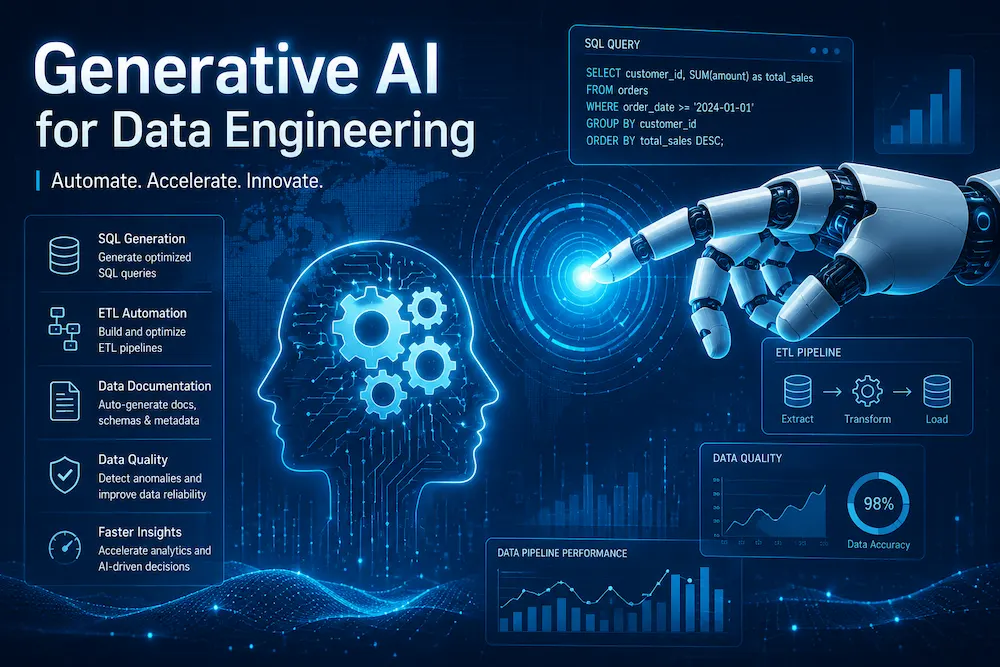

Traditionally, data engineers spend a significant amount of time writing SQL queries, building ETL pipelines, documenting workflows, resolving data quality issues, and maintaining infrastructure. While these tasks are essential, they often leave little room for innovation and strategic work.
Generative AI is changing this landscape. Instead of replacing data engineers, it acts as an intelligent generative ai development services assistant capable of automating repetitive tasks, accelerating development, improving code quality, and helping organizations build more efficient data ecosystems. As enterprises continue investing in AI-driven transformation, Generative AI is becoming a valuable tool for modern data engineering teams.
What Is Generative AI for Data Engineering?
Generative AI for data engineering refers to the use of Large Language Models (LLMs) and AI-powered development tools to assist with designing, building, managing, and optimizing data engineering workflows. These systems understand natural language prompts and generate SQL queries, Python scripts, ETL workflows, documentation, data transformations, and even recommendations for improving pipeline performance.
Rather than manually writing every line of code, data engineers can describe their requirements in plain English and allow AI to generate an initial solution. Engineers then validate, customize, and optimize the output before deploying it into production.
This collaborative approach significantly improves productivity while maintaining human oversight over business logic, governance, and security.
Why Data Engineering Needs Generative AI
Enterprise data environments have grown far more complex than they were just a few years ago. Organizations are now managing structured databases, data lakes, streaming platforms, APIs, cloud warehouses, and real-time analytics systems simultaneously. Every new business initiative generates additional data that must be cleaned, transformed, validated, and integrated.
As demand for AI-powered applications increases, data engineering teams often struggle to keep pace with growing workloads. Manual coding, documentation, and pipeline maintenance slow development cycles and increase operational costs.
Generative AI addresses these challenges by reducing repetitive work and enabling engineers to focus on architecture design, optimization, governance, and business innovation instead of routine coding tasks.
How Generative AI Improves Data Engineering Workflows
One of the most valuable applications of Generative AI is SQL generation. Instead of manually creating complex database queries, engineers can simply describe the information they need. AI converts those requests into optimized SQL statements, reducing development time while improving query consistency.
Generative AI also simplifies ETL development. Building extraction, transformation, and loading pipelines often requires extensive coding and testing. AI can generate reusable pipeline templates, recommend transformation logic, and even identify optimization opportunities based on historical development patterns.
For an example of a cloud data pipeline, see how AWS Lambda interacts with Databricks on AWS to trigger a job when a new file arrives in Amazon S3.
Documentation has long been one of the least enjoyable aspects of data engineering. Unfortunately, outdated documentation often creates operational risks and slows collaboration between teams. AI can automatically generate pipeline documentation, data dictionaries, schema explanations, API documentation, and workflow summaries, making enterprise knowledge easier to maintain.
Another important capability is data quality management. AI-powered systems can identify missing values, duplicate records, inconsistent formats, schema mismatches, and unusual data patterns before they affect downstream reporting or machine learning models. Instead of manually reviewing datasets, engineers receive intelligent recommendations that accelerate issue resolution.
Enterprise Use Cases Across Industries
Organizations across industries are already integrating Generative AI into their data engineering operations.
In healthcare, AI helps engineering teams process electronic health records, standardize clinical data, automate documentation, and improve reporting accuracy while supporting regulatory compliance.
Financial institutions use Generative AI to automate fraud analysis pipelines, improve risk reporting, accelerate regulatory documentation, and optimize financial data integration across multiple systems.
Manufacturing companies rely on AI-powered data engineering to combine information from IoT sensors, MES platforms, ERP systems, and production equipment. This enables predictive maintenance, quality monitoring, and production optimization without requiring extensive manual data preparation.
Retail organizations leverage Generative AI to automate customer data processing, inventory analytics, recommendation systems, and sales forecasting. Faster data engineering directly improves decision-making and customer experiences.
Supply chain organizations benefit from AI-generated data pipelines that consolidate logistics data, warehouse information, supplier performance metrics, and transportation analytics into unified reporting environments.
Traditional Data Engineering vs Generative AI
| Capability | Traditional Data Engineering | Generative AI-Powered Data Engineering |
|---|---|---|
| SQL Development | Manual query writing | AI-generated SQL from natural language prompts |
| ETL Pipeline Creation | Built manually by engineers | AI-assisted pipeline generation with reusable templates |
| Data Documentation | Time-consuming manual documentation | Automatically generated documentation and metadata |
| Data Quality Checks | Manual validation rules | AI detects anomalies, duplicates, and missing values |
| Code Generation | Written from scratch | Generates SQL, Python, Spark, and PySpark code |
| Development Speed | Moderate | Significantly faster development cycles |
| Developer Productivity | Limited by manual effort | Higher productivity through AI assistance |
| Scalability | Requires larger engineering teams | Supports faster scaling with smaller teams |
| Maintenance | Manual monitoring and updates | AI-assisted monitoring and optimization |
| Business Impact | Slower delivery of analytics | Accelerates AI, analytics, and business decision-making |
Best Practices for Successful Implementation
Although Generative AI offers significant advantages, organizations should implement it thoughtfully. AI-generated code should always be reviewed by experienced engineers before deployment to ensure accuracy, security, and compliance with internal standards.
Businesses should also establish governance policies that define how AI tools access enterprise data. Sensitive customer information, financial records, and proprietary business data should be protected using secure enterprise AI platforms rather than public AI development team services.
Another best practice is to begin with low-risk automation opportunities such as documentation, SQL generation, or internal analytics before expanding AI into production-critical workflows. This allows teams to build confidence while measuring productivity improvements.
Organizations that invest in employee training also achieve better outcomes. Data engineers who understand prompt engineering and AI-assisted development techniques can generate higher-quality results and integrate AI more effectively into daily workflows.
Why Skilled Generative AI Engineers Still Matter
While Generative AI can automate many routine tasks, enterprise data engineering services still requires experienced professionals who understand architecture, governance, scalability, and security. AI cannot independently design enterprise-grade data platforms, integrate complex business systems, or make strategic technology decisions.
Experienced Generative AI engineers understand how to combine Large Language Models, Retrieval-Augmented Generation (RAG), vector databases, cloud platforms, and modern data architectures into production-ready solutions that align with business objectives.
For organizations planning enterprise AI initiatives, partnering with experienced professionals or choosing to hire Generative AI engineers can significantly accelerate implementation while reducing technical risks and long-term maintenance costs.
Conclusion
Generative AI is rapidly becoming an essential component of modern data engineering. By automating repetitive development tasks, improving documentation, accelerating pipeline creation, and enhancing data quality, AI enables engineering teams to focus on innovation rather than manual effort.
However, successful adoption depends on more than simply introducing AI tools. Organizations need strong governance, skilled engineers, and a clear implementation strategy to realize long-term value. As data continues to drive digital transformation, businesses that combine Generative AI with experienced engineering expertise will be better positioned to build scalable, intelligent, and future-ready data platforms.
FAQs
No. Generative AI enhances productivity by automating repetitive tasks, but experienced data engineers remain essential for architecture design, governance, security, and validation.
The primary benefits include faster development, improved productivity, better documentation, enhanced data quality, lower operational costs, and accelerated analytics initiatives.
Healthcare, finance, manufacturing, retail, logistics, insurance, and technology companies are among the industries seeing significant value from AI-assisted data engineering.
Organizations typically begin by identifying repetitive engineering tasks, selecting secure AI platforms, implementing governance policies, and working with experienced Generative AI engineers to build scalable enterprise solutions


![How to Build an Enterprise Knowledge Base for AI Agents [5-Step Guide]](https://www.intellectyx.com/wp-content/uploads/2026/09/enterprise-knowledge-base-methodology-ai-agents-768x432.webp)