
Enterprises have spent years building data lakes to centralize information from applications, transactions, operations, customers, machines, documents, and digital platforms. Yet having large volumes of enterprise data does not automatically mean that data is ready for generative AI.
A GenAI application needs more than access to stored information. It needs to find the right data, understand its context, respect user permissions, retrieve current information, and distinguish trusted enterprise knowledge from outdated or irrelevant content.
That makes generative AI data lake implementation as much a data architecture and governance challenge as an AI development project.
The question enterprises should be asking is no longer simply, “Do we have enough data?” It is: Can our AI systems reliably access and use the right data in production?
If the answer is unclear, evaluating AI data readiness before scaling Generative AI development can prevent expensive architecture and implementation problems later.
What Is an AI-Ready Enterprise Data Lake?
An AI-ready enterprise data lake is a governed data foundation that makes structured and unstructured enterprise information accessible, discoverable, contextualized, secure, and usable by machine learning, generative AI, and AI agents. It combines enterprise data with metadata, quality controls, permissions, retrieval capabilities, and integrations required for production AI.
What Makes a Data Lake AI-Ready?
Traditional data lakes were largely designed to consolidate information for analytics, reporting, data science, and machine learning. Generative AI introduces different requirements.
Consider an enterprise knowledge assistant answering a question about a customer’s contract.
The contract may exist in document storage. Customer information may be in CRM. Pricing could come from ERP. Updated commercial policies may be stored in a knowledge repository.
Simply giving an LLM access to one of those sources does not provide enough context.
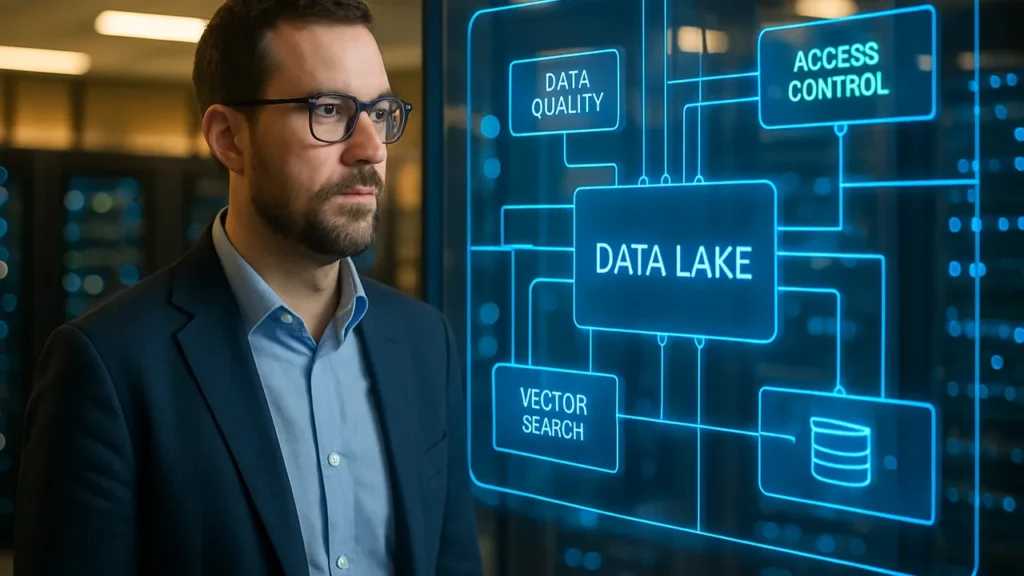
An AI-ready architecture needs to make relevant information discoverable across these environments while preserving metadata, relationships, permissions, and freshness.
Unstructured information becomes especially important. Contracts, manuals, PDFs, policies, engineering documentation, emails, reports, support conversations, and knowledge articles contain valuable enterprise context that traditional analytical pipelines may not have been designed to serve.
Data quality is equally important. Duplicate documents, conflicting business definitions, outdated policies, missing metadata, and inconsistent records can all reduce the reliability of AI-generated answers.
Finally, access must remain governed. An employee should not receive confidential information through an AI assistant simply because that information happens to exist somewhere in the enterprise data estate.
For a practical example of event-driven data integration, see how AWS Lambda interacts with Databricks on AWS when new data arrives in Amazon S3.
Traditional Data Lake vs. AI-Ready Enterprise Data Lake
The distinction is not primarily about storing more data. It is about making data usable by AI safely and reliably.
| Capability | Traditional Data Lake | AI-Ready Enterprise Data Lake |
|---|---|---|
| Primary purpose | Data storage and analytics | Analytics and production AI |
| Data coverage | Primarily analytical datasets | Structured and unstructured data |
| Metadata | Cataloging and technical metadata | Rich technical and business context |
| Retrieval | Queries and pipelines | Query, semantic search and AI retrieval |
| Governance | User/application access | User, model and agent access |
| Data quality | Analytics-focused | AI reliability-focused |
| AI integration | Often added later | Designed into architecture |
| Agent access | Limited | Governed data and tool access |
An organization can therefore have a sophisticated data lake and still not have an AI-ready data foundation.
Not Sure If Your Data Lake Can Support Generative AI Yet?
Talk to Our AI TeamHow to Build an AI Data Lake Architecture: Best Practices
The most important architectural decision should happen before selecting a vector database or LLM.
Start With the AI Use Case
Begin with what the AI needs to accomplish.
An enterprise knowledge assistant may require policies, manuals, CRM information, and project documentation. A manufacturing maintenance agent could require machine telemetry, work orders, maintenance history, manuals, and spare-parts information.
These applications have different requirements for freshness, latency, permissions, retrieval, and integration.
Starting with the use case prevents the organization from spending months reorganizing data that the first AI application may never use.
Create Governed Access Across Enterprise Data
AI data architecture does not necessarily require moving every source into a single repository.
Enterprises can maintain information across data lakes, warehouses, operational databases, SaaS platforms, document repositories, ERP, CRM, and other systems while establishing governed mechanisms through which AI applications can retrieve approved information.
This becomes particularly valuable in complex organizations where replacing established data platforms would be impractical.
Add Metadata and Business Context
An AI system needs to know more than where a file is stored.
Who owns it? What customer, product, asset, or process does it relate to? When was it updated? Is it authoritative? Who is allowed to access it?
Metadata, data catalogs, lineage, entity relationships, and semantic definitions help transform stored information into usable enterprise context.
Prepare Unstructured Data for Retrieval
Generative AI increases the importance of documents and text-heavy enterprise information.
Documents may need to be parsed, cleaned, segmented, enriched with metadata, indexed, and made searchable through semantic retrieval.
Embeddings and vector search can be valuable here, but they should be treated as components of the architecture rather than the architecture itself.
Design Governance From the Beginning
AI access should reflect enterprise permissions.
Sensitive data classification, identity, authorization, lineage, retention requirements, auditability, and policy enforcement should be considered before GenAI applications reach production.
This becomes even more important when AI agents can use tools or interact with enterprise applications.
Generative AI Data Lake Implementation: From Foundation to Production
A practical generative AI data lake implementation can be organized around seven stages.
First, define a specific AI business use case. Determine the user, workflow, problem, and measurable outcome the application will support.
Second, identify the information required to accomplish that task. Instead of asking what data exists, ask what data the AI actually needs.
Third, assess whether those sources are ready. Examine accessibility, quality, metadata, freshness, permissions, completeness, and integration requirements.
Fourth, establish the AI retrieval and data-access layer. This is where the application gains controlled access to the information required for its task.
Fifth, enforce security and governance so that AI applications retrieve only information permitted for the user, model, or agent.
Sixth, integrate the AI application with the workflow where people actually work.
Finally, evaluate continuously. Retrieval quality, answer grounding, freshness, latency, access behavior, AI performance, cost, and business outcomes all need monitoring.
This approach keeps the architecture tied to business value rather than turning data modernization into an open-ended infrastructure program.
If your enterprise already has a GenAI use case but is uncertain whether the underlying data can support it, a focused AI and data-readiness assessment can identify the gaps before development begins.
Generative AI Data Lake Integration Strategies
There is no single correct way to connect GenAI with enterprise data.
Retrieval-augmented generation (RAG) is useful when an AI application needs to retrieve relevant enterprise information and provide that context to a language model before generating an answer.
Semantic and vector retrieval can help identify relevant information based on meaning rather than requiring exact keyword matches. This is especially useful across documents and knowledge repositories.
APIs and enterprise connectors can provide access to current information held inside operational applications. A customer-service AI, for example, may need live CRM information rather than a copy that was loaded into the data lake several days earlier.
Real-time or event-driven integration becomes important when AI decisions depend on changing operational conditions.
A hybrid approach will often be the most practical generative AI data lake integration strategy. Some data can remain within existing enterprise applications while an AI data layer provides controlled retrieval across multiple sources.
The correct pattern depends on three questions: what does the AI need to know, how current must that information be, and what is the AI permitted to access?
How Generative AI Uses an Enterprise Data Lake
Consider an enterprise knowledge AI application.
An employee asks how a particular company policy applies to a customer situation. The AI may need to search current policy documents, customer information, approved procedures, and previous internal guidance.
The quality of the response depends on more than the LLM. If retrieval surfaces an obsolete policy or the system ignores the user’s access rights, the answer may be confidently wrong or expose restricted information.
Now consider a manufacturing maintenance agent.
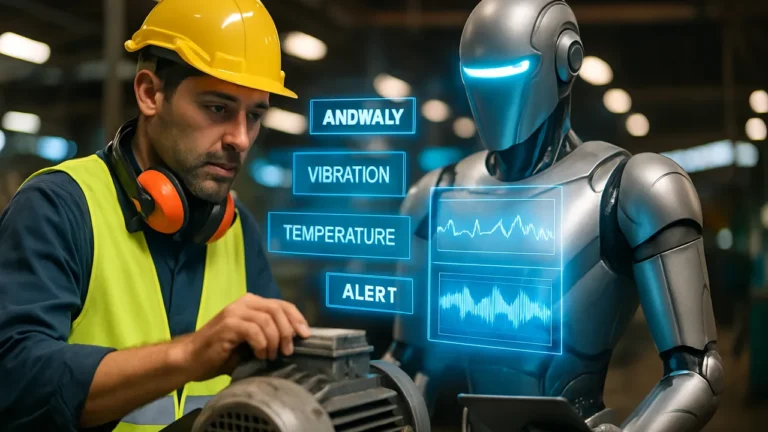
A machine begins showing abnormal vibration. The AI agent may need sensor history, previous work orders, equipment manuals, maintenance procedures, operating conditions, and parts information to investigate the issue.
The data foundation makes this possible. The agent provides the reasoning and workflow layer around it.
The same architecture can support financial research assistants, customer-service copilots, supply chain intelligence, compliance applications, and other enterprise AI use cases.
Can AI Agents Set Up and Manage a Data Lake?
AI agents can increasingly assist data engineering teams, but fully autonomous management of critical enterprise data infrastructure should be approached carefully.
An agent could monitor data pipelines, investigate failed jobs, detect schema changes, identify data-quality anomalies, enrich metadata, classify datasets, update documentation, or recommend remediation.
For example, imagine that a source-system change causes a nightly ingestion pipeline to fail.
Instead of waiting for an engineer to manually inspect logs across several tools, an AI agent could identify the failed pipeline, review recent schema changes, retrieve previous incidents, determine the probable cause, and recommend a fix.
That can significantly reduce investigation effort.
It does not mean the agent should automatically modify production pipelines, delete data, or change security policies without appropriate controls.
The stronger near-term model is an AI data operations layer that helps data teams detect, investigate, document, and resolve problems faster while maintaining human approval for consequential changes.
What Can Go Wrong With Generative AI Data Lake Implementation?
One common mistake is connecting GenAI directly to poor-quality enterprise data. The model cannot compensate reliably for outdated, contradictory, or poorly contextualized source information.
Another is ignoring permissions during retrieval. Security controls at the application interface are not enough if the underlying retrieval system can surface restricted content.
Enterprises can also over-focus on vector databases. Vector search is valuable for semantic retrieval, but it does not replace data governance, metadata, integration, lineage, quality management, or operational data access.
The opposite problem is attempting to modernize everything before deploying anything.
An enterprise can spend years creating the theoretically perfect data architecture while delivering no AI outcome. A use-case-led implementation creates a much tighter connection between architecture investment and business value.
AI-Ready Enterprise Data Lake Checklist
Before scaling enterprise GenAI, evaluate your current foundation:
- Have you defined the AI use cases the data foundation must support?
- Can AI applications discover the required enterprise information?
- Can they access both structured and unstructured data?
- Does the data contain sufficient metadata and business context?
- Can you measure and monitor data quality?
- Are sensitive datasets classified appropriately?
- Can permissions be enforced during AI retrieval?
- Can AI access information at the freshness required by the use case?
- Can AI agents receive narrowly controlled data and tool access?
- Can you monitor retrieval, model performance, data changes, and business outcomes?
If several answers are no, the organization may have a functioning enterprise data lake, but it does not yet have an AI-ready data foundation.
How to Start Building an AI-Ready Data Foundation
Do not begin by trying to make every enterprise dataset AI-ready.
Choose one valuable AI application.
Suppose the first use case is an enterprise knowledge assistant for operations teams. Identify the five or six information sources needed to answer the highest-value questions. Assess their quality, permissions, metadata, and freshness.
Then build the retrieval and governance capabilities required for that application and measure whether employees receive accurate, useful, permission-aware answers.
The architecture components proven through that implementation can then be reused for additional copilots, GenAI applications, and AI agents.
This creates a more practical path from enterprise data modernization to measurable AI value.
How Intellectyx Helps Enterprises Prepare Data for Generative AI
Intellectyx helps enterprises connect AI strategy, data engineering, AI development, enterprise knowledge, integration, and production deployment.
The approach starts with the AI opportunity rather than assuming an organization needs to replace its existing data environment. Intellectyx is model-independent and works with existing ERP, CRM, and enterprise systems rather than requiring a rip-and-replace approach.
For generative AI data lake implementation, that means identifying the data required by the use case, addressing readiness gaps, establishing governed access and retrieval, and connecting the resulting data foundation to production AI applications and agents.
The goal is not simply to make more enterprise data available to AI. It is to make the right data reliable, contextualized, governed, and usable at the point where AI creates business value.
Conclusion
An AI-ready enterprise data lake is not defined by how much information it stores.
It is defined by whether AI applications can reliably discover, retrieve, understand, and use approved enterprise information in the context of a real business workflow.
Successful generative AI data lake implementation therefore requires data quality, metadata, semantic context, retrieval, integration, governance, permissions, monitoring, and a clear connection to the AI use case.
AI agents make this foundation even more important. As AI moves from answering questions toward investigating problems and coordinating workflows, the quality and governance of the underlying enterprise data directly influence what those agents can accomplish safely.
Enterprises do not need to make every dataset AI-ready at once. Start with a valuable use case, identify the information it requires, close the most important readiness gaps, prove the architecture, and expand from there.
Is Your Enterprise Data Ready for Production AI?
Connect with our AI experts to assess your data foundation and build a practical path from enterprise data to production GenAI.
Build a Generative AI Foundation That Passes Governance Review
Schedule a Readiness AssessmentFAQs
A scoped pilot on a well-governed dataset can launch in 3 to 4 months following an assessment and remediation phase. Enterprise-wide expansion across multiple domains typically takes 9 to 18 months depending on data complexity and governance maturity.
Most organizations can upgrade their existing lake by adding a vector store, tightening access governance, and standardizing metadata, rather than rebuilding from scratch. A full rebuild is usually only necessary when the current architecture has severe structural or compliance issues.
A data lake stores raw, unstructured data with minimal schema enforcement, while a lakehouse adds structured querying, ACID transactions, and often built-in support for embeddings. Lakehouses are generally better suited to generative AI workloads that mix structured and unstructured data.
Costs vary widely based on data volume, existing infrastructure maturity, and scope, but most enterprises underestimate the data engineering and governance remediation work, which often represents the largest cost component rather than the AI model itself.
Teams with strong existing data engineering capacity can often handle remediation in-house, while organizations lacking mature governance or vector search experience typically move faster with an experienced implementation partner guiding architecture decisions.
Any organization planning to deploy generative AI on internal or customer data needs to assess readiness, regardless of size, though the scope of remediation work scales with data volume and the number of existing silos.
Run automated data quality checks measuring completeness, duplication, and freshness against the specific datasets feeding your pilot use case, and use the readiness scorecard framework to benchmark before committing to a production rollout.