

Banks already have fraud models, transaction-monitoring systems, rules engines, customer data, device intelligence, and case-management platforms. The difficult part is getting them to work together fast enough to influence a transaction while it is still in flight.
This is where AI orchestration in banking becomes useful. Instead of treating fraud detection as a single model call, fraud detection AI agents can coordinate the complete decision path: transaction ingestion, contextual enrichment, model inference, policy checks, risk scoring, response, human escalation, and monitoring.
The objective is not simply to generate a fraud probability. It is to turn that probability into the right action, at the right time, with the right controls.
Microsoft’s current fraud-detection reference architecture follows this pattern: streaming transactions are captured across financial channels, enriched with customer and behavioral context, scored by machine-learning models, and routed to alerts and operational responses.
How Do Banks Use AI Orchestration to Coordinate Fraud Detection Model Inference With Real-Time Transaction Monitoring?
The simplest way to understand the architecture is:
Transaction → Detect → Enrich → Infer → Decide → Act → Monitor
AI orchestration controls how information and decisions move through these stages.
A payment entering the bank’s infrastructure generates an event. The orchestration layer determines which contextual information is required, retrieves the relevant features, sends them to the appropriate fraud model, receives the inference result, applies risk and business rules, and routes the transaction toward the correct response.
AWS documents a comparable pattern for card payments: an authorization request makes a real-time call for fraud scoring, the request is enriched with historical customer and merchant information, an ML model produces a fraud score, and that result is returned to the authorization system for the transaction decision.
The result is a coordinated fraud workflow rather than a collection of disconnected models.
What Happens Between a Transaction and a Fraud Decision?
The Basel Committee states that banks should maintain monitoring systems appropriate to their size, activities, complexity, and risk profile. For many banks, particularly internationally active institutions, effective transaction monitoring is likely to require automated monitoring.
1. Capture the transaction in real time
The process starts when a bank receives an event such as:
- Card payment
- Account transfer
- ATM withdrawal
- New beneficiary
- Login or authentication event
- Account-profile change
Real-time transaction monitoring ai agents evaluate these events as they occur instead of waiting for batch analysis.
Microsoft’s architecture, for example, continuously ingests events from mobile banking, ATMs, e-commerce and call-center channels.
2. Enrich the transaction with context
A $5,000 transfer alone says relatively little about fraud.
The system may need to know:
Who initiated it?
Is the device recognized?
Is the beneficiary new?
Does the transaction match normal behavior?
Did the customer recently change credentials?
The orchestration layer can retrieve customer profiles, transaction history, device information, behavioral signals, location and other permitted contextual data before model inference.
This is important because fraud risk often comes from the relationship between signals, not one field in isolation.
3. Invoke the right fraud model
Not every transaction needs every model.
A bank could operate separate models for:
- Card fraud
- Account takeover
- Transaction anomalies
- Scam detection
- Beneficiary risk
- Mule-account activity
The orchestration layer determines which inference services are relevant.
For example:
Card transaction → Card Fraud + Device Risk + Behavioral Model
while:
New beneficiary transfer → Account Takeover + Beneficiary Risk + Scam Model
This selective routing can help control both processing overhead and latency.
Why Isn’t a Fraud Model Alone Enough?
A fraud model answers something similar to:
How risky does this transaction appear?
The bank still needs to answer:
What should we do about it?
Imagine a model returns:
Fraud probability: 0.87
That score needs context and policy.
A simplified decision framework might be:
| Risk | Result | Possible Response |
|---|---|---|
| Low | Low risk detected | Continue transaction |
| Moderate | Moderate risk detected | Apply additional authentication |
| High | High risk detected | Hold and investigate |
| Critical + policy trigger | Critical risk or policy violation | Block or escalate |
Ready to Coordinate Fraud Detection Across Every Channel?
Talk to Our AI TeamThese thresholds are illustrative rather than universal banking rules.
The important distinction is that model inference produces intelligence; orchestration coordinates the decision and subsequent workflow.
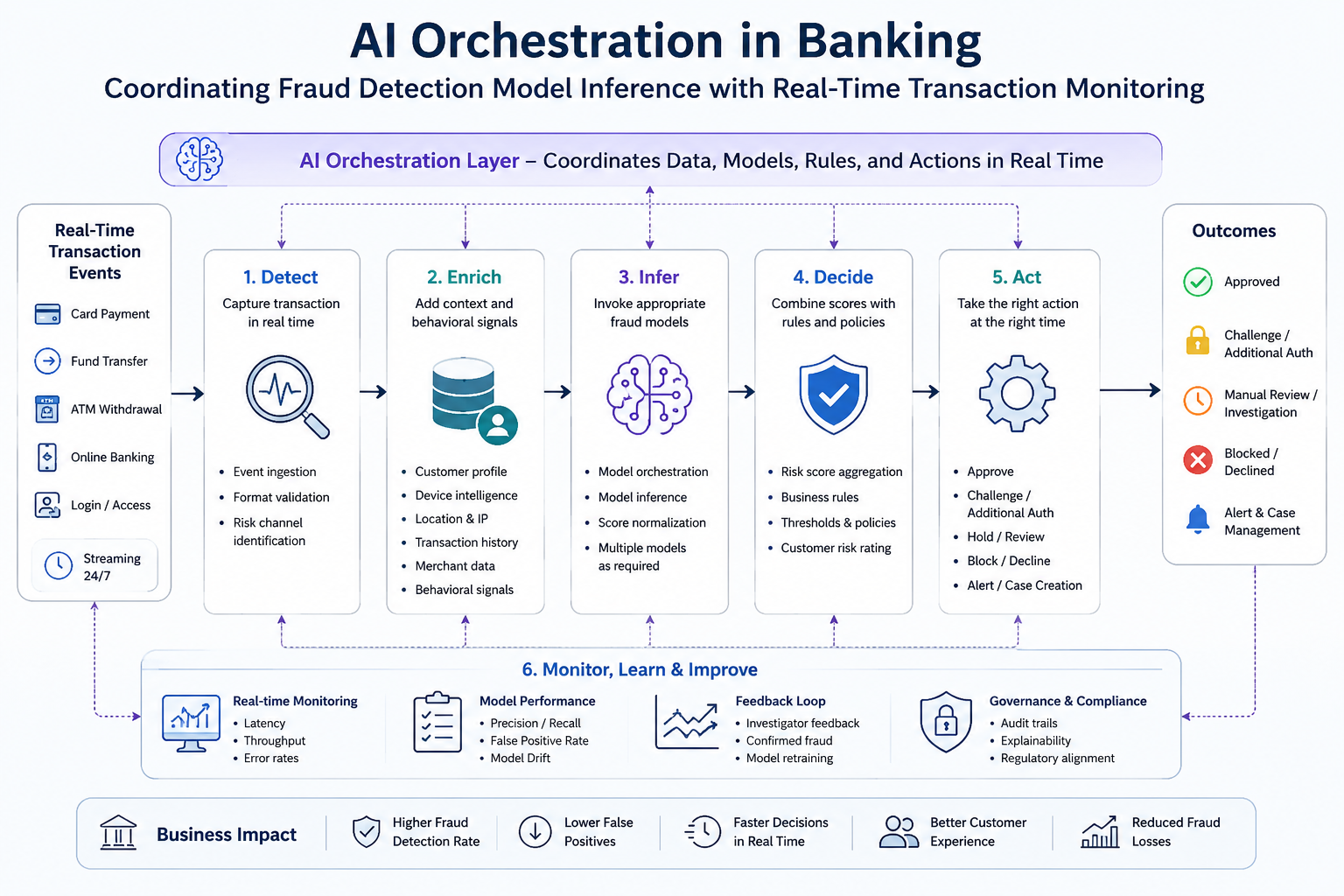
The Detect-Enrich-Infer-Decide Framework
Banks planning fraud orchestration can use this seven-stage framework:
Detect
Capture transaction and behavioral events as they occur.
Enrich
Add permitted customer, device, identity, account and historical context.
Infer
Route the transaction to the appropriate fraud-detection models.
Decide
Combine model outputs with business rules, thresholds, policies and risk controls.
Act
Approve, challenge, hold, notify, investigate or escalate.
Explain
Record which signals, model outputs, rules and approvals contributed to the decision.
Learn
Use confirmed fraud outcomes and investigator feedback to support model evaluation and improvement.
This framework makes the orchestration layer a control plane for fraud decisioning, rather than simply middleware between applications.
How Can Banks Coordinate Multiple Fraud Models Without Slowing Transactions?
Banks should not assume better fraud detection means running every available model against every transaction.
Real-time systems operate within latency constraints. IBM notes that real-time fraud detection requires fast, scalable inference and that even milliseconds of latency can affect customer experience and risk exposure.
Banks can therefore design different processing paths.
For example:
Known device + expected amount + familiar merchant
→ Lightweight scoring
versus:
New device + high-value payment + new beneficiary + unusual location
→ Additional enrichment + multiple risk models + stronger controls
Possible architecture techniques include precomputed features, model routing, cached context, asynchronous processing for noncritical signals, and separating low- and high-risk decision paths.
The goal is not maximum inference.
It is appropriate inference for each transaction’s risk context.
Practical Example: High-Value Transfer to a New Beneficiary
Consider a hypothetical customer initiating a high-value transfer to a beneficiary they have never used before.
Problem: The transaction deviates from the customer’s established payment behavior.
Input: Transaction amount, beneficiary history, device fingerprint, login behavior, location and account history.
AI process: The orchestration layer invokes relevant account-takeover, behavioral and transaction-risk models.
Decision: Model outputs are combined with the bank’s risk policies.
Human control: An ambiguous high-risk result can trigger additional authentication or fraud-analyst review rather than an automatic block.
Output: Approve, challenge, hold or escalate.
Business KPIs: Fraud capture rate, false-positive rate, decision latency and analyst-review rate.
The key measurement isn’t how many alerts AI generates. It is whether the bank makes better fraud decisions without creating unnecessary friction for legitimate customers.
What Happens After AI Detects Potential Fraud?
The same principle applies across lending workflows, where AI for mortgage underwriting and fraud detection can connect risk signals with document analysis, underwriting processes, and fraud controls rather than treating fraud detection as an isolated model.
AI orchestration can extend beyond inference into:
Detection → Alert → Enrichment → Case Creation → Prioritization → Investigation → Resolution
This is increasingly relevant as agentic AI enters fraud operations. In March 2026, IBM announced agentic capabilities for Safer Payments that allow AI agents to query trusted real-time fraud intelligence while assessing transactions, alerts and emerging threat patterns.
That doesn’t mean an agent should autonomously make every high-impact decision.
Instead, an agent might gather transaction history, correlate behavioral signals, prepare an investigation summary and route the case to the appropriate analyst.
The analyst then spends less time collecting evidence and more time making the decision.
Where Should Human Oversight Remain?
The right principle for banking is:
Appropriate autonomy > maximum autonomy.
Human review remains particularly important when:
- Model outputs conflict
- Confidence is low
- Transactions have significant customer impact
- An account restriction is being considered
- Activity falls outside known patterns
- Regulatory or financial-crime escalation may be required
Basel Committee guidance emphasizes risk-based ongoing transaction monitoring and systems capable of identifying unusual or suspicious activity.
Banks should therefore define permissions, thresholds, escalation paths, audit trails and human approval requirements before increasing automation. These controls are also fundamental to secure financial transactions with autonomous AI agents, where identity, least-privilege access, real-time fraud checks, approval gates, and audit trails work together to constrain transaction execution.
AI orchestration also needs lifecycle governance, not just model accuracy. NIST’s AI Risk Management Framework organizes AI risk management around four functions—Govern, Map, Measure, and Manage and treats risk management as an ongoing activity throughout the AI lifecycle.
How Should Banks Measure Fraud Orchestration?
Start with the existing operational baseline.
| Objective | KPI |
|---|---|
| Catch fraud | Fraud capture/detection rate |
| Reduce customer friction | False-positive rate |
| Make faster decisions | Decision latency |
| Improve investigations | Case-handling time |
| Improve analyst productivity | Alerts/cases per analyst |
| Control losses | Fraud losses |
| Maintain model quality | Precision, recall and drift |
| Maintain reliability | Failed inference/tool calls |
One metric should never be optimized in isolation.
For example, a system could increase fraud detection by blocking more legitimate transactions. That might improve one number while degrading customer experience.
What Commonly Goes Wrong With AI Orchestration in Banking?
Disconnected data: Models cannot access timely or consistent features.
Too many model calls: Every transaction invokes every model, increasing latency and infrastructure cost.
Conflicting outputs: Multiple models and rules disagree without a clear decision hierarchy.
Detection without response: The bank identifies suspicious activity quickly, but case handling remains manual and fragmented.
Poor explainability: Investigators cannot reconstruct why a decision occurred.
Overautomation: High-impact actions occur without sufficient controls.
Weak production monitoring: Model drift, inference failures, latency degradation or agent errors go undetected.
The architecture therefore has to coordinate not only AI, but also data, policy, people and operational controls.
Expert perspective: Michael S. Barr has emphasized that banks remain responsible for managing risks associated with the AI they use, including understanding third-party AI tools sufficiently to exercise appropriate controls.
Read Michael S. Barr’s remarks on AI, fintechs and banks
How Intellectyx Helps Banks Build Coordinated AI Fraud Workflows
Intellectyx helps financial institutions design and operationalize AI workflows across data, models, enterprise systems, decision logic and human controls.
For a fraud-orchestration initiative, this can begin with mapping the existing transaction-monitoring and fraud-investigation workflow, identifying integration and latency bottlenecks, assessing data readiness, and defining where predictive models, AI agents development and human reviewers should participate.
Relevant capabilities include Agentic AI Strategy, custom AI agent development, data engineering, enterprise integration and AgentOps. AgentOps becomes particularly important after deployment for monitoring reliability, performance, governance and agent behavior.
The objective isn’t to replace a bank’s existing fraud stack unnecessarily. It is to determine how existing and new AI capabilities can operate as a coordinated, governed fraud workflow.
Connect with Intellectyx’s AI experts to assess where orchestration could strengthen your fraud detection and response architecture.
Conclusion
Banks don’t need to treat real-time transaction monitoring, fraud models, rules engines and investigations as separate AI projects.
AI orchestration in banking provides the coordination layer that connects them:
Transaction → Context → Model Inference → Risk Policy → Action → Human Oversight → Monitoring
The strongest architecture isn’t necessarily the one running the most models. It’s the one that invokes the right intelligence at the right moment, converts it into an appropriate action, preserves human control where necessary, and continuously measures both fraud performance and customer impact.
FAQs
AI is creating measurable value in banking where it improves high-volume, data-intensive workflows such as fraud detection, transaction monitoring, anti-money-laundering analysis, risk assessment, customer service, and document processing. For fraud specifically, value should be measured through fraud capture rates, false positives, decision latency, losses prevented, and investigation time—not simply the number of AI models deployed. BIS has highlighted fraud and money-laundering detection among real-world banking AI/ML applications.
When fraud represents a tiny fraction of transactions, accuracy alone becomes misleading because a model can classify nearly everything as legitimate and still appear highly accurate. Teams should consider class weighting or carefully controlled resampling, anomaly-detection approaches, appropriate validation strategies, and metrics such as precision, recall, PR-AUC, and false-positive rate. A BIS study demonstrates a layered approach that first identifies unusual payments and then applies anomaly detection to that smaller population.
Costs vary widely based on transaction volume, number of channels, and whether the bank builds in-house or partners with a vendor. Most banks start with a pilot on one channel before committing to full-scale rollout costs, which helps control initial investment.
AI can detect transaction fraud by comparing each transaction with historical patterns, account behavior, device signals, location, transaction value, frequency, identity information, and other risk indicators. Machine-learning models generate risk or anomaly scores, which can then be combined with rules and policies to approve, challenge, hold, or escalate transactions. Real-time monitoring allows this evaluation to happen while transactions are being processed.
Yes. Banks can use commercial fraud platforms or build custom ML systems that score transactions in or near real time. Examples include IBM Safer Payments and architectures built with cloud ML and streaming services. The right approach depends on transaction volume, latency requirements, existing fraud systems, available data, explainability, integration requirements, and regulatory controls.
Banks typically see fewer false positives, reduced investigator workload from lower-quality alert volume, and faster fraud case resolution, though exact returns depend on transaction volume and how mature the existing fraud stack was before orchestration.