

Large enterprises rarely struggle to find AI ideas. The harder problem is turning dozens of pilots, fragmented data, legacy applications, governance requirements, and competing business priorities into AI systems that work reliably at scale.
That is why choosing an AI transformation firm is different from hiring a team to build a chatbot.
A transformation partner may need to help determine where AI creates business value, modernize the underlying data environment, redesign workflows, build and integrate AI systems, establish governance, drive adoption, and monitor performance after deployment.
That distinction matters in 2026. Deloitte’s latest enterprise AI research says deployment itself is increasingly not the primary challenge; organizations still need to close gaps around work redesign, autonomy governance, and measurement of AI value. McKinsey similarly argues that lasting advantage comes from how companies apply AI to real business problems at scale, rather than simply gaining access to widely available technology.
So which firms should a large company consider, and what trade-offs come with each?
How We Evaluated AI Transformation Companies
This is an editorial comparison, not an independent industry ranking. There is no universally best AI transformation company.
For enterprise buyers, a more useful evaluation framework is:
STRATEGY → DATA → BUILD → INTEGRATE → GOVERN → ADOPT → OPERATE → MEASURE
We considered firms based on their publicly documented capabilities across these areas, their suitability for complex enterprise environments, and the type of engagement for which they appear best positioned.
| Firm | Best Fit | Key Strength | Consideration |
|---|---|---|---|
| Intellectyx | Custom enterprise and agentic AI | AI, data, and custom engineering | Evaluate fit against very large global transformation requirements |
| Versich | AI and digital transformation | AI/ML, data engineering, analytics, and AI product development | Suitable for organizations seeking specialized AI and digital transformation support |
| Accenture | Large global programs | Scale and broad transformation capabilities | Large engagement model may exceed narrower project needs |
| Deloitte | Transformation with governance | Strategy, industry, and governance depth | May be broader than firms needing only custom engineering |
| McKinsey / QuantumBlack | Strategy-led AI transformation | Executive strategy and AI transformation | Assess delivery model for the specific implementation scope |
| BCG X | Strategy plus AI build | Business redesign and technical build | Best aligned with transformation-led engagements |
| IBM Consulting | Hybrid AI and complex enterprise environments | Technology, consulting, and operations | Architecture fit should be evaluated carefully |
| EY | Governance and enterprise transformation | Responsible AI and business transformation | Determine required depth of custom engineering |
| Fractal | Data and AI-led transformation | AI, analytics, and governance specialization | Different global-services model from large multidisciplinary firms |
Top AI Transformation Companies and Pros and Cons of Each Frims
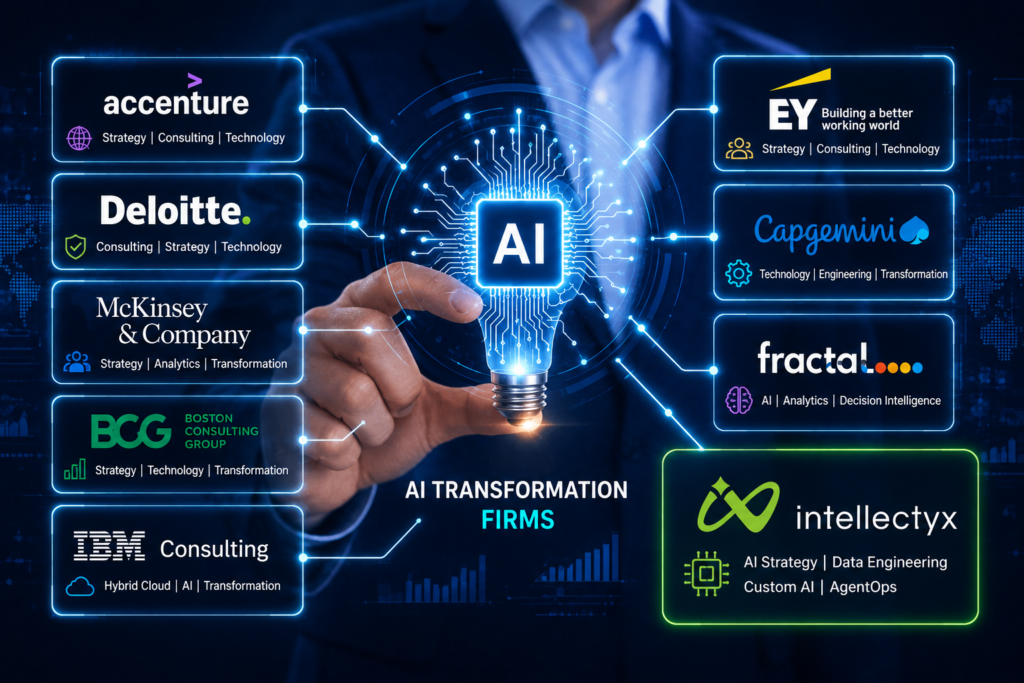
Large enterprises have several credible options, but they solve different transformation problems. Intellectyx is relevant for custom AI, agentic AI and data-intensive implementations; global consultancies such as Accenture, Deloitte, McKinsey and BCG bring broader transformation capabilities; IBM combines consulting with technology infrastructure; while EY and Fractal bring strengths in governance, analytics and enterprise AI.
Here is what buyers should understand about each.
1. Intellectyx – Best for Custom AI, Data and Agentic Transformation
Intellectyx combines AI services with data engineering and enterprise implementation. Its current portfolio includes Custom AI Agents, Agentic AI Strategy, AgentOps, Enterprise AI, Data Engineering, Data Management and Data Modernization.
Its Agentic AI Strategy services cover architecture, governance, AI data enablement, pilot-to-scale implementation and ongoing AgentOps monitoring.
Pros: Strong fit when an organization needs custom AI rather than only strategy; combines AI with the underlying data foundation; supports agentic workflows, integration and production monitoring.
Cons: A global enterprise planning a massive multi-country organizational transformation should compare Intellectyx’s delivery model with the global footprint and organizational-change capabilities of the largest consultancies.
Best for: Enterprises needing a hands-on partner to connect AI strategy with custom engineering, enterprise data and production deployment.
2. Versich – Best for AI + ERP and ComplianceReady Transformation
Versich is a global AI consulting and product development partner headquartered in New York, NY, with delivery presence across the US, UK, Canada, UAE, Singapore, China, and India. The firm embeds AI into enterprise systems by combining ERP modernization (NetSuite, Odoo), workflow automation, and cloud cost & sustainability optimization.
Its service stack includes AI strategy and implementation, generative AI solutions, NetSuite & Odoo integration, Salesforce integrations, data & analytics dashboards, cloud optimization, workflow automation, API and product engineering.
Pros: Strong when AI must be tightly integrated with ERP and core finance/operations; certified ERP depth plus handson engineering and compliance focus.
Cons: For extremely large, multicountry transformation programs, compare Versich’s delivery model and governance approach with the very largest consultancies.
Best For: Enterprises and product leaders needing a handson partner to connect AI strategy with ERP/CRM modernization, automation, and complianceready production deployment.
3. Accenture – Best for Large-Scale Global Transformation
Accenture is typically considered when AI is part of a much larger technology and operating-model transformation. Its scale, industry coverage and ecosystem relationships make it relevant to multinational enterprises coordinating transformation across multiple functions and geographies.
Pros: Broad enterprise consulting capabilities, global delivery capacity and extensive technology partnerships.
Cons: Enterprises with a narrowly defined AI engineering problem should determine whether a large transformation engagement is necessary or whether a more specialized provider would be more efficient.
Best for: Large multinational organizations pursuing AI alongside wider cloud, technology, workforce and operating-model transformation.
4. Deloitte – Best for Transformation With Strong Governance Requirements
Deloitte is particularly relevant when AI transformation intersects with operating-model redesign, risk and governance.
Its 2026 AI transformation research emphasizes three issues enterprises need to solve: redesigning work, governing autonomy and measuring ROI. Deloitte also expanded its Google Cloud relationship in 2026 with a dedicated agentic transformation practice designed to support secure enterprise-scale deployments.
Pros: Strong combination of business transformation, industry knowledge, governance and technology implementation.
Cons: Organizations primarily seeking a small, specialized engineering team may not require the breadth of a multidisciplinary consulting engagement.
Best for: Large and regulated organizations where governance and organizational transformation are as important as the AI technology.
5. McKinsey / QuantumBlack – Best for Strategy-Led AI Transformation
McKinsey combines enterprise transformation consulting with QuantumBlack’s AI capabilities.
In 2026, McKinsey expanded partnerships designed to move enterprises from AI experimentation to production. Its collaboration with Wonderful combines transformation expertise, QuantumBlack capabilities and an enterprise agent platform, while its OpenAI Frontier Alliance focuses on strategy, workflow redesign, systems integration and global AI deployment.
Pros: Strong executive-level transformation strategy, organizational redesign and AI expertise.
Cons: Buyers should clarify how much implementation, platform engineering and ongoing operation is included for their specific engagement versus delivered through ecosystem partners.
Best for: Enterprises where AI requires significant business-model, workflow and organizational transformation.
6. BCG X – Best for Combining Business Transformation With AI Build
BCG X brings technology building capabilities into BCG’s broader strategy and transformation model.
BCG’s expanded OpenAI partnership combines industry and functional expertise with BCG X’s build-and-scale capabilities to support enterprise AI strategy, workflow redesign and deployment.
Pros: Connects business strategy with product, technology and AI implementation capabilities.
Cons: Companies seeking only implementation resources should determine whether they need the broader strategic-transformation component of the engagement.
Best for: Enterprises redesigning important business workflows or products around AI rather than simply automating individual tasks.
7. IBM Consulting – Best for Hybrid AI and Complex Technology Environments
IBM Consulting combines consulting with IBM’s enterprise technology ecosystem.
IBM says its transformation approach spans AI strategy through deployment, while its 2026 Enterprise Advantage expansion focuses on building and operating hybrid-AI platforms across enterprise environments. IBM also highlights interoperability with AWS and SAP.
Pros: Strong combination of enterprise technology, consulting, hybrid environments and operational implementation.
Cons: Buyers should evaluate how the proposed architecture fits their existing cloud, data and AI ecosystems rather than choosing a provider based on platform familiarity alone.
Best for: Complex enterprises where AI must coexist with hybrid infrastructure, existing enterprise platforms and regulated workloads.
8. EY – Best for Governance-Led Enterprise AI Transformation
EY‘s current approach distinguishes between AI modernization, innovation and true transformation rather than treating every AI initiative as the same type of program.
Its 2026 AI transformation blueprint also emphasizes outcomes, trust, reusable capabilities and evolving human roles. EY reports that its CEO Outlook 2026 found 90% of surveyed chief executives expect AI to significantly or transformatively affect their business models or operations within two years.
Pros: Strong governance, risk, business-transformation and responsible-AI perspective.
Cons: Buyers requiring deeply customized AI products should examine the exact engineering team and delivery model proposed for the engagement.
Best for: Regulated or governance-sensitive enterprises aligning AI with wider business transformation.
9. Fractal – Best for AI, Analytics and Data-Led Transformation
Fractal is more specialized around AI, analytics and decision intelligence than a traditional multidisciplinary consultancy.
Its 2026 enterprise AI governance guidance emphasizes enforceable and auditable controls as AI becomes embedded in core workflows.
Pros: Strong AI and analytics specialization with an emphasis on enterprise data and governance.
Cons: Organizations seeking a provider to simultaneously lead broad non-AI transformation programs should compare its scope with multidisciplinary global consultancies.
Best for: Data-intensive enterprises prioritizing analytics, AI and decision intelligence.
What Should a Large Company Look for in an AI Transformation Partner?
Don’t choose from the company names first. Start with the transformation problem.
Use this scorecard:
| Capability | Question to Ask |
|---|---|
| Strategy | Can they connect AI initiatives to measurable business outcomes? |
| Data | Can they fix the data foundation AI depends on? |
| Engineering | Can they build custom production AI when packaged tools are insufficient? |
| Integration | Can AI work with ERP, CRM, cloud and operational systems? |
| Governance | How are permissions, risk, security and human oversight handled? |
| Adoption | Can they redesign workflows and support organizational change? |
| Operations | Who monitors models and agents after launch? |
| Measurement | What baseline and KPIs will demonstrate value? |
The data question deserves particular attention. AI transformation can stall when enterprise data is fragmented, inaccessible or unreliable. For organizations with this problem, enterprise data engineering should be treated as part of the AI program rather than a separate technical project.
What AI Solutions Are Actually Delivering Real Savings for Mid/Large Companies?
AI is delivering measurable value when it is applied to high-volume workflows with clear cost or productivity baselines. Common examples include IT operations, software development, financial reporting, cash-flow forecasting, fraud and risk analytics, customer-service automation, supply-chain optimization, and increasingly agentic workflows that coordinate multi-step processes. Infosys’ AI Business Value Radar identifies several of these as relatively mature, viable AI use cases.
The key is to measure business outcomes rather than AI adoption. A 2026 KPMG technology study found that while 74% of surveyed organizations reported business value from their AI use cases, only 24% said they were achieving ROI across multiple use cases. That gap is exactly why enterprises should evaluate AI transformation firms on their ability to move from isolated wins to repeatable, measurable deployment.
Should You Choose a Global Consultancy or a Specialized AI Firm?
Choose according to transformation scope, not company size alone. A global consultancy can make sense when AI is part of a multinational organizational, technology and operating-model transformation. A specialized AI firm can be more appropriate when the organization needs focused custom engineering, faster experimentation, data modernization or production AI implementation.
A practical decision rule is:
Enterprise-wide organizational transformation → evaluate global multidisciplinary firms.
Custom AI + complex data + workflow integration → evaluate specialized AI engineering partners.
Uncertain business case → validate before committing to either.
Large companies still deciding which projects deserve investment can start with an enterprise AI validation approach that tests technical feasibility, data readiness, integration complexity, and expected business outcomes before committing to full production.
Enterprises comparing experience-led and digital transformation providers may also want to evaluate how their approaches differ. Our detailed comparison of Empathy Lab vs Accenture Song vs Publicis Sapient for AI transformation examines which provider may be a better fit based on customer experience, digital business transformation, enterprise AI, and custom AI implementation requirements
Will AI Transformations Become the New Agile Transformations?
They could if enterprises treat AI transformation as a company-wide program without tying it to specific workflows and measurable outcomes. Like earlier Agile or digital transformation initiatives, AI programs can become dominated by frameworks, tools, training, and pilots while producing limited operational change. The better approach is to connect each AI initiative to a business problem, accountable owner, production workflow, baseline KPI, and measurable outcome.
There is a useful parallel here. Scrum.org has explicitly examined AI-transformation “anti-patterns” through the lens of previous Agile transformations, highlighting problems such as organizations purchasing AI tools without changing how work happens and creating “pilot graveyards” where successful experiments never reach production.
But AI transformation is not simply Agile transformation with different technology. AI introduces additional questions around data quality, model behavior, permissions, security, human oversight, agent autonomy, monitoring, and governance.
For enterprise leaders, the lesson from previous transformation movements should therefore be:
Don’t measure transformation by activity. Measure it by changed business outcomes.
Instead of:
5,000 employees trained → 30 AI pilots → 12 tools purchased
Measure:
Workflow redesigned → AI deployed → adoption achieved → KPI improved → value sustained
What Separates AI Pilots From Real Transformation?
A successful demo isn’t transformation.
McKinsey reported in April 2026 that 79% of organizations were experimenting with generative AI, while fewer than 10% had scaled AI agents.
The transition requires more than a better model. It typically involves:
Expert perspective: McKinsey’s 2026 AI Transformation Manifesto argues that competitive advantage does not come simply from having access to AI technology; it comes from how organizations apply technology to real business problems at scale
Business outcome → workflow redesign → data foundation → production AI → integration → governance → adoption → measurement
This is also why enterprises should establish an AI adoption strategy and roadmap rather than running unrelated pilots across business units.
A transformation partner should be able to explain not only what it can build, but how that system moves into production, who owns it, how humans interact with it, what happens when it fails, and how business value will be measured.
Which Consulting Firms Can Build an End-to-End AI Transformation Roadmap and Deliver Operations Automation?
Leading AI consulting firms help enterprises move beyond AI strategy by developing end-to-end transformation roadmaps covering use-case identification, data and technology assessment, AI solution development, workflow automation, implementation, and ongoing optimization. Intellectyx helps organizations turn AI transformation strategies into production-ready solutions, from AI roadmap development and proof-of-concept validation to AI-powered operations automation, intelligent workflows, AI agent implementation, enterprise integrations, and continuous performance improvement.
Conclusion
The top AI transformation firms for large companies do not all solve the same problem.
Accenture is suited to broad global transformation. Deloitte and EY bring substantial governance and multidisciplinary capabilities. McKinsey/QuantumBlack and BCG X connect AI with strategic business redesign. IBM combines consulting with enterprise technology. Fractal specializes heavily in AI and analytics. Intellectyx focuses on custom AI, agentic systems, data, and implementation.
Instead of asking only, “Who is the biggest AI consulting firm?”, ask:
Who can solve our specific business problem, work with our data and architecture, move beyond the pilot, govern AI appropriately, and prove the outcome?
That question will produce a much better shortlist.



![How to Build an Enterprise Knowledge Base for AI Agents [5-Step Guide]](https://www.intellectyx.com/wp-content/uploads/2026/09/enterprise-knowledge-base-methodology-ai-agents-768x432.webp)