
Customer communication is one of the most difficult parts of running a busy dealership or automotive service center. Customers want immediate answers about appointments, vehicle status, repair estimates, expected completion times, maintenance requirements, and pricing, while service advisors are simultaneously managing technicians, repair orders, calls, approvals, and walk-in customers.
Poor communication can quickly affect the entire service experience. Cox Automotive’s 2025 Ownership Study found that 26% of dealership service customers reported a frustration during their visit. Among customers who experienced frustration, the most frequently cited problem was that the process took too long. The study also found that speed and communication were important factors among customers whose service experience exceeded expectations.
This makes customer service a practical area for AI adoption in automotive retail.
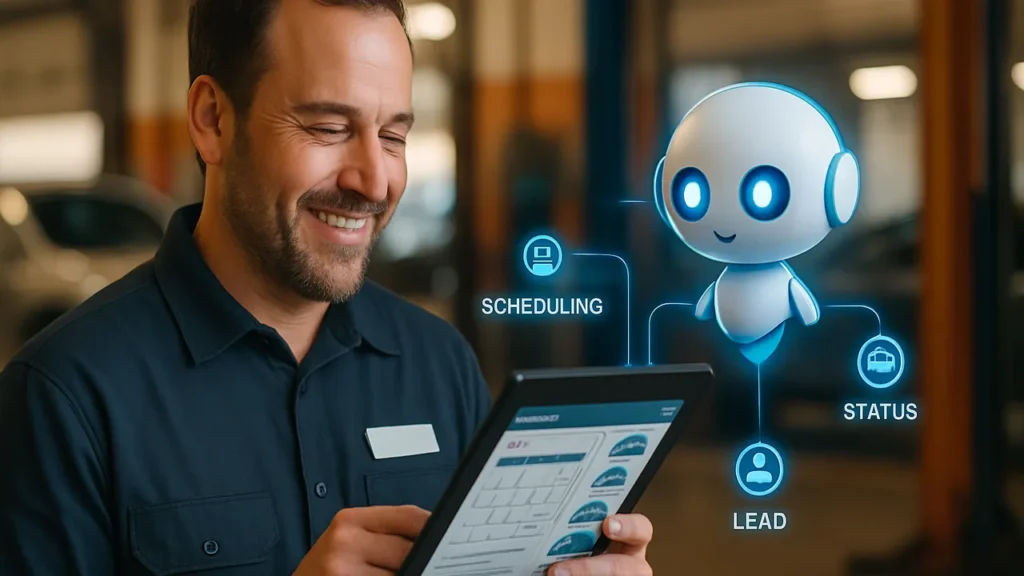
AI agents can help dealerships respond to customers outside business hours, schedule service appointments, send maintenance reminders, provide repair-status updates, answer routine questions, and escalate more complicated conversations to employees.
The objective should not be to replace the service advisor. It should be to reduce the communication workload surrounding the advisor so employees have more time for customers and situations that genuinely require human attention.
How Are AI Agents Improving Car Service Center Communications?
A traditional dealership communication process often depends heavily on phone calls.
A customer calls to schedule service. Another calls for an update. Someone else wants to know whether their vehicle is ready. A fourth customer wants to approve a repair. Meanwhile, service advisors may be speaking with technicians or customers already at the dealership.
AI agents can handle some of these repetitive interactions across voice, SMS, website chat, and email.
For example, a customer might ask whether their vehicle is ready. Instead of requiring the service advisor to stop working and answer the phone, an appropriately integrated AI system could retrieve the authorized repair-order status and provide the latest approved update.
The same principle applies to scheduling. Rather than collecting a customer’s information and manually searching the calendar, an AI agent can potentially understand the service request, identify available appointment times, confirm the selection, and update the scheduling platform.
The value comes from connecting conversational AI with dealership systems rather than deploying a generic chatbot that has no understanding of the customer or vehicle.
How Do AI Agents Help Dealerships Manage Customer Interactions?
AI agents help dealerships manage customer interactions by handling repetitive conversations, retrieving relevant customer and vehicle information, coordinating appointments, providing service updates, and escalating complex requests to dealership employees.
Unlike a basic chatbot that primarily answers predefined questions, an integrated AI agent can work across multiple stages of the dealership customer journey.
For example, a customer could ask about available vehicles through website chat, schedule a test drive, receive a confirmation by text, and later ask follow-up questions without dealership staff manually managing every interaction.
In the service department, AI agents can help with appointment scheduling and rescheduling, maintenance reminders, repair-status inquiries, service confirmations, declined-service follow-ups, and other routine communications.
They can also support interactions across voice, SMS, website chat, and email, helping dealerships respond when employees are busy or when customers contact the dealership outside normal business hours.
The biggest advantage comes from connecting the AI agent with dealership systems such as the CRM, DMS, scheduling platform, service systems, and approved knowledge sources. With the right integrations and permissions, the agent can use relevant context rather than giving generic responses.
AI agents can therefore help dealerships manage customer interactions across four areas:
- Respond: Answer routine customer questions and after-hours inquiries.
- Coordinate: Schedule appointments, test drives, callbacks, and service visits.
- Update: Provide approved vehicle, appointment, and repair-status information.
- Escalate: Transfer conversations to sales representatives, service advisors, or other employees when human judgment is required.
The goal is not to remove dealership employees from the customer relationship. It is to automate repetitive communication so sales and service teams can spend more time on interactions that require expertise, negotiation, judgment, or personal attention.
What Are the Benefits of AI Agents for Car Service Centers?
The most immediate benefit is availability. Dealership employees cannot answer every customer request around the clock, but customers may want to schedule service or ask questions outside normal operating hours.
AI agents can provide an additional communication layer during those periods.
Another benefit is consistency. Routine questions about opening hours, appointment availability, scheduled maintenance, service processes, or vehicle status can be answered according to approved dealership information.
AI can also make communications more proactive.
Cox Automotive reports that 80% of dealership service customers in its study considered personalized service reminders based on vehicle mileage or age helpful, while 79% valued text updates about upcoming or scheduled service. The study also found that 47% of dealership service customers had made an unplanned service visit because of a personalized reminder.
That suggests AI communication should not be limited to answering incoming questions. It can also help dealerships maintain the customer relationship between service visits.
What Is the Smartest Way to Use AI in a Car Dealership Right Now?
The smartest starting point is usually a high-volume workflow where employees spend substantial time handling repetitive communication.
Service scheduling is a good example.
Instead of attempting to automate the entire service department, a dealership could initially use AI to handle appointment requests, rescheduling, confirmations, and reminders.
Once that workflow performs reliably, AI can expand into vehicle-status communications, maintenance reminders, declined-service follow-ups, repair approvals, and other customer interactions.
Cox Automotive’s current retail platform demonstrates how this model is evolving. Its dealership technology supports personalized appointment reminders, mobile appointment management, text and multimedia repair updates, electronic approvals, and digital payments.
Cox has also introduced agentic AI virtual assistants capable of engaging customers, answering multi-intent questions, creating appointments and CRM tasks, updating notes, and handing conversations to dealership employees when human involvement is required.
This is an important distinction between simple automation and AI agents. A basic chatbot answers a question. An integrated agent can potentially understand the request and coordinate the next step in the dealership workflow.
Customer service is only one part of the opportunity. Dealerships exploring broader AI adoption should also consider how dealer management systems with AI integration can connect sales, inventory, service, parts, customer engagement, and analytics within a more intelligent dealership operation.
Where Can Dealerships Use AI Customer Service?
AI can support customer communication throughout the automotive ownership lifecycle.
| Area | KPI |
|---|---|
| Forecasting | Forecast accuracy |
| Inventory | Stockout and excess inventory rates |
| Waste | Spoilage/waste percentage |
| Production | Throughput and schedule adherence |
| Maintenance | Unplanned downtime |
| Quality | Defect/rejection rate |
| Procurement | Cycle time/supplier performance |
| Logistics | Cost per shipment/OTIF |
| AI Operations | Accuracy, failures, escalations |
The best candidates are generally repetitive interactions where the AI has access to reliable information and there is a clear path for escalation.
What Are the Best Practices for Implementing AI-Driven Customer Service in Car Dealerships?
Successful dealership AI begins with integration.
An AI assistant that cannot access the dealership’s approved customer, vehicle, scheduling, or service information may create more work because employees have to correct its responses.
The AI system should connect with the relevant CRM, DMS, scheduling, service, and communication platforms according to the specific workflow.
Dealerships should also establish clear boundaries around what the AI can communicate or change. Scheduling an appointment presents relatively limited risk. Making an unsupported diagnosis, promising an exact repair completion time, or authorizing expensive work is very different.
Human handoff should therefore be part of the design from the beginning.
Cox Automotive’s generative AI implementation provides a useful example of this principle. Its system can generate personalized dealership emails and text messages, but employees can modify, edit, and approve communications before they are sent.
Another important practice is maintaining context. Customers become frustrated when they have to repeatedly explain the same problem.
An integrated AI agent should be able to use permitted customer, vehicle, appointment, and conversation context so that a customer can move from chat to text or employee assistance without restarting the conversation.
Can AI Help Diagnose and Fix Cars?
The forum question about an AI assistant to diagnose and fix cars is relevant, but it should be separated from customer-service automation.
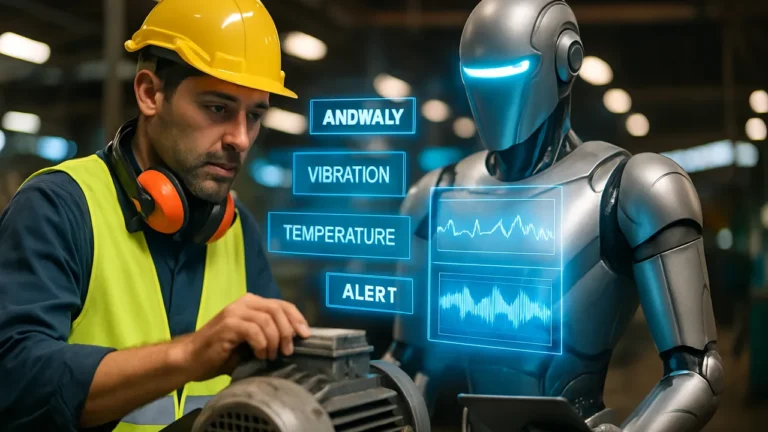
AI can assist technicians by analyzing diagnostic trouble codes, symptoms, vehicle information, repair history, technical documentation, and potentially sensor data.
Computer vision is also entering automotive service. Mercedes-Benz India recently introduced an AI-powered automated vehicle scanner at a service center to inspect vehicles and make evaluations faster and more transparent for customers.
However, an AI assistant should not be presented as a replacement for a qualified automotive technician.
Vehicle problems can involve mechanical, electrical, software, and safety considerations that require physical inspection and professional judgment. A better role for AI is to support technicians by retrieving relevant information, organizing diagnostic evidence, and suggesting possibilities for investigation.
This creates two complementary applications.
Customer-service AI helps manage communication and workflow, while technician-facing AI helps with information retrieval and diagnostic support.
How Can AI Improve Repair Status Updates?
Repair-status communication sounds simple, but it is one of the most useful dealership applications.
Customers commonly want to know whether the technician has started work, whether additional repairs were identified, whether parts have arrived, when approval is needed, and when the vehicle will be ready.
The challenge is that the AI cannot invent these answers.
A properly designed system should retrieve the latest authorized status from dealership systems and communicate only what is known.
If the repair completion time is uncertain, the system should communicate that uncertainty rather than generating an artificial estimate.
This is where connected dealership data becomes essential. Cox Automotive argues that agentic AI becomes significantly more useful when it operates on connected, high-quality data rather than fragmented dealership systems.
Can AI Actually Improve Dealership Customer Engagement?
There is emerging evidence that well-integrated AI can improve response rates.
In a Cox Automotive case study published by Anthropic, AI-generated personalized communications through VinSolutions more than doubled consumer lead responses and test-drive appointments. The implementation combines generative AI with verified vehicle information and customer shopping data rather than allowing the model to generate generic communications.
More recently, AWS reported that Cox Automotive’s agentic AI deployment for VinSolutions achieved consumer response rates more than three times higher in an initial pilot, although AWS notes that the pilot involved a small sample.
These results should not be treated as guaranteed benchmarks for every dealership. They do illustrate why the quality of the underlying data, personalization, integration, and workflow matters more than simply adding an AI chatbot to a dealership website.
How Should Dealerships Measure AI Customer Service ROI?
AI customer service should be evaluated against business and customer outcomes rather than the number of conversations the bot handles.
Useful measures include response time, appointment booking rate, missed-call recovery, service appointment volume, customer wait time, employee handling time, escalation rate, appointment no-shows, repair approval time, customer satisfaction, and service retention.
Dealerships should also monitor incorrect answers and failed conversations.
That last measurement is important because adoption does not eliminate concerns about AI reliability. A Cox Automotive dealer study found that 74% of surveyed dealers were concerned about AI accuracy and errors, while 60% cited concerns involving data and algorithms.
A dealership AI program should therefore measure both how much work AI automates and how reliably it performs that work.
How Intellectyx Helps Automotive Businesses Build AI Agents
Intellectyx helps automotive organizations develop custom AI agents, enterprise integrations, analytics, and intelligent automation around customer and operational workflows.
For dealerships and automotive service organizations, this can include AI-powered appointment scheduling, customer communication agents, service-status assistance, CRM integration, knowledge assistants, workflow automation, and analytics.
As an AI agent development company in the USA, Intellectyx can also build agents around dealership-specific business logic rather than forcing every automotive business into the same generic chatbot workflow.
The most useful implementation connects the AI agent with approved customer and operational data, defines what actions the agent can perform, and provides a clear handoff to dealership employees when a conversation requires judgment or personal attention.
Conclusion
The best practices for implementing AI-driven customer service in car dealerships start with a simple principle: automate communication friction rather than trying to remove humans from the customer relationship.
Service scheduling, appointment reminders, routine inquiries, repair-status updates, declined-service follow-ups, and after-hours communication are practical places to begin.
AI can also support technicians with diagnostic information, but customer-facing agents should not make unsupported repair diagnoses or promises simply because a customer expects an immediate answer.
The strongest dealership AI systems combine conversational intelligence with reliable CRM, DMS, scheduling, service, and vehicle information. They know when they have enough information to respond and, equally importantly, when the conversation needs to move to a person.
For dealerships, that balance can turn AI from another website chatbot into a useful part of the service experience.
FAQs
Costs vary by scope, but most dealer groups start with a single-channel pilot (scheduling or lead response) before scaling. Pricing typically depends on integration complexity with the DMS/CRM and the number of channels supported, not a flat per-dealership rate.
Most dealerships buy or customize an existing conversational AI platform rather than building from scratch, since integration with DMS and CRM systems matters more than the underlying model. Custom development is usually reserved for unique workflow logic.
AI can draft responses and summarize complaint history for staff, but final complaint handling should stay human-led. Emotional, reputational, and legal risk make complaints a poor fit for autonomous AI resolution.
A focused pilot on one use case, such as service scheduling, typically takes a few weeks to a couple of months including DMS/CRM integration and staff training, with broader rollout following a successful 90-day evaluation period.
No, it is designed to absorb routine, high-volume tasks like status updates and after-hours scheduling, freeing staff for complex, high-value interactions rather than replacing the roles entirely.
Clean, accessible data from the DMS and CRM, appointment history, and inventory feeds is the minimum requirement. Poorly structured or siloed data is the most common reason dealership AI pilots stall.
It can be, provided the vendor follows recognized frameworks such as the NIST AI Risk Management Framework and the dealership enforces strict access controls, encryption, and human review for any interaction touching credit or payment data.