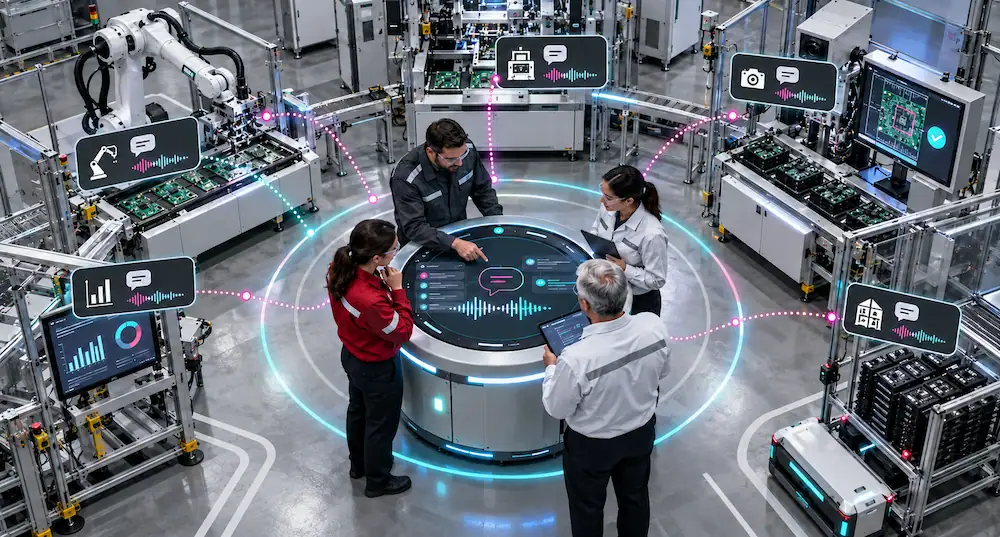

Manufacturing teams generate enormous amounts of information through production systems, maintenance records, quality reports, engineering documents, equipment manuals and employee knowledge. The problem is not always a lack of information. It is often the difficulty of finding and using that information when a decision must be made.
Conversational AI in manufacturing gives employees, suppliers, dealers, and customers a natural-language interface to access operational knowledge and complete approved tasks. Instead of searching multiple systems or waiting for a specialist, users can ask questions through text or voice and receive context-aware answers.
A manufacturing chat solution can help an operator retrieve a work instruction, guide a technician through troubleshooting, explain an alarm, check inventory availability or create a maintenance request. However, reliable performance depends on governed data, enterprise integration, security controls and appropriate human oversight.
What Is Conversational AI in Manufacturing?
Conversational AI in manufacturing uses technologies such as natural language processing, speech recognition, large language models, enterprise search and workflow automation to let people interact with manufacturing information through text or voice.
Unlike a basic chatbot for manufacturing that follows predefined scripts, an enterprise conversational assistant can retrieve information from approved documents, interpret user intent, connect with ERP or MES applications and support authorized business actions.
It should assist employees and customers without replacing human responsibility for safety, quality, engineering or production decisions.
What Is a Conversational AI Virtual Assistant?
A conversational AI virtual assistant is software that understands natural-language requests and responds through text or voice. It may answer questions, retrieve documents, summarize information, recommend a next step or complete an approved workflow.
In manufacturing, a virtual assistant can be connected to:
- Enterprise resource planning systems
- Manufacturing execution systems
- Quality management systems
- Computerized maintenance management systems
- Product lifecycle management platforms
- Warehouse and inventory systems
- Equipment historians and sensor platforms
- Standard operating procedures
- Engineering drawings and technical manuals
- Customer relationship management systems
A simple chatbot generally works within a limited set of questions and predefined responses. A conversational AI assistant can understand broader questions, maintain context and retrieve answers from multiple authorized sources.
More advanced copilots and AI agents can also initiate actions. Intellectyx’s AI copilot development services connect conversational interfaces with enterprise knowledge, applications and role-specific workflows.
Chatbot, Virtual Assistant, Copilot and AI Agent: What Is the Difference?
| Solution | Primary Function | Typical Manufacturing Example | Level of Action |
|---|---|---|---|
| Rule-Based Chatbot | Answers predefined questions | Provides plant hours or order-status options | Very limited |
| Conversational AI Assistant | Understands natural-language questions | Retrieves an approved maintenance procedure | Information and guidance |
| AI Copilot | Supports a particular employee or role | Helps a planner investigate a production delay | Recommendations and draft actions |
| AI Agent | Coordinates tasks across connected systems | Creates a work-order draft and routes it for approval | Bounded workflow execution |
These terms are sometimes used interchangeably. Manufacturers should evaluate what the system can access, what actions it can perform and where human approval is required rather than relying only on the product name.
How Does Conversational AI Work in a Manufacturing Environment?
A manufacturing assistant normally follows five stages.
1. Receive the request
The user submits a question through a web chat, mobile application, collaboration platform, operator terminal or voice interface.
2. Interpret the user’s intent
The system identifies what the user is trying to accomplish. It may also consider the user’s role, location, equipment, shift and previous conversation.
3. Retrieve relevant information
The assistant searches authorized documents, databases and applications. Retrieval-augmented generation can ground answers in company-specific information instead of relying only on the model’s general training.
An enterprise knowledge AI and RAG architecture can help connect assistants with governed documents, operational records and approved knowledge sources.
4. Generate or recommend a response
The model creates an answer, summary, explanation or recommended action. Important responses should include supporting sources so employees can verify the information.
5. Complete or escalate the workflow
If permitted, the assistant may prepare a transaction, create a ticket or route an exception. High-risk decisions should be escalated to qualified personnel.
Intellectyx’s manufacturing offering includes voice and chat assistants for shop-floor operations, engineering knowledge, troubleshooting and enterprise self-service.
Key Use Cases for Conversational AI in Manufacturing
Shop-Floor Knowledge Assistance
Operators often need immediate access to work instructions, product specifications, setup requirements and standard operating procedures.
A conversational assistant can answer questions such as:
- Which setup procedure applies to this product?
- What inspection is required after this changeover?
- Where is the approved work instruction?
- What should I check when this alarm appears?
The assistant should retrieve the latest approved version and show its source. It should not invent instructions when reliable information is unavailable.
Maintenance and Troubleshooting
Maintenance teams may need to search equipment manuals, work-order histories, alarm records and technician notes.
A manufacturing assistant can consolidate this information and help technicians:
- Interpret fault codes
- Find relevant procedures
- Review similar past failures
- Identify required tools or parts
- Summarize recent maintenance work
- Prepare a work-order draft
For more complex operational environments, manufacturers can combine conversational interfaces with AI agents for industrial operations to support maintenance, production and quality workflows.
Quality Management
Quality teams can use conversational AI to retrieve inspection requirements, explain defect codes and summarize nonconformance records.
For example, a quality engineer could ask:
Have similar defects occurred on this line, product or supplier batch?
The assistant could search approved quality records, identify related cases and present evidence for investigation. Engineers would still determine the actual root cause and approve corrective actions.
Production Planning
Production planners regularly coordinate demand, capacity, material availability, labor and maintenance constraints.
A conversational assistant can provide a simpler way to investigate planning exceptions:
- Which orders are at risk this week?
- What material shortage is affecting the schedule?
- Which work centers have available capacity?
- Why did the recommended production sequence change?
- What happens if a rush order is accepted?
The assistant can summarize connected planning data, but the underlying optimization and scheduling logic should remain visible and reviewable.
ERP and MES Assistance
Employees often find enterprise systems difficult to navigate. A conversational interface can reduce that friction by helping users retrieve information or prepare transactions.
Examples include checking inventory, reviewing order status, locating a production record, creating a purchase request or preparing a maintenance notification.
The assistant should operate under the user’s existing permissions. It should not become an unrestricted route around ERP or MES controls.
Workforce Training and Knowledge Retention
When experienced employees retire or change roles, important knowledge may leave with them.
Conversational AI can make approved procedures, expert interviews and historical service records searchable through a natural-language interface. The system can help new employees understand terminology, locate examples and prepare for unfamiliar tasks.
The article on AI knowledge retention in manufacturing explains how expert knowledge can be captured and made available through a secure conversational assistant.
Supplier and Procurement Support
A manufacturing chat solution can help procurement employees retrieve supplier information, summarize quotations and identify missing documentation.
A supplier-facing assistant may also answer approved questions about specifications, onboarding requirements, delivery procedures and invoice status.
Contract commitments, supplier selection and pricing decisions should continue to require appropriate procurement authorization.
Customer, Dealer and Field-Service Support
A chatbot for manufacturing can support customers and dealers with:
- Product information
- Parts identification
- Warranty questions
- Service scheduling
- Troubleshooting
- Order updates
- Technical-document retrieval
The assistant can collect relevant information before transferring the conversation to a human specialist. This reduces repetitive intake work and gives the employee better context.
Why Is Conversational AI Critical for the Automotive Industry?
Automotive companies coordinate manufacturers, suppliers, dealerships, service centers, technicians and vehicle owners. Each group requires access to different information across the product lifecycle.
Conversational AI can support this environment in several ways.
Dealer and Customer Assistance
A virtual assistant can answer vehicle questions, provide service reminders, schedule appointments and communicate repair updates.
Technician Support
Service technicians can ask questions about diagnostic codes, repair procedures, compatible parts and previous cases without searching through multiple portals.
Manufacturing Operations
Plant employees can retrieve work instructions, quality requirements and equipment guidance through a conversational shop-floor assistant.
Warranty and Claims Support
AI can collect claim information, check for missing documents and summarize the case for an authorized warranty employee.
Engineering Knowledge Access
Engineers can search specifications, design history, product changes and lessons learned using natural-language questions.
Supplier Coordination
Conversational assistants can provide approved information about delivery requirements, engineering changes and quality documentation.
The value is not simply faster conversation. It is the ability to connect people with the right information and workflow across a complex automotive ecosystem. The guide to AI agents for automotive customer service explores how virtual assistants can support customers and dealerships throughout vehicle ownership.
Can a Conversational AI Model Perform Well Without Human-Labeled Data?
Yes, a conversational AI model can provide useful performance without a large collection of manually labeled conversations, but the answer depends on the use case.
Pretrained language models already understand general language patterns. Manufacturers can connect these models with approved documents through retrieval-augmented generation. They can also use existing manuals, knowledge articles, service histories, FAQs and system records without labeling every sentence.
Other approaches include:
- Using rules for clearly defined requests
- Generating synthetic training examples
- Learning from unlabeled documents
- Using existing search and metadata
- Starting with a pretrained model
- Collecting feedback during a controlled pilot
However, human-labeled data remains valuable for specialized terminology, intent classification and uncommon operational situations. Human review is also required to create a reliable evaluation set.
A model may produce fluent answers without labeled data while still giving incorrect or unsupported information. Manufacturers should test it using representative questions from operators, engineers, technicians and other intended users.
A structured enterprise knowledge-base methodology for AI agents can improve grounding through source auditing, metadata, retrieval design and continuous validation.
Benefits of Conversational AI in Manufacturing
Faster Access to Information
Employees can ask a direct question instead of searching several applications, folders and manuals.
Reduced Administrative Work
The assistant can summarize records, prepare reports, collect information and draft routine transactions.
More Consistent Support
Responses can be grounded in approved procedures rather than depending entirely on who is available.
Better Employee Onboarding
New employees can find explanations and guidance while learning plant terminology and processes.
Improved Knowledge Retention
Manufacturers can make expert knowledge more accessible after experienced employees leave.
Easier Use of Enterprise Applications
Conversational interfaces can reduce the effort required to retrieve data from complex ERP, MES, QMS and maintenance systems.
Scalable Customer and Dealer Support
A chatbot for manufacturing can handle common questions while routing technical or sensitive issues to specialists.
These are potential benefits rather than guaranteed outcomes. Actual value depends on integration quality, source accuracy, employee adoption and the organization’s response process.
Best Practices for Implementing a Manufacturing Chat Solution
Start With One Defined Workflow
Choose a problem with clear users, accessible knowledge and measurable outcomes. Maintenance knowledge retrieval or technical-document search may be safer starting points than autonomous production control.
Connect the Assistant to Approved Knowledge
Do not upload every available document without reviewing it. Remove duplicates, archive outdated procedures and assign ownership for important sources.
Integrate With Existing Applications
The assistant should fit into the systems employees already use. Relevant connections may include ERP, MES, QMS, CMMS, PLM, CRM and document repositories.
Preserve Source Traceability
Show the document, record or system used to produce important answers. Users should be able to verify critical guidance.
Apply Role-Based Access
An operator, supplier, customer and engineering manager should not see the same information. The assistant should enforce existing identity and permission policies.
Separate Advice From Action
An assistant that answers a question carries less operational risk than an agent that modifies a production schedule or creates an ERP transaction. Introduce actions gradually and require approval where consequences are significant.
Create Human Escalation Paths
The system should recognize uncertainty, unavailable information, and high-risk requests. It must provide a clear route to the appropriate employee.
Monitor the System After Deployment
Governance should continue after launch. Organizations that need a tailored assistant can use enterprise AI chatbot development services to connect conversational experiences with company knowledge, applications and workflow controls.
How Should Manufacturers Measure Success?
Manufacturers should establish a baseline before deployment and monitor both AI performance and business outcomes.
Useful measures include:
- Answer accuracy
- Grounded-response rate
- Unsupported-answer rate
- Retrieval success
- Human escalation rate
- Resolution time
- Employee adoption
- Repeat usage
- Search time saved
- Workflow completion rate
- User satisfaction
- Error or rework rate after assistance
- Security and permission incidents
High usage does not necessarily prove business value. The assistant must help users complete work accurately, safely, and efficiently.
Common Risks and Limitations
Incorrect or Unsupported Answers
A conversational model may produce a convincing response that is not supported by company information.
Outdated Knowledge
Even a well-designed assistant can provide outdated guidance if source documents are not maintained.
Excessive Access
Connecting the assistant to many systems without carefully designed permissions can expose sensitive information.
Poor Integration
An assistant that cannot access current operational data may provide answers that sound useful but do not reflect actual plant conditions.
Low Employee Trust
Employees may avoid the system if responses are unreliable, sources are hidden or the assistant disrupts existing work.
Unsafe Automation
A conversational interface should not make uncontrolled changes to production, safety or quality systems.
These risks can be reduced through source governance, testing, role-based access, audit logs, human escalation, and continuous monitoring.
Conclusion
Conversational AI in manufacturing can make operational knowledge, enterprise data and business workflows easier to access through text or voice. Its applications range from shop-floor assistance and maintenance troubleshooting to quality support, employee training and automotive customer service.
The strongest solution is not necessarily the chatbot with the most natural conversation. It is the one that retrieves reliable information, respects permissions, integrates with existing systems, and knows when to involve a person.
Manufacturers should begin with a clearly bounded use case, validate the assistant with real users, and expand only after accuracy, adoption, and operational value have been demonstrated.
Ready to Make Manufacturing Knowledge Easier to Access?
Talk to Our AI ExpertsFAQs
Yes. Pretrained models, retrieval-augmented generation, existing documents, rules and synthetic examples can support useful performance without extensive labeled data. Human-labeled examples are still valuable for evaluation, specialized intents and improving domain accuracy.
It can connect vehicle owners, dealerships, technicians, manufacturers and suppliers with relevant information throughout production, sales, service, warranty and ownership workflows.
Yes. It can connect through approved APIs, integration platforms or data services. Access should follow existing identity, permission, validation and audit requirements.
No. It helps employees retrieve information, investigate issues and complete routine work. Qualified personnel remain responsible for safety, engineering, quality, production and other consequential decisions.