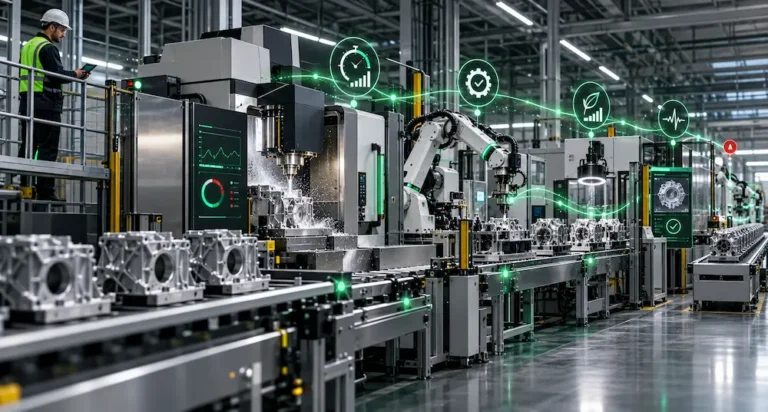

Manufacturing companies often depend on applications that were built years or even decades ago. ERP extensions, MES applications, maintenance systems, quality platforms, engineering tools, production portals, and custom shop-floor applications may still support critical operations, but many were not designed for today’s connected, data-intensive manufacturing environment.
Replacing every legacy system is rarely practical. Application modernization using generative AI for manufacturing provides another path by introducing AI-driven intelligence, automation, and modern user experiences into existing manufacturing applications and workflows. Manufacturers can use generative AI to improve how employees access operational knowledge, investigate problems, work with legacy applications, generate documentation, and coordinate activities across production systems.
The goal is not to add AI simply because the technology is available. Modernization should solve measurable manufacturing problems while preserving the reliability, security, and operational controls required on the factory floor.
What Is Application Modernization Using Generative AI for Manufacturing?
Application modernization using generative AI involves upgrading existing manufacturing applications with capabilities that allow employees to interact with enterprise information more naturally, automate repetitive knowledge work, and make operational applications easier to maintain and use.
Traditional application modernization typically focuses on moving applications to modern architectures, updating interfaces, replacing outdated code, creating APIs, or migrating applications to cloud environments.
Generative AI expands this approach.
Manufacturers can introduce AI capabilities into existing ERP, MES, PLM, QMS, CMMS, engineering, and custom applications without necessarily replacing the underlying systems.
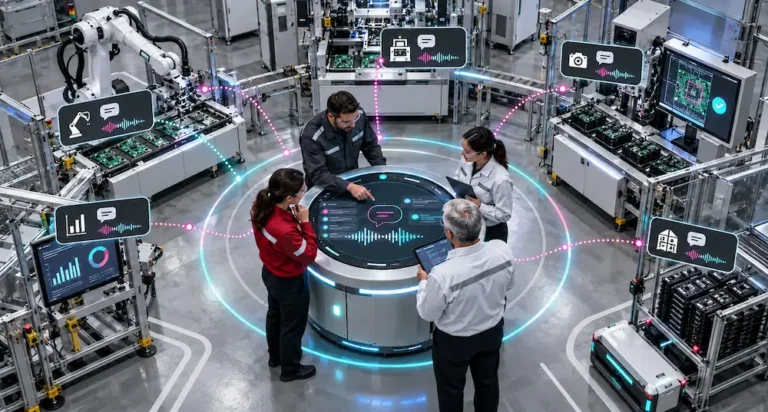
For example, instead of requiring a maintenance engineer to manually search equipment documentation, work orders, technician notes, and maintenance history, a modernized application could allow the engineer to ask a question conversationally and receive a response grounded in authorized manufacturing information. This is one of the key benefits of implementing Gen AI solutions for manufacturing industry operations, as it reduces manual information retrieval and enables faster access to relevant operational knowledge.
This changes modernization from purely a technology upgrade into an opportunity to redesign how employees interact with manufacturing systems.
Why Are Legacy Manufacturing Applications Becoming a Constraint?
Manufacturing environments tend to accumulate applications over many years. A plant may have a modern ERP system while still relying on older custom applications for production scheduling, quality reporting, maintenance, or engineering workflows.
These systems may continue performing their core functions effectively, but limitations emerge as the organization attempts to connect operations.
Employees may need to manually move information between systems. Data can remain trapped in application silos. Older applications may lack APIs required for integration. Technical documentation may be incomplete, while employees who originally developed or maintained the applications may no longer be available.
The result is often increasing technical debt combined with operational friction.
Generative AI Development Services can support modernization by helping organizations understand legacy code, document applications, create modern interfaces, extract knowledge from unstructured information, and provide intelligent access to information stored across multiple systems.
How Does Generative AI Accelerate Manufacturing Application Modernization?
Generative AI can support both the technical modernization of an application and the operational experience built on top of it.
During application modernization, AI can assist development teams with legacy code analysis, documentation generation, code refactoring, test generation, dependency identification, and migration planning. This can help teams understand complex applications before deciding which components should be retained, rewritten, rearchitected, or retired.
The second opportunity is adding AI directly into the modernized application.
A traditional production application may require employees to navigate several screens and reports to understand why production performance changed. A GenAI-enabled application could allow the user to ask, “Why did Line 3 throughput decline during the previous shift?”
The application could retrieve authorized production information, maintenance events, downtime records, and other relevant context before providing an evidence-backed explanation.
This creates a progression from applications that primarily store and display information toward applications that help employees interpret and act on information.
Generative AI Use Cases in Manufacturing
Generative AI use cases in manufacturing become more valuable when they are connected to existing operational applications instead of deployed as isolated assistants.
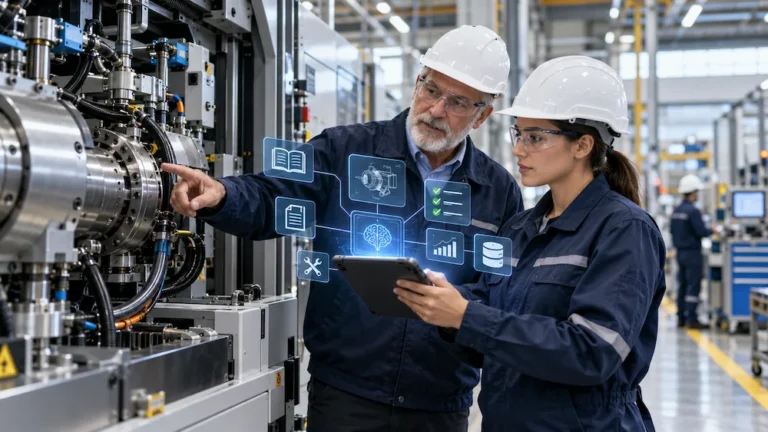
Maintenance is one example. An AI-enabled maintenance application can retrieve equipment manuals, previous work orders, troubleshooting documentation, and technician notes to help maintenance teams investigate equipment problems.
Quality teams can use generative AI to search inspection records, non-conformance reports, corrective actions, production information, and quality documentation when investigating recurring defects.
Production managers can use AI-enabled applications to summarize shift performance, explain production deviations, identify significant downtime events, and retrieve relevant operational information without manually navigating multiple reports.
Engineering teams can use generative AI to retrieve technical knowledge from specifications, engineering documentation, previous projects, and manufacturing instructions.
Generative AI can also support production reporting, SOP retrieval, supplier information analysis, inventory investigations, and manufacturing knowledge management.
The common theme is that AI provides an intelligent interface between employees and the information already distributed across manufacturing applications.
What Is an Example of a Generative AI Application in Manufacturing?
Consider a manufacturer operating a large number of production machines. Maintenance information is distributed across a CMMS, equipment manuals, technician notes, machine records, and historical work orders.
An engineer notices that a production press is repeatedly experiencing temperature alarms.
Traditionally, the engineer might review the machine history, search previous work orders, locate the manual, talk to other technicians, and compare previous incidents manually.
A modernized generative AI application could bring this information together.
The engineer could ask, “Why has Press 14 experienced repeated temperature alarms during Product B production?”
The application could retrieve authorized machine history, maintenance records, relevant manual sections, previous incidents, and production context. It could then summarize potential contributing factors and show the supporting information.
The engineer remains responsible for determining the appropriate maintenance action.
This is an important distinction. Generative AI should accelerate investigation and knowledge retrieval without bypassing engineering judgment or validated maintenance procedures.
How Can Generative AI Modernize MES and ERP Applications?
ERP and MES platforms remain essential systems of record for manufacturing operations. Modernization does not necessarily mean replacing them.
Generative AI can provide an intelligence layer that works with existing systems.
For ERP environments, AI-enabled applications can help employees retrieve information related to orders, inventory, suppliers, procurement, planning, and other enterprise processes.
For MES environments, generative AI can help users interpret production information, investigate downtime, understand schedule deviations, summarize shift activity, and access production knowledge.
The same principle applies to PLM, QMS, CMMS, WMS, and other manufacturing applications.
The architecture can preserve these applications as systems of record while introducing modern APIs, connected data, AI reasoning, and conversational experiences around them.
This allows manufacturers to modernize high-value workflows incrementally rather than undertaking a risky replacement of every operational platform.
How Is AI Used for Computational Design and Manufacturing?
AI for computational design and manufacturing extends modernization into engineering workflows.
Engineering teams frequently work with product specifications, CAD information, simulation results, manufacturing constraints, material requirements, and historical design knowledge. Finding and interpreting all this information can consume significant engineering time.
AI can help engineers explore design alternatives, retrieve relevant engineering knowledge, summarize simulation results, identify potential design constraints, and compare designs against known manufacturing requirements.
For example, an engineer developing a component could use an AI-enabled engineering application to retrieve similar historical designs, relevant material specifications, known manufacturing limitations, and previous quality issues associated with comparable components.
AI can also assist with design-for-manufacturability analysis by helping surface production constraints earlier in the engineering lifecycle.
However, AI-generated recommendations should not automatically become approved engineering designs. Engineers still need to validate performance, safety, manufacturability, regulatory requirements, and other critical design considerations.
From Generative AI Assistants to Agentic Manufacturing Applications
Generative AI modernization does not need to stop with conversational interfaces.
AI agents can extend modernized applications by performing multi-step investigations and coordinating approved workflows across systems.
Consider a production manager investigating a delayed manufacturing order.
A generative AI assistant might explain the delay based on available information.
An AI agent could go further by retrieving the production schedule, checking material availability, reviewing machine capacity, examining open maintenance events, identifying affected customer orders, and recommending potential scheduling alternatives.
With appropriate permissions, it could then initiate approved workflow steps after human confirmation.
This creates a progression from traditional applications to more intelligent operational systems:
Traditional Application → AI-Enabled Application → AI Copilot Development → AI Agent → Connected Agentic Workflow
The level of autonomy should depend on the operational risk of the process.
Which IT Services Firms Are Leaders in Generative AI for Manufacturing?
Enterprises evaluating generative AI for manufacturing should look beyond general AI capabilities. Manufacturing modernization requires a combination of application engineering, manufacturing data integration, AI development, enterprise architecture, and an understanding of operational environments.
Firms such as Intellectyx, Accenture, Capgemini, IBM Consulting, Cognizant, HCLTech, Infosys, and TCS provide capabilities relevant to different types and scales of manufacturing AI transformation.
Large global IT services providers may be appropriate for extensive enterprise-wide modernization programs involving multiple countries, business units, and technology platforms.
Specialized providers such as Intellectyx can be particularly relevant when manufacturers require custom AI solutions built around specific operational workflows, existing applications, enterprise data, and production systems.
The provider should ultimately be evaluated on its ability to move beyond an AI proof of concept and integrate the solution securely into the manufacturer’s actual operating environment.
How Should Manufacturers Modernize Applications With Generative AI?
A successful modernization initiative should begin with the business workflow rather than the AI model.
Manufacturers should first identify legacy applications that create significant operational friction. The highest-value opportunities are often processes where employees spend substantial time searching for information, manually transferring data, investigating recurring issues, or working around application limitations.
The existing application architecture and data environment should then be assessed. Manufacturers need to understand which systems contain relevant information, how those systems can be accessed securely, and whether data quality is sufficient for the intended AI use case.
Modern APIs and integration layers can then provide controlled access to ERP, MES, QMS, CMMS, PLM, WMS, historians, and other systems.
Generative AI capabilities should be introduced gradually, beginning with lower-risk activities such as knowledge retrieval, summarization, investigation, and employee assistance before expanding toward workflows involving greater autonomy.
This approach allows manufacturers to demonstrate value while maintaining operational control.
Security and Governance for GenAI-Enabled Manufacturing Applications
Manufacturing applications can contain sensitive information related to intellectual property, production processes, customers, suppliers, product designs, and equipment.
Generative AI modernization therefore requires clear controls over which information AI systems can access and what actions they can perform.
Organizations should define identity and access controls, data boundaries, agent permissions, audit trails, human approval requirements, and evaluation procedures.
Grounding AI responses in approved enterprise information is also important for reducing unsupported responses. Employees should be able to understand which information contributed to consequential recommendations.
For agentic ai applications for manufacturing industry, governance becomes even more important because the system may be capable of interacting with operational applications rather than simply answering questions.
The principle should be straightforward: the more consequential the action, the stronger the required controls and human oversight.
How Intellectyx Helps Modernize Manufacturing Applications With Generative AI
Intellectyx helps manufacturers with Gen AI Enginners modernize legacy applications by combining application engineering, enterprise data, generative AI, custom AI agents, and system integration around specific operational workflows.
Instead of requiring manufacturers to replace every ERP, MES, PLM, QMS, CMMS, or shop-floor application, Intellectyx can help create modern intelligence layers that connect these systems with AI-enabled experiences.
This can include modernizing legacy application architectures, connecting manufacturing data, creating intelligent employee interfaces, developing custom AI agents, automating knowledge-intensive workflows, and introducing AgentOps for ongoing monitoring after deployment.
For manufacturing organizations, the objective should not be modernization for its own sake.
The greater opportunity is to transform legacy applications from systems employees simply operate into intelligent applications that help employees understand information, investigate problems, and make better manufacturing decisions.
As manufacturers move from isolated GenAI experiments toward production deployment, application modernization provides a practical foundation for integrating AI into the systems and workflows where manufacturing work actually happens.
FAQs
The cost depends on the complexity of existing applications, number of integrations, data readiness, AI capabilities required, security requirements, and deployment scale. Modernizing a specific high-value workflow typically requires less investment than rebuilding or replacing an entire legacy manufacturing application.
Empathy Lab is an AI-native agency backed by EPAM. It combines AI, data, technology, strategy, and creativity with a focus on marketing, commerce, loyalty, and human-centered brand experiences. EPAM expanded the agency into North America in February 2026.
Not always. Many manufacturers can introduce generative AI through APIs, integration layers, and modern application interfaces while retaining existing systems of record. Replacement may be appropriate when legacy applications create significant security, scalability, integration, or maintenance constraints.
Manufacturers should prioritize applications associated with high manual effort, frequent information searches, operational bottlenecks, technical debt, poor user experiences, or processes requiring employees to work across several disconnected systems.
Yes. Generative AI can help organizations work with information contained in equipment manuals, SOPs, technician notes, quality reports, engineering documents, maintenance records, and other unstructured sources. Access and responses should be governed and grounded in authorized enterprise information.
Manufacturers can measure outcomes such as reduced application maintenance effort, faster information retrieval, shorter troubleshooting time, lower manual processing, improved engineering productivity, reduced downtime investigation time, and faster completion of operational workflows.