
Enterprises have spent years automating repetitive tasks, building dashboards, and deploying predictive analytics. Yet many business decisions still require employees to gather information from multiple systems, interpret what it means, determine the next action, and coordinate that action across teams.
Agentic AI for intelligent enterprise decision-making changes this model. Instead of simply providing an insight or responding to a prompt, AI agents can monitor business conditions, retrieve relevant context, reason through possible actions, make recommendations, and execute permitted tasks within defined business controls.
The result is a shift from AI that helps enterprises understand what is happening to AI that can help determine what should happen next.
What Is Agentic AI for Intelligent Enterprise Decision-Making?
Agentic AI refers to AI systems designed to work toward defined goals with a degree of autonomy. An AI agent can observe an event, retrieve information, reason about the situation, use enterprise tools, and take actions within its assigned permissions.
For enterprise decision-making, a typical workflow could look like:
Business Event → AI Agent → Retrieve Enterprise Context → Analyze Situation → Evaluate Options → Recommend Decision → Human Approval if Required → Execute → Monitor Outcome
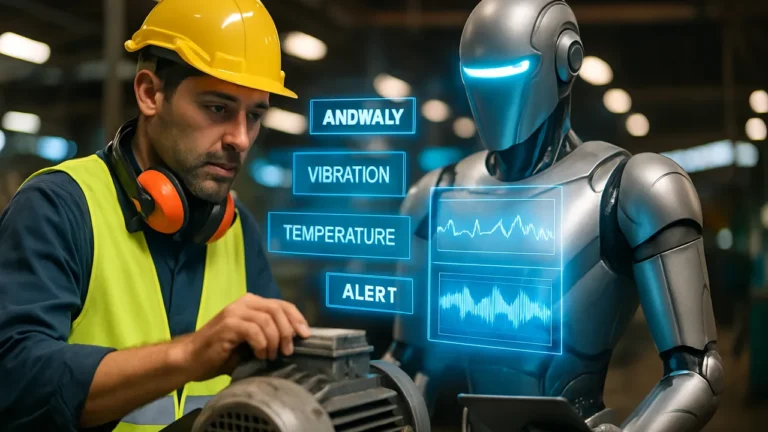
Consider a manufacturer facing an unexpected production delay. A traditional monitoring system might generate an alert. An AI agent could go further by checking machine availability, production schedules, inventory, supplier status, open orders, and customer commitments.
The agent could then evaluate alternative production plans and recommend the option that minimizes disruption.
This ability to connect information, decisions, and actions is what separates agentic AI from many traditional automation approaches.
How Agentic AI Is Changing Automation and Decision-Making
Traditional automation works particularly well when processes are predictable.
For example:
Invoice Approved → Trigger Payment
or:
Inventory Below Threshold → Create Replenishment Alert
These workflows depend on predefined conditions and actions. If circumstances change or an exception occurs outside those rules, employees usually need to investigate.
Agentic AI introduces reasoning between the event and the action.
Business Event → Understand Context → Investigate → Evaluate Alternatives → Apply Policies → Decide → Act
Suppose a critical material is projected to run out before the next scheduled supplier delivery. Rather than simply generating a low-stock alert, an AI agent could investigate available inventory across locations, evaluate alternative suppliers, review existing purchase orders, calculate production impact, and recommend the most appropriate response.
The difference is significant.
Traditional automation executes predefined instructions. Agentic AI can determine which approved action is appropriate based on the current context.
How Do AI Agents Make Enterprise Decisions?
An enterprise AI agent should not make decisions based solely on a language model’s response.
Production systems can combine AI reasoning with trusted enterprise data, deterministic business rules, APIs, policies, permissions, predictive models, and validation mechanisms.
The decision process may follow:
Observe → Retrieve → Analyze → Evaluate → Validate → Decide → Execute → Learn
First, the agent identifies an event requiring attention. It then retrieves relevant information from approved systems such as ERP, CRM, financial platforms, supply chain applications, knowledge bases, or operational databases.
Next, it evaluates possible actions against business policies and constraints.
Before an action is executed, additional controls can verify permissions, risk levels, transaction limits, or required approvals.
For example, an AI agent might recommend reallocating inventory between two distribution centers. Before making the change, the workflow could verify available inventory, transportation costs, service-level requirements, and authorization policies.
The agent therefore becomes part of an enterprise decision architecture rather than operating as an unrestricted autonomous system.
Agentic AI vs. Traditional Rule-Based Automation
Traditional automation remains valuable. Agentic AI does not need to replace it.
Rule-based automation is often the better option when the input, decision, and output are highly predictable. Agentic AI becomes more useful when the workflow involves changing conditions, unstructured information, multiple systems, exceptions, or several possible actions.
Consider supplier management.
A traditional workflow might be:
Delivery Late → Send Alert → Procurement Manager Investigates
An agentic workflow could become:
Delivery Risk Detected → Investigate Supplier → Check Inventory → Assess Production Impact → Evaluate Alternatives → Recommend Response → Buyer Approval → Execute
The AI agent can still use deterministic automation to execute the final approved task.
This creates a practical enterprise model where AI handles reasoning and orchestration while existing automation performs reliable predefined actions.
Could Agentic AI Eventually Make Business Decisions Better Than Humans?
For certain types of decisions, AI agents may have advantages over individual employees.
An agent can continuously analyze large volumes of information across multiple systems without becoming overwhelmed by the number of variables involved. It can also apply the same decision criteria consistently and respond quickly when conditions change.
This makes agentic AI strategy particularly useful for decisions that are high-volume, data-intensive, repetitive, time-sensitive, and governed by measurable rules.
Consider inventory replenishment. An agent can simultaneously evaluate demand forecasts, current inventory, supplier lead times, production requirements, purchase orders, and service levels before recommending an order.
A human planner can make the same decision, but doing so continuously across thousands of SKUs and locations becomes difficult.
However, this does not mean AI agents should replace human decision-makers.
Strategic decisions often involve ambiguity, negotiation, organizational priorities, ethics, incomplete information, and trade-offs that cannot easily be represented by data.
The stronger model is therefore:
Low-Risk Decision → Agent Can Execute
Medium-Risk Decision → Agent Recommends, Human Validates
High-Risk Decision → Human Makes Final Decision
Agentic AI can outperform humans in some narrow, data-intensive decisions while humans remain essential for judgment-intensive and consequential decisions.
Where Can Agentic AI Improve Enterprise Decision-Making?
The strongest opportunities usually appear where employees spend significant time collecting information before making repeatable operational decisions.
In manufacturing, agents can evaluate production schedules, machine conditions, quality signals, inventory, and material availability to recommend production adjustments.
In supply chain operations, agents can identify potential shortages, investigate supplier risks, evaluate inventory across locations, and recommend replenishment or sourcing actions.
In finance, agents can investigate transaction exceptions, reconcile information across systems, support forecasting, and coordinate controlled financial workflows.
In procurement, specialized agents can analyze suppliers, contracts, purchase orders, inventory requirements, pricing, and risk information before recommending sourcing actions.
In customer operations, agents can understand customer requests, retrieve account context, investigate problems, and coordinate resolution across CRM and operational applications.
The common pattern is:
Enterprise Data → Agentic Intelligence → Decision → Approved Action → Business Outcome
The business value comes from reducing the distance between identifying an issue and taking the appropriate action.
Agentic AI in Enterprise Network Operations vs. Traditional Automation
Enterprise network operations provide a clear example of how agentic AI changes decision-making.
Traditional network automation commonly depends on predefined thresholds, alerts, and scripts.
For example:
CPU Threshold Exceeded → Alert → Script Triggered → Engineer Investigates
This works when the problem and remediation are predictable. More complicated incidents may require engineers to correlate telemetry, configuration changes, historical incidents, application dependencies, and network topology.
An AI agent could coordinate that investigation:
Network Anomaly → AI Agent Investigates → Retrieve Network Context → Correlate Signals → Identify Probable Cause → Evaluate Remediation → Validate Policy → Execute Approved Action → Confirm Recovery
Suppose application latency suddenly increases. Rather than automatically restarting a service because a threshold was exceeded, an agent could investigate whether the cause is network congestion, infrastructure failure, a configuration change, or an application dependency.
It could then recommend the appropriate remediation based on the actual situation.
This illustrates an important difference: traditional automation responds to known conditions, while agentic AI can help investigate unfamiliar conditions before deciding which automation should be used.
How Multi-Agent Systems Can Coordinate Enterprise Decisions
Some enterprise decisions are too complex for a single agent because they cross multiple business functions.
Multi-agent systems address this by giving specialized agents different responsibilities.
Consider an unexpected increase in product demand:
Demand Agent → Inventory Agent → Production Agent → Procurement Agent → Finance Agent → Decision Orchestration → Human Approval → Enterprise Action
The demand agent identifies the change.
The inventory agent determines whether sufficient stock exists.
The production agent evaluates additional manufacturing capacity.
The procurement agent determines whether additional materials can be sourced.
The finance agent evaluates the financial implications.
A coordinating layer can then bring these findings together and recommend an enterprise-level response.
This approach can reduce the fragmented decision-making that occurs when every department independently analyzes the same business event.
Connecting Agentic AI With Enterprise Systems
Intelligent decision-making depends on reliable enterprise context.
An agent needs controlled access to the systems containing the information required for its decisions. Depending on the workflow, these may include ERP, CRM, MES, SCM, financial platforms, data warehouses, knowledge systems, IT service management tools, or custom applications.
A typical architecture can look like:
Enterprise Systems & Data
↓
Secure Data and Tool Access
↓
AI Agents
↓
Reasoning + Business Rules + Policies
↓
Decision / Recommendation
↓
Human Approval Where Required
↓
Enterprise Action
The integration layer is particularly important. An agent that cannot access current inventory, customer, financial, or operational information may produce recommendations based on incomplete context.
Enterprises therefore need to treat data readiness and system integration as fundamental parts of agentic AI deployment.
Human Oversight and Governance for Agentic Decisions
Greater autonomy creates greater responsibility.
Organizations need to define exactly what an agent can see, what it can decide, what it can execute, and when it must escalate.
A practical approach is to increase autonomy gradually:
Observe → Assist → Recommend → Human-Approved Action → Controlled Autonomy → Continuous Optimization
During the early stages, an agent might only observe a workflow and provide recommendations. Organizations can compare those recommendations with actual employee decisions and measure accuracy.
Once reliability has been demonstrated, the agent can receive permission to execute specific low-risk actions.
Higher-risk activities can continue requiring human approval.
Enterprises should also maintain auditability. For significant decisions, organizations should be able to understand the information the agent accessed, policies applied, tools used, actions taken, approvals received, and resulting business outcome.
This makes governance part of the agent architecture rather than something added after deployment.
Measuring Whether Agentic AI Improves Decision-Making
Deploying agents does not automatically mean enterprise decisions have improved.
Organizations need business metrics that compare agent-assisted decisions with the existing process.
Relevant measures can include decision time, employee effort, accuracy, exception rates, cost per decision, percentage of decisions automated, human override rate, operational errors, and resulting business outcomes.
For example, a supply chain agent should not be evaluated only on how accurately it predicts shortages.
The enterprise should also determine whether its recommendations actually reduce stockouts, expedite costs, production disruptions, or excess inventory.
The measurement model becomes:
Agent Decision → Enterprise Action → Business Outcome → Feedback → Agent Evaluation
This closes the loop between AI performance and actual business value.
How Intellectyx Helps Enterprises Build Agentic Decision Systems
Intellectyx helps enterprises design and develop custom AI agents and multi-agent systems around existing business workflows, enterprise applications, and organizational data.
Rather than starting with the question, “Where can we deploy an AI agent?”, the approach should begin with a business decision or workflow where better intelligence can produce measurable value.
That may involve production planning, procurement, supply chain management, financial operations, customer service, enterprise knowledge, or other complex processes.
Agents can then be connected with relevant ERP, CRM, manufacturing, financial, supply chain, data, and operational environments.
For production deployment, organizations also need appropriate permissions, human-in-the-loop controls, evaluation frameworks, monitoring, security, governance, and AgentOps.
The objective is not maximum autonomy. It is the right level of autonomy for each enterprise decision.
Conclusion
Agentic AI for intelligent enterprise decision-making represents an important evolution from traditional automation.
Instead of simply executing predefined tasks or generating insights, AI agents can observe business events, retrieve enterprise context, investigate problems, evaluate alternatives, recommend decisions, and execute permitted actions.
The greatest opportunity is not to remove humans from enterprise decision-making. It is to change how human expertise is used.
Agents can handle the continuous collection, analysis, and coordination of information behind high-volume operational decisions, while employees focus on strategic, ambiguous, and consequential choices.
For enterprises, the progression should therefore be:
Automate Tasks → Assist Decisions → Coordinate Decisions → Execute Approved Actions → Introduce Controlled Autonomy
Organizations that approach agentic AI this way can move toward a more intelligent enterprise without sacrificing the governance, accountability, and human judgment required for critical business decisions.
Build Governed, Measurable Agentic AI for Your Enterprise
Schedule a Strategy CallFAQs
Costs vary widely based on workflow complexity, integration needs, and governance requirements. A focused pilot on one decision workflow typically costs far less than an enterprise-wide rollout; most organizations start with a scoped pilot before estimating full-scale investment.
It depends on internal AI engineering maturity. Enterprises with limited in-house data science teams often start with a vendor-supported build, using external expertise for strategy and integration, then bring more capability in-house as the workflow matures.
Generative AI produces content, code, or summaries from a prompt. Agentic AI plans and executes multi-step actions across systems, often using generative AI as one component, but adding reasoning, data orchestration, and controlled decision-making on top.
Yes, when designed with strict permission boundaries, audit logging, and human escalation paths. Regulated industries should start with low-risk, reversible decisions and expand autonomy only after governance frameworks, aligned to standards like the NIST AI RMF, are proven in practice.
Most well-scoped pilots show measurable results, such as reduced decision cycle time or lower escalation rates, within a few months, provided the workflow has clean data and clear success metrics defined before launch.
Mid-size and large enterprises with multi-step, cross-system decision workflows see the clearest value, since agentic AI’s strength is orchestration complexity. Smaller businesses can benefit too, but should target one high-friction workflow rather than broad automation.
Ownership typically sits jointly between the business unit affected (operations, risk, finance) and IT or data teams, with a governance stakeholder involved from the start to define escalation rules and audit requirements before deployment.