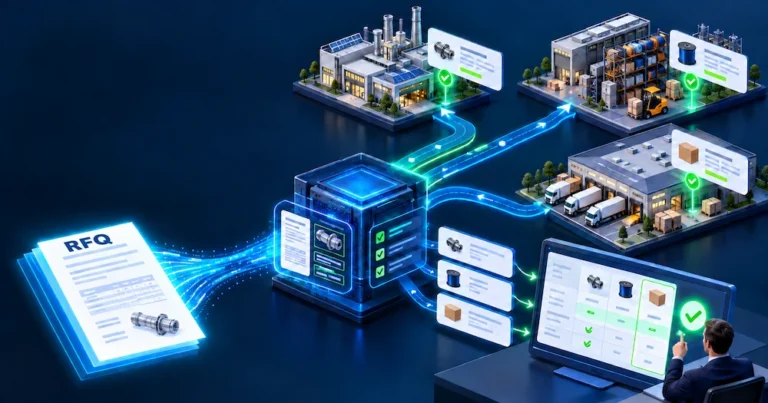

What Is AI-Driven Demand Sensing?
AI-driven demand sensing is the use of machine learning and recent operational signals to detect near-term changes in demand more quickly than a conventional periodic forecast.
A traditional demand forecast may rely heavily on historical sales, seasonality, and long-range assumptions. Demand sensing supplements this view with more recent information such as current orders, shipment velocity, distributor inventory, point-of-sale activity, promotions, pricing changes, customer behavior, weather, market events, and supply constraints.
The objective is not to replace the approved demand plan every time a new signal appears. It is to identify meaningful changes, estimate their likely impact, and help planners decide whether production, replenishment, or inventory allocation should be adjusted.
Demand forecasting versus demand sensing
| Area | Traditional Demand Forecasting | AI-Driven Demand Sensing |
|---|---|---|
| Primary Horizon | Medium- to long-term planning | Near-term operational planning |
| Typical Inputs | Historical sales, seasonality, and business plans | Recent orders, shipments, inventory, channel signals, and external events |
| Refresh Frequency | Weekly, monthly, or planning-cycle based | Daily, intraday, or event-driven where appropriate |
| Main Purpose | Establish the expected demand baseline | Detect and respond to short-term deviations |
| Output | Baseline forecast by product, region, or period | Updated forecast, exception alert, or recommended response |
| Human Role | Review assumptions and approve the demand plan | Review signal credibility, exceptions, and operational actions |
Demand sensing and demand forecasting should work together. Demand forecasting provides the planning baseline. Demand sensing evaluates whether recent evidence suggests that the near-term outlook has changed.
How Does AI for Demand Sensing Work?
An AI demand-sensing workflow usually follows six connected stages.
1. Collect current demand and operational signals
The system collects approved data from enterprise and external sources. Depending on the manufacturer, this may include:
- Customer orders and order changes
- Sales history and open orders
- Shipments, returns and cancellations
- Distributor or retailer inventory
- Point-of-sale and channel data
- Promotions and price changes
- Product availability and allocation
- Production plans and actual output
- Material shortages and supplier delays
- Warehouse inventory and transfer orders
- Lead times and transportation events
- Weather, economic or market signals
More data does not automatically create a better forecast. Each source needs a clear business meaning, appropriate timing, reliable identifiers, and sufficient historical coverage.
2. Align and validate the data
Demand signals often arrive at different frequencies and levels of detail. One source may use daily SKU-location records while another reports weekly product-family totals. Product names, customer identifiers, units of measure, locations, and timestamps must be reconciled before the information can be modeled.
The system should detect missing data, duplicates, late feeds, extreme values, and inconsistent product mappings. Weak validation can cause the model to interpret a data problem as a genuine demand change.
3. Establish the baseline forecast
Demand sensing needs a baseline against which new signals can be evaluated. That baseline may come from an existing planning application, an enterprise forecast, or a machine-learning model.
The model should account for relevant demand patterns such as trend, seasonality, intermittent demand, product substitution, promotions, customer concentration, and new-product introductions. The appropriate method varies by product type and planning horizon.
4. Detect meaningful demand changes
AI models compare recent signals with the baseline and estimate whether a change is likely to persist. For example, the system might detect that orders for a component are accelerating across several customers, that a promotion is performing above plan, or that distributor inventory is falling more quickly than expected.
Not every variation should trigger a response. The solution should distinguish routine noise from changes that could materially affect production, inventory, or customer service.
5. Recommend a planning response
The solution may recommend actions such as:
- Increase or reduce near-term production
- Rebalance inventory between locations
- Adjust replenishment quantities
- Review safety-stock settings
- Reserve constrained materials
- Expedite a purchase order
- Reprioritize customer allocation
- Investigate an unusual order pattern
These recommendations should respect capacity, material availability, labor, lead times, quality requirements, service policies, and contractual commitments.
6. Capture planner decisions and outcomes
Planners should be able to accept, reject, or modify a recommendation and document the reason. Those decisions, together with actual demand and operational results, create valuable feedback for future model improvement.
Manufacturers that need help connecting forecast outputs with implementation decisions can review this guide to choosing an AI demand forecasting implementation consultant.
What Data Does a Manufacturer Need?
The required data depends on the planning problem, but most implementations use a combination of demand, inventory, production, supply, and commercial information.
| Data Source | Example Fields | Demand-Sensing Use |
|---|---|---|
| ERP | Orders, customers, products, prices, shipments, and backorders | Establish recent demand and commercial activity |
| MES | Production schedules, output, yield, downtime, and work-in-progress | Determine whether sensed demand can be fulfilled |
| WMS | On-hand stock, allocated stock, receipts, transfers, and dispatches | Measure inventory availability by location |
| CRM and Channel Systems | Opportunities, customer activity, and distributor information | Identify early commercial or channel signals |
| Planning Systems | Baseline forecasts, overrides, scenarios, and targets | Compare sensed demand with the approved plan |
| Procurement and Supplier Systems | Purchase orders, lead times, shortages, and supplier performance | Evaluate supply feasibility and material risk |
| External Data | Weather, events, market indicators, and commodity signals | Add context where external factors affect demand |
Data quality should be assessed at the same level where decisions will be made. A dataset may look complete at a monthly product-family level but still be unreliable for daily SKU-location decisions.
How AI-Powered Demand Sensing Improves Inventory Optimization
AI-powered demand sensing and inventory optimization are closely connected. A demand signal has limited value if it never changes a replenishment, allocation, production, or inventory decision.
Reduce stockout risk
When recent demand begins exceeding the baseline, the system can identify products and locations at risk of running out. Planners can then evaluate whether to increase production, expedite supply, transfer inventory, or prioritize specific customers.
Limit excess inventory
Demand sensing can also identify products whose orders, consumption, or channel movement are weakening. This provides an earlier opportunity to reduce replenishment, revise production, redirect inventory, or limit additional purchases.
Improve safety-stock decisions
Safety stock should reflect demand variability, lead-time uncertainty, service targets, and product criticality. Demand sensing can provide more current estimates of variability, but changes to safety stock should follow approved inventory policies rather than being driven by a single short-term signal.
Support inventory prioritization
When materials or capacity are constrained, the system can help planners understand which products, customers, and locations face the greatest service risk. This supports a more informed allocation decision.
Connect demand with production planning
An updated demand estimate must be tested against real production constraints. This includes available capacity, machine downtime, labor, changeovers, material supply, quality holds, and maintenance plans. The relationship between forecasts and factory decisions is explored further in AI in production planning.
How AI Supports Global Inventory Balancing Through Demand Sensing
Multi-site manufacturers often have inventory in the network while still experiencing local shortages. Stock may be available at the wrong plant, warehouse, region, or stage of production.
AI-based global inventory balancing combines sensed demand with:
- On-hand and available-to-promise inventory
- Expected receipts and production output
- Transfer lead times and transportation costs
- Product shelf life or obsolescence risk
- Customer priorities and service commitments
- Regional restrictions and compliance requirements
- Capacity and material constraints
The system can identify potential transfers or allocation changes before recommending new production or procurement. For example, if one distribution center faces an expected shortage while another carries excess stock, the system can compare transfer cost, timing, demand uncertainty, and service impact.
The final decision should remain governed by business rules. A mathematically efficient transfer may still be inappropriate because of customer commitments, packaging differences, regulatory restrictions, quality status, or transportation risk.
Demand Sensing Software: Buy vs Build AI
The right approach depends on the manufacturer’s process maturity, integration requirements, available technical capabilities, and need for differentiation.
Buy a packaged solution when:
- Planning processes are relatively standardized
- Existing ERP or supply-chain platforms are already supported
- Common forecasting and inventory capabilities meet most requirements
- Faster configuration is more important than deep customization
- The organization wants vendor-supported upgrades and product roadmaps
Packaged software can reduce initial engineering work, but manufacturers should evaluate licensing, implementation, configuration, data preparation, integration, change management, and long-term operating costs.
Build a custom solution when:
- Demand patterns or product structures are highly specialized
- The workflow depends on proprietary operational signals
- Several legacy and industrial systems must be connected
- Planning policies differ significantly across plants or business units
- Explainability, deployment, security or governance requirements are unusual
- Demand sensing creates a meaningful competitive advantage
Custom development provides greater control over models, workflows, interfaces, and integrations. It also requires clear product ownership, model monitoring, support, and continuous improvement. Manufacturers considering this route can evaluate custom AI solution development around their data, planning rules, and operational systems.
Use a hybrid approach when:
A hybrid approach combines packaged planning capabilities with custom models, data pipelines, decision services, or AI agents. This is often appropriate when the organization wants to preserve its current planning platform but needs better signal processing or industry-specific workflows.
| Evaluation Area | Buy | Build | Hybrid |
|---|---|---|---|
| Initial Deployment | Often faster after data and process preparation | Usually requires more design and engineering | Varies by integration scope |
| Customization | Limited to supported configurations and extensions | High | Targeted to differentiating workflows |
| Integration | Strongest within supported ecosystems | Can connect specialized and legacy systems | Preserves the platform while adding custom services |
| Model Control | Depends on vendor capabilities | Greater control over models and evaluation | Shared between platform and custom components |
| Operating Responsibility | Vendor plus internal administrators | Internal team or development partner | Shared responsibility |
| Best Fit | Standardized planning requirements | Specialized or differentiating processes | Existing platform with capability gaps |
What Should Manufacturers Look for in a Demand-Sensing Solution?
The best AI-driven demand sensing solution for manufacturers should be evaluated against the decision it needs to improve, not only its model features.
Relevant system integration
The solution should connect with the systems that hold demand, inventory, production, supply, and planning information. Integration should include error handling, data lineage, access controls, and monitoring.
Appropriate forecast granularity
Confirm whether the system can forecast at the required combination of SKU, customer, channel, location, and time horizon. More granular forecasting is not automatically more accurate or useful.
Signal transparency
Planners should be able to see which signals influenced a forecast revision. The system should distinguish historical patterns, current orders, promotions, external events, and operational constraints.
Scenario planning
Users should be able to test changes in demand, lead time, production capacity, service levels, or supply availability without altering the approved plan.
Human overrides and audit trails
Planner overrides should be captured with timestamps, reasons, and outcomes. This supports accountability and helps teams understand when human judgment improves or weakens performance.
Inventory and operational recommendations
The solution should connect predictions with actionable decisions such as replenishment, production, transfers, allocation, or exception review.
Governance and security
Access controls, data handling, model approval, change management, and audit logging should reflect the sensitivity of customer, supplier, pricing, and operational data.
Production monitoring
Model accuracy can decline as product mix, customer behavior, market conditions, and operational processes change. Ongoing monitoring should cover input data, forecast error, bias, overrides, workflow completion, latency, and operating cost. AI managed services can support monitoring, evaluation, incident management, and continuous optimization after deployment.
How to Pilot AI-Driven Demand Sensing
A focused pilot is more useful than attempting to transform the entire planning network at once.
1. Select a bounded planning problem
Choose one product family, plant, customer segment, warehouse, or region with measurable demand variability and a clear operational decision.
2. Establish the baseline
Measure current forecast error, forecast bias, stockouts, excess inventory, service level, expedite cost, inventory turns, and planner effort.
3. Assess data readiness
Validate identifiers, timestamps, units, historical coverage, missing records, and system ownership. Confirm that the available data represents the conditions expected in production.
4. Run the model in shadow mode
Generate demand-sensing outputs without changing production or inventory decisions. Compare the model with the existing process over the same products, locations, and time periods.
5. Review errors with planners
Investigate where the model performed well or poorly. Determine whether errors came from the model, missing data, unusual events, mapping problems, or business assumptions.
6. Introduce controlled recommendations
Begin with alerts and planner-reviewed recommendations. Define thresholds for escalation and identify decisions that always require human approval.
7. Expand after demonstrated value
Add products, locations, signals, and automated actions only after the pilot demonstrates repeatable operational value.
Organizations that need to define architecture, business value, governance, and an implementation roadmap before development can begin with AI consulting services.
How Should Demand-Sensing Performance Be Measured?
Forecast accuracy alone is not sufficient. Manufacturers should measure prediction quality and operational results against the previous planning baseline.
| Metric | What it indicates |
|---|---|
| MAE or WAPE | Size of forecast errors at the relevant planning level |
| Forecast bias | Persistent overforecasting or underforecasting |
| Forecast value added | Whether demand sensing improves the prior planning step |
| Stockout rate | Frequency of unavailable products or materials |
| Service level | Ability to fulfill demand according to customer commitments |
| Excess inventory | Inventory above approved targets or expected demand |
| Inventory turns | How efficiently inventory supports sales or production |
| Expedite cost | Cost created by late demand or supply responses |
| Planner override rate | Frequency with which users change recommendations |
| Recommendation acceptance | Percentage of recommendations approved and executed |
| Production stability | Effect on schedule changes, changeovers and operational disruption |
Results should be segmented by product, location, customer, horizon, demand pattern, and business condition. An aggregate improvement can conceal poor performance for strategically important products.
Demand sensing may also become part of a broader intelligent supply-chain operating model. This article on how agentic AI transforms manufacturing supply chains explains how forecasts can connect with inventory, sourcing, production, and logistics workflows.
Common Implementation Mistakes
Treating every new signal as useful
A source should be included because it improves a defined decision, not because it is available. Weak or redundant signals can add noise.
Ignoring forecast hierarchy
Product-family forecasts may not reconcile with SKU-level forecasts, and regional forecasts may conflict with plant or warehouse plans. The solution needs clear reconciliation rules.
Optimizing accuracy without operational feasibility
A more accurate demand estimate has little value if production, material, labor, or logistics constraints make the recommended response impossible.
Automating decisions too early
Demand-sensing recommendations should first be evaluated in shadow mode and reviewed by planners. Automation can be introduced gradually for bounded, well-understood decisions.
Failing to monitor drift
Models can degrade as customers, products, channels, and market conditions change. Monitoring and retraining responsibilities should be defined before launch.
Measuring only average accuracy
Average metrics can hide repeated underforecasting, poor performance for high-value items, or unstable results during promotions and disruptions.
Conclusion
The best AI-driven demand sensing solution for manufacturers is not simply the product with the most algorithms or dashboards. It is the solution that reliably converts current demand and operational signals into explainable, governed, and actionable planning decisions.
Manufacturers should begin with a specific decision, validate the required data, compare buy, build, and hybrid approaches, and test the solution against an existing baseline. The strongest implementations connect demand sensing with inventory, production, procurement, logistics, and planner workflows while retaining human control over consequential decisions.
When implemented carefully, AI-driven demand sensing can help manufacturers respond earlier to changing demand, improve inventory positioning, reduce avoidable shortages and excess, and make production planning more resilient.
Ready to Turn Demand Data Into Reliable, Governed Forecasts?
Schedule a ConsultationFAQs
Demand forecasting establishes an expected demand baseline, often over medium- or long-term horizons. Demand sensing uses recent orders, shipments, inventory, channel activity, and external signals to identify short-term deviations from that baseline.
It can help manufacturers identify excess and shortage risks earlier, but inventory reduction is not guaranteed. Results depend on forecast quality, lead times, supply reliability, inventory policies, operational response, and service-level requirements.
Manufacturers should buy when their planning processes are standardized and supported by a packaged platform. They should consider building when requirements, data, models, integrations, or decision workflows are highly specialized. A hybrid approach can extend an existing planning platform with custom AI capabilities.
Common integrations include ERP, MES, WMS, CRM, demand-planning, procurement, supplier, logistics, data-platform, and business-intelligence systems. The required systems depend on the decision being improved.
Manufacturers can use MAE, WAPE where appropriate, forecast bias, and forecast value added. They should also measure stockouts, service levels, excess inventory, inventory turns, expedite costs, planner overrides, and production stability.
No. Demand sensing helps planners detect changes, evaluate scenarios, and prioritize exceptions. Planners remain responsible for interpreting context, reviewing recommendations, coordinating stakeholders, and approving consequential decisions.