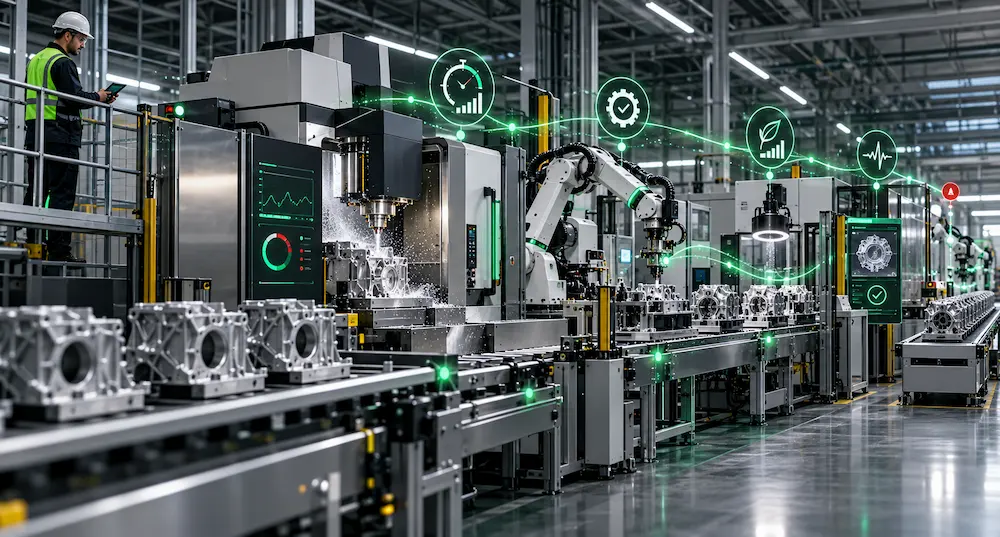

AI process optimization uses machine learning, mathematical optimization, simulation and real-time operational data to identify how a manufacturing process can achieve better outcomes within defined constraints.
Those outcomes may include higher throughput, consistent quality, lower scrap, reduced energy consumption, shorter changeovers or more stable production.
The important word is “constraints.” A useful AI system cannot simply recommend the setting associated with the highest output. It must consider equipment limits, material characteristics, safety requirements, product specifications, maintenance conditions and production priorities.
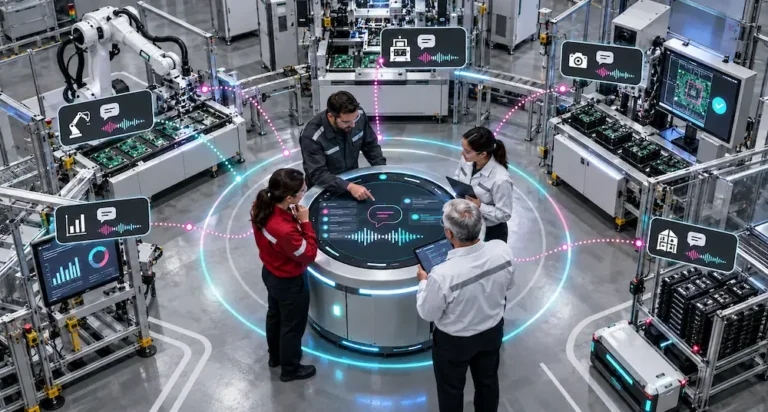
AI process optimization combines historical production data, current operating conditions and manufacturing constraints to predict process outcomes and recommend improved operating decisions.
A typical system collects information from machines, sensors, MES, QMS, ERP and maintenance applications. Models estimate outcomes such as yield, cycle time, energy consumption or failure risk. An optimization engine then evaluates possible actions, while operators and engineers review consequential recommendations.
What Is AI Process Optimization?
AI process optimization is the use of artificial intelligence to improve the performance of a production or business process.
It normally involves three related capabilities:
- Prediction: What is likely to happen under the current conditions?
- Prescription: Which action or parameter combination may produce a better outcome?
- Execution: How should an approved change enter the operational workflow?
Prediction alone is not optimization. A model may predict that a batch will fall outside specification, but an optimization system must also evaluate possible responses.
Traditional Process Optimization Vs AI
| Area | Traditional Approach | AI-Supported Approach |
|---|---|---|
| Decision Logic | Engineering rules and fixed models | Learned patterns combined with rules and constraints |
| Data | Selected variables and periodic samples | Historical, real-time, and contextual data |
| Relationships | Primarily known relationships | Can detect nonlinear and interacting variables |
| Updates | Periodic engineering review | More frequent recalculation as conditions change |
| Output | Fixed operating targets | Predictions, scenarios, or bounded recommendations |
| Human Role | Analyze and modify the process | Validate models, constraints, and recommended changes |
Traditional engineering models remain important. AI should complement process knowledge rather than replace it.
How AI-Driven Process Optimization Works
1. Define the Operational Objective
The project should begin with a measurable decision.
Examples include:
- Reduce cycle time without increasing defects
- Improve yield within equipment limits
- Reduce energy per unit
- Minimize changeover losses
- Improve schedule adherence
- Reduce unplanned downtime
- Balance output, quality and material cost
A model without a clearly defined objective may identify patterns without producing a useful operational decision.
2. Establish the Baseline
Measure current performance before introducing AI.
The baseline should cover:
- Throughput
- Yield
- Scrap and rework
- Cycle time
- Downtime
- Energy consumption
- Schedule adherence
- Changeover duration
- Cost per unit
- Quality deviations
Compare the AI-supported process against the same operating conditions and measurement definitions.
3. Connect Manufacturing Data
Data may come from:
- PLCs and machine controllers
- SCADA and DCS platforms
- Historians
- Manufacturing execution systems
- Quality management systems
- Maintenance systems
- ERP applications
- Laboratory systems
- Material and supplier records
- Environmental sensors
- Operator logs
Intellectyx’s AI intelligent automation services connect AI models and workflows with enterprise applications, databases and operational processes.
4. Align and Contextualize the Data
Manufacturing data frequently arrives at different frequencies and uses inconsistent identifiers.
A technical team may need to align:
- Machine and asset identifiers
- Product and batch numbers
- Timestamps
- Units of measurement
- Production states
- Shift information
- Maintenance periods
- Material lots
- Quality outcomes
Without operational context, a model may incorrectly compare normal production with startup, cleaning, changeover or maintenance conditions.
5. Build Predictive Models
Models estimate how process variables affect an outcome.
Depending on the use case, these may include:
- Regression models
- Gradient-boosted trees
- Neural networks
- Time-series models
- Anomaly-detection models
- Computer-vision models
- Survival and failure-risk models
- Hybrid physics and machine-learning models
The best model is not automatically the most complex one. Manufacturers should also consider interpretability, latency, maintenance effort and data availability.
6. Apply an Optimization Method
The predictive model estimates outcomes. The optimizer searches for an acceptable decision.
Common methods include:
- Linear and mixed-integer programming
- Constraint programming
- Bayesian optimization
- Evolutionary algorithms
- Multi-objective optimization
- Simulation-based optimization
- Model predictive control
- Reinforcement learning for carefully bounded applications
For example, the optimizer may search for process settings that maximize yield while remaining within temperature, pressure, speed and quality constraints.
7. Present Recommendations to the User
Results can be delivered through:
- Dashboards
- Alerts
- AI copilots
- Operator workstations
- Mobile applications
- MES or ERP workflows
- Maintenance systems
A production engineer should be able to see the recommendation, expected benefit, confidence, applicable constraints and supporting evidence.
8. Record the Decision and Outcome
Capture:
- The model recommendation
- The employee’s decision
- Any override
- The action taken
- The resulting process performance
This feedback allows teams to determine whether the system is generating measurable operational value.
Reference Architecture
| Architecture Layer | Function |
|---|---|
| Source Systems | PLC, SCADA, DCS, MES, ERP, QMS, CMMS, historian, and sensor data |
| Connectivity | OPC UA, MQTT, APIs, industrial gateways, events, and data pipelines |
| Data Platform | Time-series storage, lakehouse, master data, and contextual models |
| Analytics | Feature engineering, anomaly detection, and predictive models |
| Optimization | Constraints, objectives, simulation, and optimization algorithms |
| Copilot or Agent | Explanation, scenario analysis, workflow coordination, and escalation |
| Integration | MES, ERP, maintenance, quality, and planning application updates |
| Governance | Identity, permissions, approval, audit logs, and model controls |
| Operations | Monitoring, drift detection, retraining, and performance improvement |
AI Capabilities in Manufacturing Process Optimization
Predictive Quality
AI can estimate quality outcomes before final inspection by analyzing process parameters, material information and historical results.
Anomaly Detection
Models can detect patterns that differ from normal production, helping teams investigate problems before alarms or quality failures escalate.
Computer Vision
Vision models can identify surface defects, assembly errors, missing components and process abnormalities.
Predictive Maintenance
Equipment-condition models estimate degradation or failure risk so maintenance can be coordinated with production priorities.
Production Scheduling
AI can help planners evaluate demand, capacity, changeovers, labor, material and maintenance constraints.
Energy Optimization
Models can compare production output with energy consumption to identify inefficient equipment states or operating patterns.
Generative AI Copilots
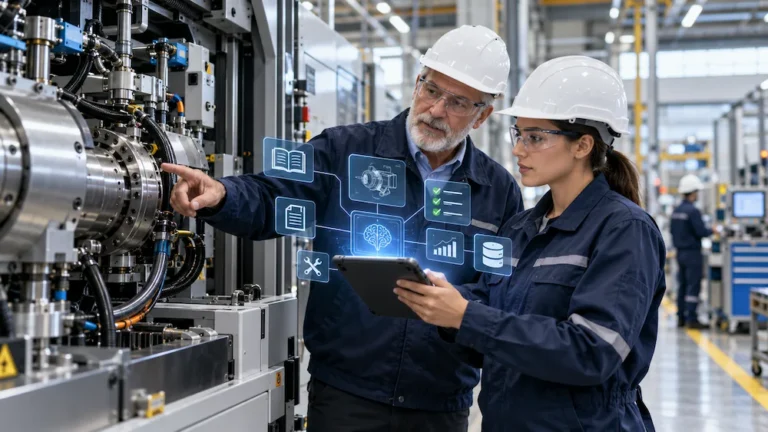
Copilots provide a natural-language interface for retrieving process information, explaining model outputs and evaluating scenarios.
Agentic Workflow Coordination
AI agents can gather data, monitor exceptions, prepare recommendations and route approved tasks across systems.
The AI agent development services offered by Intellectyx include process-optimization and scheduling agents for manufacturing environments.
Daily AI Applications for Optimizing Manufacturing Processes
Practical daily applications include:
- Recommending line schedules
- Prioritizing maintenance inspections
- Identifying drifting process variables
- Detecting defects during production
- Comparing current runs with successful historical runs
- Predicting quality before laboratory results arrive
- Recommending production sequences
- Investigating recurring downtime
- Adjusting inventory and production priorities
- Summarizing shift conditions
- Identifying energy-intensive operating states
- Escalating process exceptions
The AI should be inserted into an existing operational decision rather than presented as a separate analytics experiment.
AI Process Optimization in Semiconductor Manufacturing
Semiconductor manufacturing involves hundreds of tightly controlled process steps, expensive equipment and complex interactions between recipes, materials and environmental conditions.
AI applications may include:
- Virtual metrology
- Yield prediction
- Equipment-health monitoring
- Wafer-map defect analysis
- Recipe optimization
- Fault detection and classification
- Run-to-run control support
- Root-cause investigation
A major challenge is delayed feedback. Final yield may only become available after multiple downstream stages. Models must connect early process conditions with later outcomes while accounting for product and tool differences.
The article on implementing AI in electronics manufacturing provides a broader implementation framework for planning, inspection, maintenance and process optimization.
AI Applications in Battery Electrode Manufacturing Process Optimization
Battery electrode manufacturing includes slurry preparation, coating, drying, calendering and other interdependent stages. Process settings can affect electrode structure, conductivity, density and eventual cell performance.
AI can help teams:
- Model interactions between process variables
- Predict electrode properties
- Identify unstable operating regions
- Optimize multiple objectives simultaneously
- Reduce experimental cycles
- Connect quality results with upstream conditions
Research has demonstrated machine-learning-assisted, multi-objective optimization of electrode-manufacturing parameters using physics-based simulation data.
Recommendations still require experimental validation because laboratory data, simulation data and production-scale behavior may differ.
How Aerospace Consultants Integrate AI to Optimize Manufacturing
Aerospace manufacturing involves tight tolerances, extensive traceability, specialized materials and regulated quality processes.
Consultants may integrate AI through:
- Digital-thread architectures
- Engineering simulation
- Digital twins
- Computer-vision inspection
- Predictive maintenance
- Production scheduling
- Nonconformance analysis
- Supplier-risk monitoring
- Technician knowledge assistants
The technical challenge is maintaining traceability. Recommendations should link back to approved engineering data, process specifications and quality evidence.
Digital twins can allow engineers to test potential production changes before introducing them to the physical process. NVIDIA, for example, positions AI-accelerated digital twins and engineering simulation as manufacturing development capabilities.
How AI Services Help Optimize Automotive Manufacturing Processes
Automotive optimization spans stamping, welding, painting, powertrain, battery assembly, final assembly and supplier coordination.
Potential applications include:
- Welding-quality prediction
- Paint-process optimization
- Assembly-line balancing
- Predictive equipment maintenance
- Computer-vision inspection
- Battery-production optimization
- Changeover planning
- Supplier and inventory coordination
The Intellectyx guide to AI services for optimizing automotive manufacturing processes explains how shop-floor data can support dashboards, copilots and operational alerts.
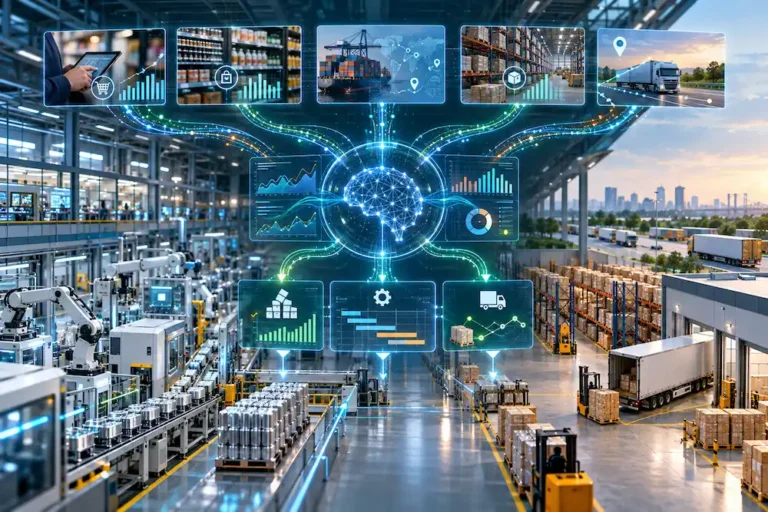
How Can AI Optimize Manufacturing and Supply-Chain Processes?
Manufacturing and supply-chain decisions are interconnected.
A production recommendation may fail if the required materials are delayed. An inventory decision may create excess stock if production capacity is constrained.
AI can connect:
- Demand signals
- Inventory positions
- Supplier lead times
- Production capacity
- Equipment availability
- Labor constraints
- Transportation conditions
- Customer priorities
An AI-supported workflow can detect a shortage, identify affected orders, evaluate alternative schedules and present options to planners.
The article on agentic AI in manufacturing supply chains explains how agents can coordinate demand, inventory, procurement and production information.
Human-Guided Versus Closed-Loop Optimization
Manufacturers can introduce optimization through four maturity levels.
| Level | System Behavior | Human Control |
|---|---|---|
| Advisory | Presents insights and recommendations | Employee decides and acts |
| Guided | Prepares an action or parameter change | Employee approves |
| Supervised Automation | Executes low-risk actions within boundaries | Employee reviews exceptions |
| Closed-Loop Optimization | Adjusts validated process variables automatically | Engineering governance and independent safeguards |
Closed-loop control requires more validation than a decision-support dashboard. Generative AI should not be treated as a replacement for validated process-control logic, safety systems or engineering safeguards.
How to Pilot AI for Process Optimization
Choose One Constrained Process
Select a process with measurable outcomes, sufficient data and a clear operational owner.
Establish Current Performance
Measure the existing process using consistent definitions.
Run the Model in Shadow Mode
Generate recommendations without changing production. Compare them with actual decisions and outcomes.
Review Errors With Process Experts
Determine whether errors originate from the model, data, constraints or an incomplete understanding of the process.
Introduce Human-Approved Recommendations
Allow authorized employees to approve, reject or modify proposed actions.
Expand Carefully
Increase automation only after the organization has evidence that the model remains reliable under different products, shifts and operating conditions.
Monitor Production Performance
Manufacturing models can deteriorate as equipment, materials, products and operating practices change. Intellectyx’s AI managed services cover model evaluation, drift detection, performance optimization and production support.
How to Measure AI Process-Optimization Results
Track model and operational performance together.
Technical Measures
- Prediction error
- False-positive and false-negative rates
- Model confidence
- Data completeness
- Latency
- Drift
- Availability
Operational Measures
- Yield
- First-pass yield
- Scrap
- Rework
- Throughput
- Cycle time
- Downtime
- Energy per unit
- Changeover time
- Schedule adherence
- Cost per unit
A highly accurate model does not automatically create value. Employees must be able to act on its recommendations within the available production window.
Common Implementation Challenges
Insufficient Process Context
Sensor values without product, batch, shift and equipment-state context can mislead a model.
Unclear Objectives
Optimizing throughput alone may reduce quality or increase energy consumption.
Poor Integration
Recommendations that remain in a separate dashboard may not influence daily decisions.
Changing Production Conditions
New products, materials, tools and maintenance states can affect model performance.
Lack of Operator Trust
Operators may reject recommendations when evidence and assumptions are hidden.
Excessive Automation
Granting direct control before validation can create operational and safety risks.
Missing Lifecycle Ownership
Someone must remain accountable for data pipelines, models, integrations, controls and operational outcomes.
Conclusion
AI process optimization can improve manufacturing decisions by connecting predictive models, operational constraints and optimization methods with daily production workflows.
Its value does not come from an algorithm alone. Manufacturers need contextualized data, process expertise, validated constraints, integration, human oversight and continuous monitoring.
Begin with one measurable process, compare the AI-supported approach with the current baseline and expand only after demonstrating reliable operational value.
Ready to Optimize Your Manufacturing Processes With AI?
Talk to Our Manufacturing AI ExpertsFAQs
AI analyzes machine, process, quality, maintenance and production data to predict outcomes. An optimization engine evaluates possible actions, and authorized employees review or approve the recommendation.
Yes, when reliable real-time data, validated models, low-latency infrastructure and clearly defined operating limits are available. Not every process requires or supports real-time optimization.
Common inputs include sensor signals, process parameters, production records, quality results, maintenance history, material information and equipment states.
No. Process engineers define objectives, validate constraints, interpret recommendations and approve consequential changes.
AI can connect demand, inventory, supplier, capacity, maintenance and logistics data to identify constraints and evaluate coordinated production and supply-chain decisions.