
Introduction
Something decisive happened in boardrooms across North America in 2026: AI stopped being a line item in the innovation budget and became the operating system of the enterprise.
According to McKinsey’s 2025 State of AI Report, 78% of organisations now use AI in at least one business function – up from 55% just two years prior. And for the first time, the majority of those organisations are reporting measurable revenue impact.
The driver behind this acceleration is AI powered solutions – integrated systems that combine large language models, autonomous agents, machine learning, and workflow automation to transform how businesses operate, decide, and compete.
This is no longer about experimenting with a chatbot or a recommendation engine. Businesses investing in AI today are deploying enterprise-grade systems that manage processes end-to-end, make decisions in real time, and continuously improve with use.
In this blog, we break down exactly why that investment is happening, where it’s delivering the highest return, and what business leaders need to know to choose the right AI solution for their organisation.
What Are AI Powered Solutions?
Before examining the investment rationale, it’s worth being precise about what “AI powered solutions” actually means in 2026.
AI powered solutions are software systems that use artificial intelligence – including machine learning, natural language processing, computer vision, and large language models – to automate tasks, generate insights, and make decisions that would otherwise require significant human effort.
Unlike traditional software that executes fixed rules, AI powered solutions adapt. They learn from data, reason through ambiguous situations, handle unstructured inputs like documents and voice, and improve their own performance over time.
Modern artificial intelligence business applications span a wide range:
- Autonomous AI agents that execute multi-step workflows without human intervention
- Predictive analytics platforms that surface risk and opportunity before they become visible in reports
- Generative AI tools that draft communications, contracts, and reports at scale
- Computer vision systems that inspect, classify, and act on visual data in real time
- Conversational AI that handles customer service, sales, and internal support around the clock
What unites them is a shift from AI as a tool to AI as a participant in business operations – one that works alongside human teams to amplify what they can achieve.
Why Businesses Are Investing in AI in 2026
1. Competitive Pressure Is No Longer Deniable
The most powerful driver of AI adoption in business in 2026 is not optimism – it is competitive fear. When a competitor can process loan applications in 10 minutes, respond to customer inquiries in seconds, or forecast supply chain disruptions days in advance, the organisations that cannot do the same face a structural disadvantage that compounds over time.
Gartner forecasts that by the end of 2026, organisations that have deployed AI at scale will outperform peers on operating margin by an average of 12 percentage points. That is not a marginal difference – it is the kind of performance gap that reshapes industries.
For C-suite leaders, the question has shifted from “should we invest in AI?” to “how fast can we deploy it safely?”
2. ROI Has Become Demonstrable
In the early years of enterprise AI, the business case was largely theoretical. Today, the benefits of AI for business are documented, measured, and replicable across industries.
Organisations deploying AI powered solutions are reporting:
- 40–60% reduction in manual processing time for document-heavy workflows (financial services, insurance, legal)
- 25–35% improvement in forecast accuracy for demand planning and inventory management
- 50–70% decrease in first-response time for customer service operations
- 20–30% cost reduction in back-office operations through intelligent workflow automation
These are not pilot-project numbers. These are production results from organisations that have moved past proof of concept and into enterprise-wide deployment.
Looking to implement AI powered solutions in your organization?
3. AI Technology Has Crossed the Enterprise Readiness Threshold
For much of the last decade, enterprise leaders were right to be cautious. AI tools were brittle, opaque, difficult to integrate, and hard to govern. That landscape has changed fundamentally.
Enterprise AI solutions in 2026 come with the security, compliance, observability, and integration capabilities that enterprise IT teams require. Leading platforms support role-based access controls, audit trails, on-premise or private cloud deployment, and integration with existing ERP, CRM, and data infrastructure.
The technical barriers that once justified a “wait and see” stance have largely fallen. What remains is the strategic and organisational challenge of deploying AI effectively – and that is where the right partner makes all the difference.
Key Benefits of AI Powered Solutions for Business
Understanding the benefits of AI for business requires looking beyond efficiency gains to the strategic advantages AI powered solutions create:
Operational Efficiency at Scale AI powered automation eliminates the throughput ceiling that limits human-only operations. A well-deployed AI agent doesn’t have shift hours, doesn’t get fatigued, and can handle thousands of tasks simultaneously. For businesses dealing with high-volume, repetitive processes, this is transformative.
Decision Quality and Speed AI systems synthesise data from across the enterprise – CRM, ERP, financial systems, market feeds – and present decision-relevant insights in seconds. Business leaders make better decisions, faster, with less cognitive load.
Consistent Customer Experience AI-driven customer service systems deliver consistent, personalised responses at any hour and any scale. Whether it’s a conversational AI handling service requests or an AI agent managing the entire onboarding process, the customer experience improves as volumes grow – not deteriorates.
Continuous Improvement Unlike traditional software that stays static until the next update, AI powered solutions learn. Every interaction, every decision, every outcome feeds back into the system. Over time, performance improves automatically – compounding the initial investment.
AI-Driven Business Growth Perhaps most importantly, businesses that deploy AI effectively unlock new growth vectors – new products, new markets, new revenue streams – that were simply not accessible before. Generative AI, for example, is enabling enterprises to create personalised content, products, and services at a scale that no human team could match.
How AI Workflow Automation Is Reshaping Operations
The single highest-volume keyword in our research – AI workflow automation – points to the area of greatest immediate business impact.
Manual workflows are the silent cost centre of every enterprise. The hours spent routing documents, chasing approvals, re-entering data between systems, and escalating exceptions represent an enormous, largely invisible drain on productivity and morale.
AI workflow automation attacks this directly. By deploying AI agents that can read documents, extract data, make decisions, call APIs, and update systems across the enterprise, organisations are automating entire process chains that previously required multiple human handoffs.
At Intellectyx, we help enterprises automate internal workflows using AI agents – from procurement and finance operations to HR onboarding and compliance reporting. The results consistently show time savings of 60–80% on targeted processes, with accuracy improvements that reduce downstream error costs.
Examples of high-value workflow automation use cases include:
- Invoice and AP processing – AI agents extract invoice data, validate against purchase orders, flag exceptions, and process payments without human touch
- Employee onboarding – AI orchestrates document collection, system provisioning, and training scheduling across HR, IT, and line-of-business systems
- Regulatory compliance reporting – AI agents pull data from multiple systems, perform calculations, and generate regulatory submissions with full audit trails
- Customer onboarding – AI processes applications, verifies identity, performs risk checks, and personalises welcome communications end to end
For organisations thinking about AI workflow automation compliance solutions, these deployments also deliver a governance benefit: every action taken by an AI agent is logged, traceable, and auditable.
AI Agent Solutions: The Next Frontier of Business Intelligence
If AI workflow automation is transforming how work gets done, AI agent development services are transforming what AI can do for your business strategy.
AI agents are autonomous software systems that can pursue complex goals, use tools, gather information, reason through multi-step problems, and collaborate with other agents to complete enterprise-scale tasks. They are the most powerful expression of AI powered solutions available today.
Businesses are deploying AI agents for:
- Sales intelligence – agents that research prospects, personalise outreach, and update CRM records in real time
- Financial analysis – agents that monitor portfolio risk, model scenarios, and generate investment recommendations
- Supply chain management – agents that track inventory, model demand, identify supplier risks, and initiate procurement actions autonomously
- Customer service – agents that handle complex service requests, access customer history, resolve issues, and escalate intelligently when needed
Custom AI agent development services allow organisations to build agents tailored to their specific processes, data environments, and industry requirements – rather than deploying generic tools that require organisations to adapt to the software.
For enterprise leaders considering agent deployments, understanding the AI agent implementation business benefits – and the architecture required to support them – is critical before making technology decisions. You can also explore what enterprise-ready AI agents require from a CTO’s perspective before scaling.
Industry Use Cases: Where AI Powered Solutions Are Delivering Results
Financial Services
Banks and lenders are using enterprise AI solutions to automate loan processing, detect fraud in real time, generate compliance reports, and personalise client communications. Processing times that once took days are measured in minutes. AI in lending is transforming modern credit operations – dramatically reducing operational cost while improving credit decision accuracy.
Healthcare
Healthcare organisations deploy AI powered solutions for clinical decision support, prior authorisation automation, patient scheduling, and medical record analysis. AI agents navigate complex regulatory requirements while reducing administrative burden on clinical staff.
Manufacturing
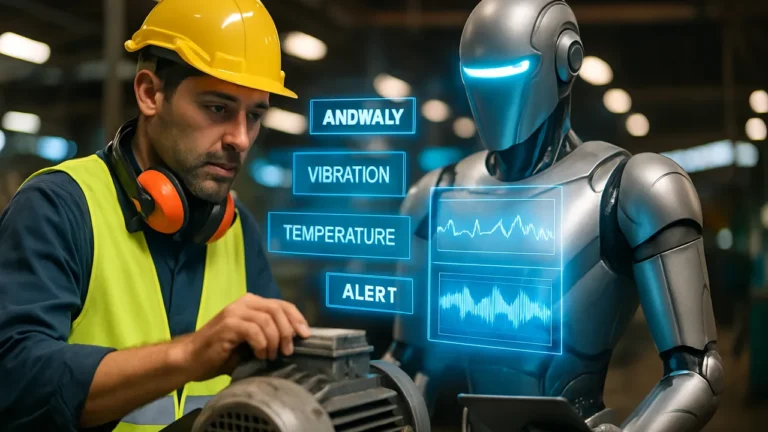
AI solutions for business in manufacturing span predictive maintenance, quality inspection, production planning, and supply chain optimisation. AI applications in manufacturing are demonstrating measurable ROI in reduced downtime, lower defect rates, and improved throughput.
Retail and E-Commerce
Retailers use AI powered solutions for dynamic pricing, personalised marketing, inventory optimisation, and AI call center solutions that handle customer inquiries at scale. The result is higher conversion, lower churn, and more efficient supply chains.
Mid-Sized Businesses
AI is no longer exclusively a large-enterprise capability. AI for mid-sized companies has become highly accessible – with cloud-based platforms and modular AI agent deployments that deliver enterprise-grade capabilities at SMB-appropriate cost structures.
Turn AI investments into business results.
How to Choose AI Solutions for Operational Expansion
To choose AI solutions for operational expansion, identify the process that needs to handle more volume, locations, or customers. Set a measurable goal, assess your data and existing systems, and compare solutions based on integration, oversight, operating cost, and ability to scale. Test one workflow before expanding deployment.
1. Start with the business problem, not the technology The most successful AI deployments begin with a clearly defined business problem – a process that is too slow, too costly, too error-prone, or too capacity-constrained. Define the outcome you need before evaluating technology options.
2. Assess your data readiness AI powered solutions are only as effective as the data they operate on. Before deploying, evaluate data quality, accessibility, and governance. Organisations that invest in data readiness before AI deployment consistently see faster time to value.
3. Prioritise integration architecture Your AI solution needs to connect to your existing systems – CRM, ERP, HRIS, data warehouse. Evaluate how each solution integrates with your stack and what the ongoing maintenance burden looks like.
4. Demand observability from day one Every production AI deployment should include monitoring, logging, and performance tracking. You need to know how your AI agents are performing, where they’re failing, and how they’re improving over time.
5. Choose a partner with domain expertise Generic AI platforms deliver generic results. The organisations getting the most from AI are working with AI implementation consultants who understand both the technology and the specific industry context – not just one or the other.
6. Plan for scale from the start The goal is not a successful pilot – it is enterprise-wide impact. Choose solutions and partners that can grow with your ambitions, not just prove a point of concept.
Conclusion: The Window Is Now
The organisations gaining the most competitive advantage from AI powered solutions today share one thing in common: they started. They made a decision, scoped a high-value use case, chose the right partner, and built from there.
The barriers to entry have fallen. The ROI is proven. The competitive consequences of inaction are increasingly visible.
AI-driven business growth is not a future aspiration – it is a present reality for organisations that have made AI a strategic priority.
At Intellectyx, we help enterprises across North America design, build, and deploy AI powered solutions that are aligned to real business outcomes – not just technology capabilities. From AI agent development services and workflow automation to enterprise strategy and ongoing optimisation, we bring the expertise to make AI work for your organisation.
Speak to our AI experts today and discover how AI powered solutions can transform your business in 2026.
FAQs
AI powered solutions are software systems that use artificial intelligence – including machine learning, natural language processing, and autonomous agents – to automate tasks, generate insights, and make decisions at scale. They range from workflow automation tools to fully autonomous AI agents capable of managing complex enterprise processes end-to-end.
Traditional automation (like RPA) follows fixed rules and breaks when processes deviate. AI powered automation is adaptive – it understands unstructured inputs, handles exceptions intelligently, and improves over time. It can automate entire workflows, not just individual tasks.
AI powered solutions are increasingly accessible to small and mid-sized businesses through cloud-based platforms and modular deployments. SMBs use AI for customer service automation, sales intelligence, marketing personalisation, and back-office efficiency – gaining competitive capabilities previously available only to large enterprises.
Compliance in AI deployments requires audit trails, role-based access controls, explainability mechanisms, and ongoing performance monitoring. Leading AI powered solutions include governance frameworks built in – not bolted on after deployment.
Look for a partner with demonstrated experience deploying AI in your industry, a clear methodology for design through deployment, strong references, and the capability to support both the technical and organisational change aspects of adoption. Explore what to look for in an AI outsourcing partner before making your decision.
Most organisations see measurable ROI within 3–6 months of a well-scoped AI deployment. Workflow automation use cases often achieve payback in the first quarter. More complex agent deployments show accelerating returns as agents learn and improve over the first 6–12 months.