
Automotive customer service has traditionally been reactive. A vehicle owner experiences a problem, needs a service appointment, wants an update, or has a question and then contacts the dealership, service center, or automotive brand.
Proactive conversational AI changes this model.
Instead of waiting for customers to initiate every interaction, AI can use authorized customer, vehicle, service, and operational information to identify when communication may be needed and initiate the appropriate conversation.
For example, an automotive customer may receive a personalized service reminder before scheduled maintenance is due. A dealership can notify a customer about a recall, provide an update while a vehicle is being serviced, or follow up after a completed repair without requiring an employee to manually initiate every interaction.
This creates an opportunity for automotive companies to move from reactive customer support to proactive customer engagement.
What Is Proactive Conversational AI for Automotive Customer Service?
Proactive conversational AI for automotive customer service uses AI to anticipate customer needs and initiate relevant conversations across channels such as voice, chat, SMS, email, and messaging applications.
Traditional automotive chatbots generally wait for customers to ask a question.
Proactive conversational AI can initiate communication when a relevant event or customer need is identified.
For example:
Vehicle or Customer Event → AI Identifies Need → Personalized Outreach → Customer Conversation → Action → Human Escalation When Required
Current automotive implementations already use this model for maintenance reminders, recall notifications, service updates, appointment management, and follow-up communication.
How Is Proactive Conversational AI Different From a Traditional Automotive Chatbot?
A conventional chatbot primarily responds.
A proactive AI assistant can identify when a conversation should happen.
Consider scheduled vehicle maintenance.
A traditional chatbot might help a customer who visits a dealership website and asks to schedule an oil change.
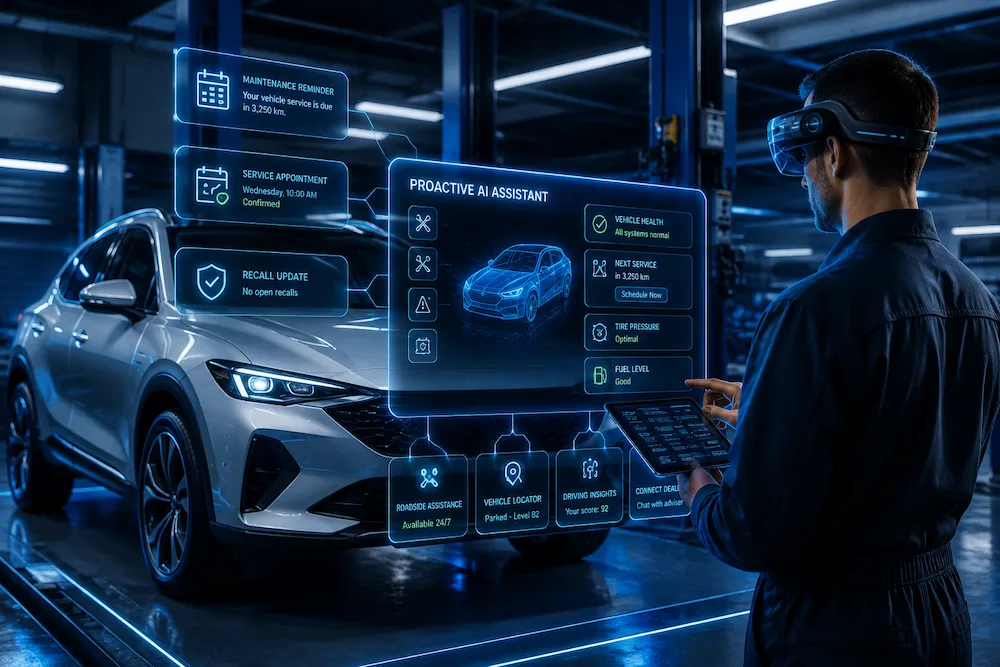
A proactive system could identify that maintenance is approaching based on available vehicle and service information, contact the customer, explain that service is due, offer available appointment times, and complete the booking.
The difference is:
Traditional AI
Customer Request → AI Response
Proactive Conversational AI
Customer or Vehicle Signal → AI Initiates Conversation → Customer Responds → AI Completes Workflow
That shift can make conversational AI part of the automotive customer lifecycle rather than simply another customer-support channel.
How Could Proactive AI Change the Way We Interact With Cars?
Most interactions with vehicles today are reactive. Drivers notice a warning light, realize maintenance is due, experience a problem, or need information before contacting the vehicle manufacturer, dealership, or service center.
Proactive AI could reverse this interaction.
Instead of waiting for the driver to recognize a need, AI can use authorized vehicle data, service history, driving context, and customer information to identify when assistance may be useful and initiate the conversation.
For example, a proactive AI assistant could notify a driver that maintenance is approaching, explain why a particular service may be required, identify a nearby authorized service center, check appointment availability, and help schedule the visit.
The interaction could evolve from:
Driver Identifies Problem → Searches for Information → Contacts Service Center → Schedules Service
to:
Vehicle Detects Need → AI Understands Context → Driver Is Notified → AI Recommends Action → Service Is Scheduled
The same model could extend to recall notifications, vehicle health alerts, roadside assistance, service-status updates, warranty questions, personalized vehicle guidance, and post-service follow-ups.
This is where proactive conversational AI for automotive customer service becomes more than a chatbot. Combined with AI-powered virtual assistants and connected automotive systems, it can create an ongoing interaction between the driver, vehicle, dealership, and service ecosystem.
AI-Powered Virtual Assistant Services for the Automotive Industry
AI-powered virtual assistant services for the automotive industry can support interactions throughout vehicle sales, ownership, servicing, and retention.
These assistants can operate across websites, mobile applications, voice calls, SMS, messaging channels, and other digital touchpoints.
Their role can include answering routine questions, retrieving authorized customer information, scheduling appointments, providing vehicle-service updates, qualifying inquiries, and escalating more complicated conversations to employees.
The technology is already being applied to automotive workflows such as service booking, vehicle troubleshooting, model comparison, and test-drive scheduling.
The more important opportunity, however, comes when virtual assistants are connected with automotive business systems rather than operating as isolated chat interfaces.
Proactive Vehicle Maintenance Reminders
Maintenance reminders are a natural use case because dealerships and service centers already possess information about vehicles, previous service activity, and recommended maintenance schedules.
An AI assistant can use authorized information to determine when outreach is appropriate.
Instead of sending every customer the same generic reminder, communication can become more contextual.
For example, the conversation could reference the customer’s vehicle, relevant maintenance requirement, dealership location, and available appointment options.
Automotive conversational AI platforms are already positioning proactive maintenance and service reminders as core applications.
Automated Service Appointment Scheduling
Appointment scheduling creates substantial repetitive work for automotive service departments.
Employees may need to answer calls, identify the vehicle, understand the requested service, check available appointments, confirm a time, and send reminders.
An AI agent can automate much of this workflow.
Customer Request → Identify Service Need → Check Availability → Offer Appointment → Confirm Booking → Send Reminder
AI voice agents are also increasingly being deployed for this purpose. For example, AutoRaptor launched an automotive AI voice agent in April 2026 designed to answer inbound dealership calls, capture lead information, qualify buyers, and schedule appointments directly in its CRM.
Proactive Recall Communication
Vehicle recalls create another opportunity for proactive customer communication.
Instead of relying primarily on customers to notice a recall notice and contact the dealership, AI can help automate outreach.
The assistant can explain that a recall applies, provide relevant information, answer common questions, and guide the customer toward scheduling the required service.
If the conversation becomes complex or sensitive, the interaction can be transferred to an employee with the relevant context.
Real-Time Vehicle Service Updates
One of the most common customer questions during vehicle servicing is simple:
“When will my car be ready?”
Employees may repeatedly answer these status questions while simultaneously coordinating technicians and service operations.
An AI assistant connected with authorized service information can provide status updates automatically.
The workflow could become:
Vehicle Checked In → Service Status Changes → Customer Notification → Customer Question → AI Response → Human Escalation if Needed
Some automotive AI customer-service providers already support proactive vehicle-ready notifications and service-status communications across channels.
Bringing Back Lost or Inactive Service Customers
Proactive conversational AI can also support customer retention.
A dealership may have customers who purchased vehicles or previously used its service department but have not returned for scheduled maintenance.
AI can identify appropriate customer segments and initiate personalized outreach based on authorized service information and business rules.
The objective should not be indiscriminate automated marketing.
Instead, AI can identify meaningful moments when a conversation is relevant, such as upcoming maintenance, missed service, declined work, or post-service follow-up.
Automotive Service AI platforms are already applying conversational AI to re-engagement, first-service outreach, declined services, and ongoing maintenance communication.
AI Voice Assistants for Automotive Customer Service
Voice is particularly important in automotive customer service because many customers still call dealerships and service centers directly.
An AI voice agent can answer common questions, capture customer information, schedule appointments, provide service information, and route more complicated conversations.
This can be particularly useful outside normal operating hours or during periods when service advisors are handling customers on site.
Rather than replacing service advisors, AI can absorb repetitive calls and allow employees to spend more time on conversations requiring automotive knowledge, judgment, negotiation, or customer relationship management.
Omnichannel Automotive Customer Service
Customers do not necessarily want every conversation to happen through the same channel.
One customer may prefer SMS for a maintenance reminder but call the dealership when they have a complicated service question.
Another might begin a conversation through website chat and later continue through messaging.
Automotive conversational AI can support interactions across voice, text, chat, and other digital channels, helping organizations provide more consistent experiences.
Ideally, context should follow the customer across these interactions rather than requiring them to explain the situation again.
From Virtual Assistants to AI Agents for Automotive Customer Service
This is where your existing service-page topic fits naturally.
Virtual assistants primarily focus on conversations.
AI agents for automotive customer service can extend those conversations into operational workflows.
Suppose a customer says:
“I think my vehicle is due for service next month.”
A conversational assistant could provide information about the recommended maintenance.
An AI agent could potentially go further:
Understand Request → Identify Customer → Retrieve Vehicle Information → Check Service History → Determine Relevant Service → Check Dealer Availability → Offer Appointment → Book Approved Slot → Send Confirmation
This transition from answering questions to completing workflows is one of the reasons AI agents are becoming increasingly relevant to automotive customer experience.
This same integration model can extend beyond customer conversations. Dealer management systems with AI integration can bring AI into inventory management, service operations, parts planning, lead management, customer engagement, and dealership analytics.
Where Should Automotive Companies Start?
Automotive companies should identify customer interactions that are both repetitive and valuable.
Service appointment calls, maintenance reminders, service-status questions, test-drive requests, recall communication, customer follow-ups, and frequently asked questions are strong candidates.
Then establish measurable outcomes.
For example:
Service Appointment Conversion
Missed Calls
Average Response Time
Customer Wait Time
Calls per Service Advisor
Service Retention
Customer Satisfaction
After-Hours Appointments
The objective should not simply be to deploy an AI assistant.
It should be to determine whether conversational AI improves customer experience while reducing repetitive work for dealership, service-center, and automotive customer-support employees.
How Intellectyx Builds AI Agents for Automotive Customer Service
Intellectyx develops custom AI agents that can integrate conversational experiences with automotive customer and operational systems.
Instead of creating another standalone chatbot, an automotive AI agent can be designed around workflows such as service appointment scheduling, maintenance reminders, customer inquiries, service-status updates, personalized engagement, and customer follow-up.
Agents can connect with relevant CRM, DMS, scheduling, service, customer, and enterprise systems so conversations can lead to actual workflow actions.
This creates a progression from:
Customer Question
to
Conversational AI
to
AI Agent
to
Connected Automotive Workflow
The result is an automotive customer-service model where AI does not simply wait for customers to ask questions. It can help organizations anticipate customer needs, initiate relevant conversations, complete routine workflows, and involve employees when human expertise is required.
FAQs
AI-powered virtual assistants can handle customer inquiries, schedule service appointments, provide vehicle information, send maintenance reminders, communicate repair status, support roadside requests, and escalate complex issues to human service teams.
Traditional chatbots typically respond after a customer initiates a conversation. Proactive AI can identify relevant customer or vehicle events and initiate an interaction, such as notifying a driver about upcoming maintenance and helping schedule a service appointment.
Yes. Custom automotive AI assistants can integrate with CRM, Dealer Management Systems (DMS), scheduling platforms, service systems, customer databases, and other enterprise applications. These integrations allow AI to access authorized information and complete workflows rather than simply answer questions.
Yes. Conversational AI can understand a customer’s service request, identify the vehicle, check available appointment slots, suggest suitable times, confirm the booking, and send reminders. Complex requests can be transferred to a service advisor when necessary.
Proactive AI could allow vehicles to anticipate when drivers need assistance instead of requiring them to identify every issue themselves. For example, AI could recognize a maintenance need, explain it to the driver, recommend an appropriate action, locate a service center, and help arrange an appointment.