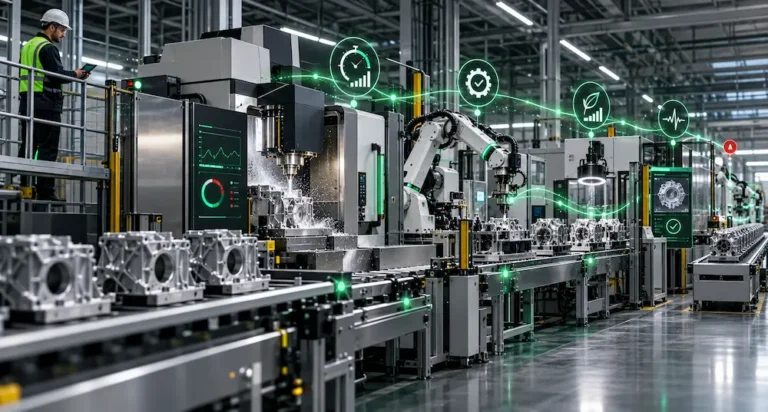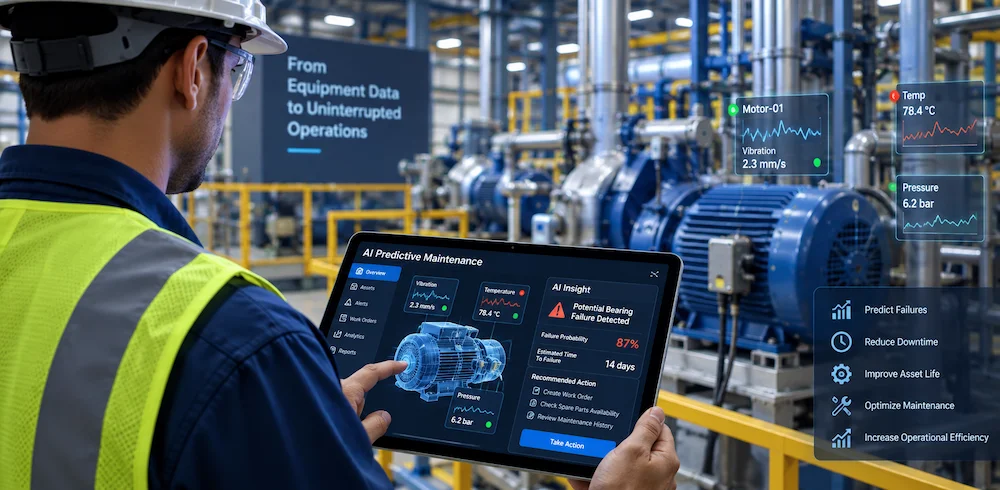

A critical machine rarely goes from healthy to failed without warning. Bearings vibrate differently as they wear. Motors run hotter. Pumps lose pressure. Gearboxes develop abnormal acoustic patterns. CNC equipment may show changes in spindle vibration or cycle performance. The warning signs are often there, but maintenance teams cannot manually monitor every signal across every asset around the clock.
AI-driven predictive maintenance for industrial equipment changes that equation. By analyzing sensor readings, operating conditions, maintenance history, and failure patterns, AI can identify developing equipment problems before they turn into unplanned downtime.
The next evolution goes beyond prediction. AI agents to predict equipment maintenance issues can help investigate an anomaly, determine its urgency, retrieve maintenance information, recommend an action, and coordinate the response with existing maintenance systems.
What Is AI-Driven Predictive Maintenance?
AI-driven predictive maintenance uses equipment condition data, operational information, maintenance history, and machine learning to identify abnormal behavior and predict potential failures. Instead of maintaining equipment only on a fixed schedule or after it breaks, manufacturers can intervene based on the actual and predicted condition of an asset.
What Is AI-Driven Predictive Maintenance for Industrial Equipment?
Industrial maintenance has traditionally followed two common approaches.
Reactive maintenance waits until equipment fails before repairs begin. While simple, an unexpected failure can interrupt production, damage connected equipment, create quality problems, and require expensive emergency maintenance.
Preventive maintenance is more proactive. Equipment is inspected or serviced according to predefined intervals, such as operating hours or calendar dates. The limitation is that equipment does not always deteriorate according to a fixed schedule. A component may fail before its planned maintenance date, while another may be replaced even though it still has significant useful life.
Predictive maintenance uses the condition of the equipment itself to determine when intervention may be needed.
AI makes this approach more powerful because models can continuously analyze large volumes of equipment and operational data, identify subtle patterns, and recognize combinations of conditions associated with deterioration.
The goal is not simply to generate more alerts. It is to give maintenance teams enough warning and context to act before a developing problem disrupts production.
How Does AI Predict Industrial Equipment Failures?
Predictive maintenance starts with understanding what normal equipment operation looks like.
Sensors and industrial systems can generate information about vibration, temperature, pressure, electrical current, flow, RPM, acoustic signals, lubrication conditions, cycle time, and other operating parameters. Historical work orders, inspections, repairs, and failure records add another layer of context. Manufacturers processing these signals across many machines can follow this guide to deploying AI agents for large-scale machine sensor data analysis, including edge processing, streaming pipelines, anomaly detection, system integration, and AgentOps.
Machine learning models can analyze these signals to establish normal operating patterns. When equipment begins behaving differently, the system can identify an anomaly even when an individual measurement has not crossed a traditional alarm threshold.
More mature AI for equipment failure prediction can also connect these anomalies with known failure modes. For example, a particular combination of increasing vibration and temperature under certain operating conditions may indicate developing bearing degradation.
Depending on the equipment, data quality, and modeling approach, predictive systems can also estimate remaining useful life, helping maintenance teams understand not only that an asset is deteriorating but how urgently intervention may be required.
What Equipment Issues Can AI Detect Early?
The value of AI predictive maintenance for industrial equipment becomes clearer when applied to specific assets.
For motors and rotating equipment, vibration and temperature patterns can indicate bearing wear, imbalance, misalignment, or lubrication problems. Electrical-current analysis may reveal abnormal motor behavior that warrants investigation.
Pumps and compressors generate pressure, flow, temperature, and vibration data that can help identify cavitation, leaks, component degradation, or declining operating efficiency.
Gearboxes can be monitored for changes in vibration and acoustic patterns associated with gear wear, lubrication issues, or damaged components.
For CNC machines and other production equipment, manufacturers can analyze spindle vibration, tool condition, temperature, cycle behavior, and machine performance to identify deterioration before it begins affecting throughput or product quality.
The same principles can extend to conveyors, fans, hydraulic systems, presses, production lines, and other assets where equipment condition can be measured.
The strongest candidates are generally not every machine in the plant. They are the assets where failure has a meaningful effect on production, safety, quality, maintenance cost, or downstream operations.
These condition-monitoring principles also apply to renewable-energy assets. AI for power electronics and renewable energy systems can analyze inverter, converter, battery, transformer, wind-turbine, and grid signals to support anomaly detection, generation forecasting, and maintenance decisions.
How AI Agents Predict Equipment Maintenance Issues
Traditional predictive maintenance is primarily designed to answer a question:
Is this equipment likely to fail?
An AI agent can help maintenance teams answer what comes next.
Suppose a model detects an unusual vibration pattern in a critical motor. A conventional system might generate an alert and leave the maintenance team to investigate it.
An AI maintenance agent could evaluate the anomaly against recent temperature readings, operating conditions, previous work orders, maintenance history, equipment specifications, and known failure patterns. It could then summarize the likely issue and assess its urgency.
If permitted, the agent could retrieve the relevant maintenance procedure, check the CMMS for previous repairs, identify whether the component has experienced similar problems, and prepare a recommended course of action.
The agent might determine that the motor should be inspected during the next planned production window rather than immediately shutting down the line. For a more severe anomaly, it could escalate the issue to a reliability engineer or maintenance supervisor.
This is where AI agents to predict equipment maintenance issues become different from another monitoring dashboard. The objective is to connect equipment intelligence with the maintenance workflow.
For safety-critical assets or consequential operational decisions, human review should remain an explicit part of that workflow.
AI Agents vs. Traditional Predictive Maintenance Systems
Traditional predictive maintenance systems are highly valuable, but their primary role is generally analytical. They monitor equipment, identify abnormal conditions, and generate predictions or alerts.
AI agents can add a coordination and reasoning layer around that prediction.
After receiving a failure-risk signal, an agent can gather additional context, compare the issue with historical events, determine which information matters, retrieve technical documentation, and recommend a next step.
That distinction matters because maintenance teams do not simply need to know that something looks wrong. They need to know why it matters, how urgent it is, what should be inspected, and what action should happen next.
The evolution is therefore from predicting equipment condition to helping coordinate the maintenance response.
How AI Predictive Maintenance Reduces Unplanned Downtime
Downtime is where predictive maintenance can translate directly into measurable business value.
The reason is straightforward. Earlier detection creates more time to act.
Instead of discovering a bearing problem after a machine stops, a maintenance team may identify degradation days or weeks earlier. The inspection can potentially be scheduled around production, replacement parts can be secured, and technicians can prepare before the equipment reaches a critical condition.
Predictive maintenance therefore isn’t only about avoiding breakdowns. It can also reduce emergency repairs, secondary equipment damage, unnecessary maintenance, and production uncertainty.
Equipment monitoring also supports AI solutions for manufacturing safety by identifying abnormal conditions before they expose operators or maintenance teams to additional risks
How AI Can Improve Maintenance Scheduling
Predicting a failure does not automatically tell a manufacturer when maintenance should occur.
A useful maintenance decision may need to consider equipment condition, estimated failure risk, production commitments, asset criticality, technician availability, planned shutdowns, and spare-parts availability.
AI can help bring these factors together.
Consider a pump showing early signs of degradation. Immediate replacement may avoid failure but unnecessarily interrupt a critical production run. Waiting too long could result in an expensive breakdown.
A predictive system can estimate the developing risk. An AI-enabled maintenance workflow can then combine that information with operational context to help determine a more practical maintenance window.
The objective isn’t simply to perform maintenance earlier. It is to perform the right maintenance at the right time.
Connecting Predictive Maintenance With CMMS, MES and ERP Systems
Predictive maintenance becomes significantly more useful when it is connected to the systems manufacturers already rely on.
A CMMS contains work orders, maintenance schedules, inspection records, asset histories, and repair information. Connecting predictive insights with the CMMS allows maintenance teams to place predictions within the context of previous equipment issues and planned work.
MES data can provide production context, including machine utilization, production schedules, operating conditions, and line performance.
ERP systems can add information about spare parts, inventory, procurement, costs, and other resources needed to execute maintenance.
At the equipment layer, data may originate from sensors, PLCs, SCADA systems, historians, IoT platforms, and machine-control systems.
In process industries, an AI operations assistant for chemical manufacturing plants can combine equipment intelligence with historian, DCS, SCADA, LIMS, MES, and maintenance data to help operations teams investigate deviations and coordinate the appropriate response.
This integration is important because an isolated AI model may correctly predict a failure while still creating little value if nobody acts on the prediction.
What Data Is Needed for AI-Driven Predictive Maintenance?
A common misconception is that manufacturers need years of perfectly labeled failure data before they can begin.
Historical failures are valuable, but they are not the only starting point.
Depending on the use case, AI can learn from sensor data, operating patterns, maintenance history, work orders, equipment specifications, inspection records, production context, and known healthy operating conditions.
Anomaly-detection models, for example, can identify deviations from normal behavior even when a manufacturer has relatively few examples of a specific failure.
This is why a data-readiness assessment should come before a large predictive-maintenance rollout.
See Where Your Plant Stands on the Predictive Maintenance Maturity Curve
Talk to Our AI TeamWhich Industrial Equipment Should You Prioritize First?
Manufacturers do not need to implement predictive AI across every machine at once.
Start with equipment where failure creates a measurable operational problem.
A good candidate usually has several characteristics: failure significantly affects production, maintenance costs are meaningful, recurring issues exist, useful equipment data is accessible, and there is enough time between early deterioration and failure for maintenance teams to intervene.
A bottleneck machine that regularly causes hours of downtime may be a much better first target than hundreds of low-criticality assets.
The business case should also be measurable. Before implementation, establish current downtime, maintenance costs, mean time between failures, emergency work orders, and other relevant reliability metrics. These become the baseline for evaluating whether the AI solution is actually creating value.
How to Start an AI Predictive Maintenance PoC
The most practical approach is usually to begin with one clearly defined maintenance problem.
Select a critical asset or equipment class and identify the failure mode you want to detect. Then determine what condition, maintenance, and operational data is available.
Establish a baseline before developing the model. If the current asset experiences 20 hours of unplanned downtime per quarter, for example, that gives the organization something concrete to measure against.
Next, build and validate the predictive model using historical and real-time data where available. Evaluate not only model accuracy but whether the prediction arrives early enough to support a useful maintenance decision. NIST research specifically highlights the importance of evaluating condition-monitoring algorithms against manufacturing KPIs such as production quantity and quality, rather than relying only on algorithm-level metrics. (NIST)
Once prediction is reliable, determine how the insight should reach maintenance teams and whether an AI agent can help investigate, recommend, or coordinate subsequent actions.
A focused PoC makes it possible to prove technical feasibility and business value before expanding across additional equipment or plants.
Have a high-downtime asset or recurring maintenance problem? Connect with our AI experts to evaluate whether it is a strong candidate for a predictive maintenance PoC.
Predictive Maintenance Readiness Checklist
Before investing in AI predictive maintenance in manufacturing, answer these questions:
- Which equipment creates the greatest downtime or production risk?
- Which specific failure modes are worth predicting?
- What sensor and machine-condition data is currently available?
- Are historical maintenance and work-order records accessible?
- Can machine data be connected with CMMS, MES, or other systems?
- How much advance warning would make a prediction operationally useful?
- Who will validate AI-generated recommendations?
- Which maintenance actions require human approval?
- Which reliability and business KPIs will measure success?
- What results would justify expanding beyond the initial PoC?
How Intellectyx Helps Manufacturers Build AI Predictive Maintenance Solutions
A successful predictive maintenance initiative requires more than selecting a machine-learning model. The solution needs to work with existing industrial data, maintenance processes, enterprise systems, and the people responsible for equipment reliability.
Intellectyx helps manufacturers design and implement custom AI solutions around specific operational problems, including predictive maintenance, equipment intelligence, manufacturing analytics, and AI agents for industrial workflows.
For manufacturers exploring agentic maintenance, the opportunity is to connect prediction with action. An AI agent can help investigate equipment signals, retrieve maintenance knowledge, provide technicians with contextual recommendations, and interact with approved enterprise systems while maintaining appropriate human oversight.
The objective is not another dashboard filled with alerts. It is a production AI capability that helps maintenance and reliability teams identify problems sooner and respond more effectively.
Conclusion
AI-driven predictive maintenance for industrial equipment gives manufacturers an opportunity to move from reacting to breakdowns toward identifying developing equipment problems before production is interrupted.
Machine learning can detect abnormal operating patterns, predict failure risk, and provide maintenance teams with earlier warning. Connecting those insights with CMMS, MES, ERP, and industrial data can make the predictions much more actionable.
AI agents take the concept further. Instead of stopping at “this equipment may fail,” they can help investigate why the problem is occurring, assess urgency, retrieve relevant maintenance information, and coordinate the appropriate next step.
Manufacturers do not need to begin with an entire plant. A critical asset, a recurring equipment problem, accessible data, and measurable downtime costs can provide a strong starting point.
Predict Equipment Issues Before They Become Downtime
Connect with our AI experts to identify a high-value predictive maintenance opportunity and build a focused path from PoC to production.