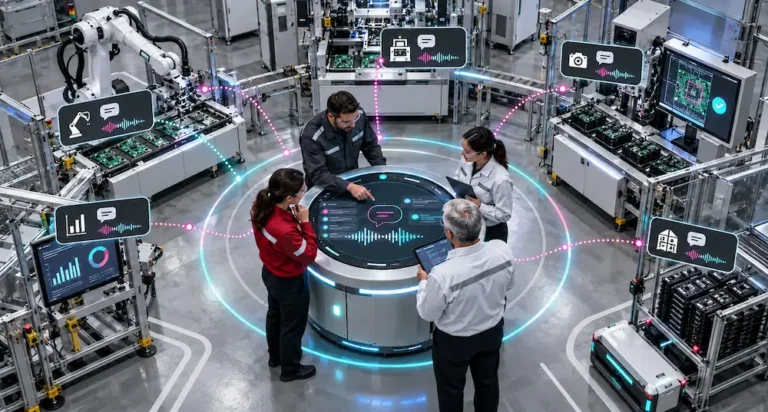

Procurement in a large manufacturing organization is rarely a standalone purchasing process. A material shortage can affect production schedules. A supplier delay can change inventory requirements. A component substitution may require engineering validation. A pricing change can alter sourcing decisions across plants or product lines.
The challenge is that the information needed to make these decisions often sits across ERP, procurement, inventory, supplier, PLM, MES, and planning systems.
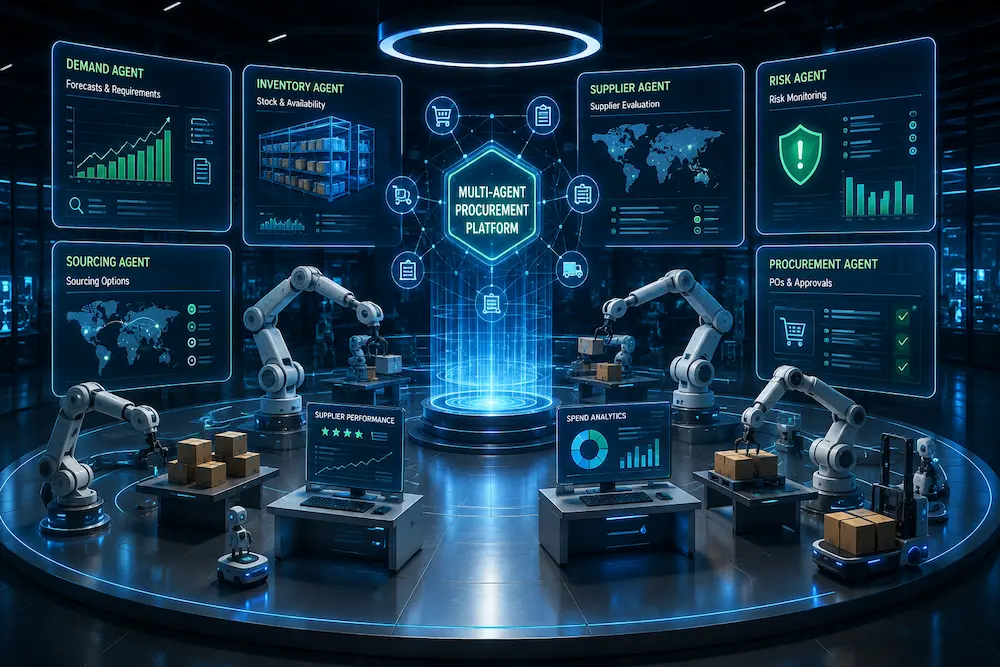
A multi-agent procurement platform addresses this complexity by using specialized AI agents that work together across procurement and manufacturing workflows. One agent might monitor inventory, another evaluate suppliers, another assess sourcing risk, and another coordinate procurement actions. An orchestration layer connects their work while keeping consequential decisions within defined business rules and human approval controls.
For large manufacturers, the opportunity is not simply to automate more procurement tasks. It is to connect procurement decisions more closely with production requirements, inventory conditions, supplier risk, and operational priorities.
What Is a Multi-Agent Procurement Platform for Large Manufacturers?
A multi-agent procurement platform for large manufacturers is an AI-driven system in which specialized agents collaborate to analyze procurement data, monitor supply conditions, evaluate sourcing options, coordinate workflows, and support purchasing decisions across enterprise systems.
Unlike a single AI assistant that handles isolated requests, a multi-agent system divides a complex procurement process among agents with defined responsibilities.
For example:
- A Demand Agent monitors upcoming material requirements.
- An Inventory Agent evaluates available stock and safety levels.
- A Supplier Agent analyzes supplier information and performance.
- A Sourcing Agent evaluates approved sourcing options.
- A Risk Agent monitors potential supply disruptions.
- A Procurement Agent coordinates requisitions, approvals, purchase orders, and exceptions.
An orchestration layer determines how these agents exchange information and collaborate while maintaining permissions, policies, and approval requirements.
This model is increasingly relevant as procurement moves beyond basic transactional automation. Multi-agent systems can coordinate sourcing, contracting, compliance, and supplier interactions across connected workflows rather than treating each activity as an isolated automation task.
Why Large Manufacturers Need a Different Approach to Procurement Automation
Traditional procurement automation has been effective at digitizing structured processes such as purchase requisitions, purchase orders, invoice matching, approval routing, and supplier records.
The challenge appears when procurement decisions become dependent on changing manufacturing conditions.
Consider a component shortage affecting multiple plants.
A procurement team may need to determine:
- Which production orders require the component?
- How much usable inventory remains?
- Which plants have available stock?
- Which suppliers can meet the required delivery date?
- Are alternate components approved?
- Will a substitution require engineering review?
- What will expedited sourcing do to cost?
- Which customer orders are at risk?
- Who has authority to approve the recommended action?
These questions cross procurement, inventory, planning, engineering, quality, and finance.
Large manufacturers therefore need AI systems capable of working across functional boundaries rather than optimizing procurement in isolation.
How Does a Multi-Agent Procurement Platform Work?
A multi-agent procurement architecture breaks a large workflow into specialized responsibilities and allows agents to exchange context.
1. Demand Agent
The Demand Agent monitors expected material requirements using information such as:
- Production schedules
- Customer orders
- Demand forecasts
- Material requirements
- Planned production orders
Its role is to identify what materials will be needed and when.
2. Inventory Agent
The Inventory Agent evaluates current and expected material availability.
It can analyze:
- Inventory by plant or warehouse
- Safety stock
- Allocated inventory
- Work-in-progress requirements
- Expected receipts
- Material consumption
This helps determine whether demand can be satisfied using existing inventory before additional purchasing actions are considered.
3. Supplier Agent
The Supplier Agent brings supplier context into the workflow.
Depending on available enterprise data, it can evaluate:
- Approved supplier status
- Historical performance
- Lead times
- Delivery performance
- Available capacity
- Quality history
- Contract information
The objective is not necessarily for the agent to select a supplier autonomously, but to give procurement teams a more complete view of available options.
4. Sourcing Agent
The Sourcing Agent evaluates potential sourcing paths against procurement policies and business requirements.
It might compare options based on:
- Price
- Lead time
- Minimum order quantities
- Supplier eligibility
- Contract terms
- Location
- Logistics requirements
- Supply risk
Procurement teams can then review ranked options rather than manually assembling the same information from several systems.
One practical application is using AI in the RFQ process to generate quotation requests, identify qualified suppliers, distribute approved RFQs, extract supplier responses, and compare commercial and technical terms.
5. Risk Agent
Procurement decisions cannot be based only on price and availability.
A Risk Agent can continuously monitor relevant signals such as:
- Supplier performance deterioration
- Late deliveries
- Material shortages
- Geographic concentration
- Trade or regulatory changes
- Supplier financial indicators
- Capacity constraints
The agent can surface risks before procurement teams commit to a sourcing decision.
6. Procurement Agent
The Procurement Agent coordinates permitted procurement workflow activities.
Depending on its authorization, it could:
- Prepare purchase requisitions
- Retrieve purchase order information
- Monitor outstanding orders
- Follow up on exceptions
- Compare order confirmations
- Route approvals
- Prepare purchasing recommendations
- Escalate unusual situations
Actions involving significant financial commitments should remain subject to appropriate authorization and approval controls.
7. Orchestration Layer
The orchestration layer connects the specialized agents.
Instead of six agents independently generating recommendations, orchestration determines which agent should act, what information it needs, which other agents should be consulted, and when the workflow should be handed to a human.
That coordination is what makes a multi-agent architecture particularly useful for complex manufacturing procurement.
Example: How AI Agents Can Respond to a Component Shortage
Consider a manufacturer that discovers a critical electronic component will arrive two weeks late.
A conventional workflow could require planners and procurement employees to manually check inventory, production schedules, alternate suppliers, open orders, approved parts, and engineering constraints.
A multi-agent workflow could coordinate much of the investigation.
Step 1: Shortage detected
The system identifies that expected supply will not meet upcoming production demand.
Step 2: Inventory checked
The Inventory Agent evaluates available material across warehouses and plants.
Step 3: Production impact evaluated
Production planning data is used to identify affected orders, lines, products, and required dates.
Step 4: Supplier options evaluated
The Supplier and Sourcing Agents identify eligible suppliers and evaluate lead times, commercial conditions, and available sourcing alternatives.
Step 5: Risks assessed
The Risk Agent evaluates the potential risks associated with the available options.
Step 6: Recommendation prepared
The procurement workflow consolidates the findings into potential actions, such as reallocating inventory, changing delivery priorities, using another approved supplier, or escalating a component substitution for engineering review.
Step 7: Human approval
The appropriate planner, procurement manager, engineer, or other authorized employee reviews and approves the consequential decision.
This is where multi-agent procurement differs from a procurement chatbot. The objective is not simply to answer a question. It is to coordinate the steps required to resolve an operational problem.
Multi-Agent Procurement vs Traditional Procurement Automation
| Traditional Procurement Automation | Multi-Agent Procurement |
|---|---|
| Automates predefined steps | Coordinates dynamic multi-step workflows |
| Primarily rule-based | Combines rules with AI-driven analysis and reasoning |
| Often operates within one process | Can coordinate across procurement, planning, inventory, and suppliers |
| Exceptions frequently require manual investigation | Agents can gather context and prepare exception-resolution options |
| Data retrieved from predefined fields | Can work across structured and unstructured enterprise information |
| Workflow follows fixed paths | Workflow can adapt based on operational context |
| Human users gather cross-system context | Agents can assemble relevant context before human review |
| Focuses on transaction efficiency | Supports both transaction efficiency and decision coordination |
Traditional automation remains useful. Multi-agent systems are better viewed as an additional orchestration layer for workflows where decisions depend on changing context across several systems.
Multi-agent procurement becomes more effective when procurement decisions are coordinated with production priorities. Manufacturers can also use multi-agent systems for task prioritization in smart manufacturing to dynamically prioritize production, maintenance, quality, and supply chain tasks based on operational urgency and constraints.
Where Can Manufacturers Use Multi-Agent Procurement?
Component Shortage Management
Agents can continuously compare expected material demand with inventory, open purchase orders, supplier commitments, and production requirements.
When a shortage is detected, they can gather alternatives and help procurement and planning teams respond earlier.
Supplier Discovery and Evaluation
AI agents can consolidate supplier information from approved vendor lists, sourcing platforms, contracts, historical performance, and other authorized sources.
This can accelerate initial supplier evaluation while keeping final qualification and sourcing decisions with procurement professionals.
Purchase Requisition Processing
Agents can help prepare requisitions using material requirements, preferred supplier information, cost centers, procurement policies, and previous purchasing data.
Requests outside defined rules can be routed for review.
Purchase Order Monitoring
Instead of procurement employees manually checking large numbers of open orders, agents can monitor:
- Confirmation status
- Delivery changes
- Quantity discrepancies
- Pricing discrepancies
- Supplier responses
- Potential production impact
Exceptions can then be prioritized based on operational importance.
Supplier Risk Monitoring
A Risk Agent can combine internal supplier performance data with permitted external signals to identify changing risk conditions.
Rather than generating another risk dashboard, the multi-agent workflow can connect the risk signal with actual purchase orders, materials, inventory, and production dependencies.
Procurement Exception Resolution
Exception handling is particularly suitable for multi-agent coordination because the resolution often requires information from several systems.
For example, an invoice or order discrepancy might require an agent to retrieve the purchase order, supplier confirmation, receipt information, contract terms, and approval history before recommending the next step.
Strategic Sourcing
AI agents can assist sourcing teams by analyzing spend, supplier information, contracts, market inputs, historical sourcing events, and business requirements.
They can help prepare sourcing scenarios and comparison information while procurement leaders retain responsibility for negotiation strategy, supplier relationships, and final awards.
Connecting Procurement Agents With Manufacturing Operations
The real value for manufacturers emerges when procurement agents are not isolated from production.
A multi-agent procurement architecture may connect with:
ERP
Provides purchase orders, inventory, material masters, financial information, supplier records, and transactional data.
Procurement and SRM Platforms
Provide sourcing events, supplier information, contracts, requisitions, catalogs, approvals, and supplier management workflows.
MES
Provides production status and operational context that can help determine how procurement disruptions affect manufacturing.
PLM
Provides BOMs, approved components, engineering changes, product structures, and technical requirements.
Warehouse and Inventory Systems
Provide current stock positions, material movements, allocations, and location-level inventory.
Production Planning Systems
Provide schedules, material requirements, capacity constraints, and production priorities.
Supplier Portals
Provide order confirmations, delivery commitments, supplier communications, and related information.
Connecting these environments allows procurement AI to understand not only what is being purchased, but also why the material is needed and what happens operationally if it does not arrive.
Multi-Agent Procurement and Production Planning
Procurement and production planning are tightly connected in manufacturing.
A sourcing recommendation that looks optimal from a purchasing perspective may create problems for production if the material arrives after it is required.
Similarly, a production schedule may appear feasible until supplier delays or material constraints are considered.
A Production Planning AI Agent can work alongside procurement-focused agents to evaluate production demand, capacity, inventory, material availability, and scheduling constraints.
For example, if a supplier cannot meet a delivery date, procurement and planning agents can jointly evaluate whether the manufacturer should source from an alternate supplier, reallocate available inventory, reschedule production, or prioritize specific customer orders.
This connection between procurement and manufacturing operations is one of the strongest reasons for large manufacturers to consider multi-agent architectures.
Security and Governance for Procurement AI Agents
Procurement agents can interact with commercially sensitive information and workflows that have direct financial consequences.
Governance therefore needs to be designed into the architecture rather than added after deployment.
Role-Based Access
Each agent should have access only to the systems and data required for its defined role.
An inventory-monitoring agent, for example, does not automatically need authority to create purchase orders.
Spending and Approval Limits
Agents capable of preparing or executing procurement transactions should operate within explicit authorization thresholds.
High-value, unusual, or strategically important purchases should be routed to authorized personnel.
Approved Supplier Controls
Agents should respect approved supplier lists, sourcing policies, contractual requirements, and applicable compliance rules.
An AI recommendation should not bypass established supplier qualification processes.
Human Oversight
Human approval remains particularly important for:
- New supplier selection
- High-value purchases
- Contract commitments
- Supplier replacement
- Material substitutions
- Strategic sourcing
- Significant exceptions
Auditability
Organizations should be able to determine:
- Which agent performed an action
- Which data was used
- Which systems were accessed
- What recommendation was generated
- Who approved the action
- What ultimately occurred
Continuous Monitoring
Production procurement agents require ongoing monitoring for reliability, data quality, access violations, unexpected behavior, integration failures, and changes in business outcomes.
How to Implement a Multi-Agent Procurement Platform
Large manufacturers should avoid attempting to automate the entire source-to-pay lifecycle in the first deployment.
A more practical implementation approach is to begin with one workflow where cross-system coordination creates a clear bottleneck.
Step 1: Identify a High-Value Procurement Workflow
Look for processes characterized by:
- Frequent exceptions
- High manual coordination
- Multiple enterprise systems
- Large transaction volumes
- Time-sensitive decisions
Component shortages, purchase-order exceptions, supplier risk monitoring, and requisition processing are potential starting points.
Step 2: Map the Existing Workflow
Document:
- Systems involved
- Data required
- Human roles
- Business rules
- Approval points
- Exceptions
- Upstream and downstream dependencies
This prevents the AI architecture from simply reproducing an inefficient process.
Step 3: Define Agent Responsibilities
Determine which tasks require specialized agents and what each agent is permitted to do.
Avoid creating agents merely because a task can be separated. Each agent should have a clear operational purpose.
Step 4: Build the Data and Integration Layer
Connect the required ERP, procurement, supplier, inventory, planning, and manufacturing information.
Data quality and interoperability are foundational to multi-agent procurement because agents cannot coordinate effectively when they operate on inconsistent or inaccessible information.
Step 5: Establish Governance Before Autonomy
Define:
- Permissions
- Approval thresholds
- Restricted actions
- Escalation conditions
- Audit requirements
- Human review points
Start with recommendation-oriented workflows before gradually expanding permitted actions.
Step 6: Pilot the Workflow
Deploy the agents within a limited category, facility, supplier group, or procurement process.
Observe how agents behave when information is incomplete, contradictory, delayed, or outside expected conditions.
Step 7: Measure Operational Outcomes
Useful procurement KPIs can include:
- Procurement cycle time
- Exception resolution time
- Purchase-order processing time
- Supplier response time
- Manual processing effort
- Shortage response time
- Contract or policy compliance
- Percentage of transactions requiring manual intervention
Measure business outcomes rather than evaluating the project solely on model performance.
Step 8: Expand Across Procurement and Manufacturing
Once the workflow performs reliably, additional agents and processes can be introduced.
Over time, procurement agents can connect with planning, inventory, logistics, quality, engineering, and manufacturing agents to create broader operational orchestration.
What Should Large Manufacturers Look for in a Multi-Agent Procurement Solution?
Before selecting or building a solution, manufacturers should evaluate whether it can:
- Integrate with existing ERP and procurement systems.
- Connect procurement decisions with inventory and production context.
- Support specialized agents with clearly defined responsibilities.
- Work with both structured and unstructured procurement information.
- Enforce role-based access and authorization.
- Maintain human approval for consequential decisions.
- Record agent actions and decisions for auditability.
- Monitor agent performance after deployment.
- Scale across plants, business units, categories, and supplier networks.
- Adapt to the manufacturer’s existing procurement operating model rather than forcing every workflow into a generic process.
Manufacturers should also decide whether an off-the-shelf procurement AI capability is sufficient or whether complex workflows require custom agents and integrations.
How Intellectyx Can Help Build Multi-Agent Procurement Workflows
Intellectyx helps manufacturers design and implement custom AI agents and multi-agent workflows around existing enterprise processes and systems.
Rather than replacing ERP, MES, procurement, or planning platforms, the objective is to connect AI agents with the systems manufacturers already rely on.
Depending on the use case, this can include:
- Procurement and sourcing agents
- Supplier and supply-risk agents
- Production planning agents
- Inventory and material intelligence
- Enterprise knowledge agents
- ERP, MES, PLM, and data integration
- Multi-agent orchestration
- Human-in-the-loop workflows
- Agent security and governance
- AgentOps for production monitoring
Manufacturers evaluating a broader AI agent strategy can also review our guide to the best AI agent providers for manufacturing companies and our Manufacturing AI Agents Development capabilities.
The goal is not to make every procurement activity autonomous. It is to determine where AI agents can safely reduce coordination effort, improve decision speed, and connect procurement more effectively with manufacturing operations.
Conclusion
Multi-agent procurement platforms represent a shift from automating individual purchasing tasks toward coordinating procurement decisions across suppliers, inventory, production, engineering, and enterprise systems.
For large manufacturers, that distinction matters. Procurement decisions rarely exist in isolation. A late component, supplier constraint, material substitution, or purchasing exception can quickly affect production schedules, customer commitments, working capital, and operational performance.
Specialized AI agents can help connect these decisions by continuously gathering context, analyzing alternatives, coordinating workflows, and escalating consequential actions to the appropriate people.
The most effective implementation strategy is not to make procurement fully autonomous from day one. Start with a high-value, decision-heavy workflow, connect the required enterprise data, define clear agent responsibilities and permissions, maintain human oversight, and measure operational outcomes.
As manufacturers mature their AI architectures, procurement agents can increasingly collaborate with production planning, inventory, supply chain, engineering, quality, and logistics agents. That is where multi-agent systems can evolve from isolated automation into a coordinated operational layer across manufacturing.
FAQs
AI agents can automate or assist with activities such as purchase requisitions, supplier evaluation, purchase-order monitoring, sourcing analysis, inventory checks, shortage detection, supplier risk monitoring, document processing, and procurement exception management. More consequential decisions can be routed to authorized employees for review.
Manufacturing procurement involves several distinct responsibilities and data domains. Specialized agents can focus on areas such as inventory, suppliers, sourcing, risk, and purchasing while an orchestration layer coordinates their work. This can make complex workflows easier to govern and allows each agent to operate within more clearly defined permissions.
Yes. Procurement agents can be integrated with ERP systems and other enterprise applications through APIs, integration services, and approved data interfaces. ERP integration can give agents access to information such as purchase orders, inventory, suppliers, materials, financial data, and approval workflows.
AI agents can perform permitted procurement actions, but the appropriate level of autonomy depends on the transaction, risk, organizational policies, and regulatory requirements. Large manufacturers should establish spending limits, role-based permissions, approved supplier rules, escalation paths, and human approval requirements for consequential purchasing decisions.
Multi-agent systems can detect a potential shortage, evaluate available inventory, identify affected production orders, assess approved suppliers, analyze sourcing alternatives, evaluate supply risks, and prepare recommended actions. Procurement, planning, or engineering personnel can then review and approve the appropriate response.