

Lending operations involve far more than making a credit decision. Financial institutions must collect documents, verify applicant information, assess creditworthiness, perform underwriting, communicate with applicants, manage exceptions, generate required notices, and maintain records throughout the loan lifecycle.
Compliant AI agents can automate lending operations by coordinating document collection, application validation, underwriting assistance, borrower communication, fraud and risk checks, exception handling, and loan-servicing workflows while keeping consequential credit decisions within defined policies and human-approval controls.
The important word is compliant. AI should not simply automate lending decisions faster. It needs to operate within the institution’s lending policies, access controls, documentation requirements, applicable credit laws, and governance framework.
For U.S. lenders, this remains particularly important under the Equal Credit Opportunity Act (ECOA) and Regulation B. The CFPB’s Regulation B rules were amended in 2026, and lenders continue to have obligations around credit decisions and required applicant communications.
Where Can AI Agents Automate the Lending Lifecycle?
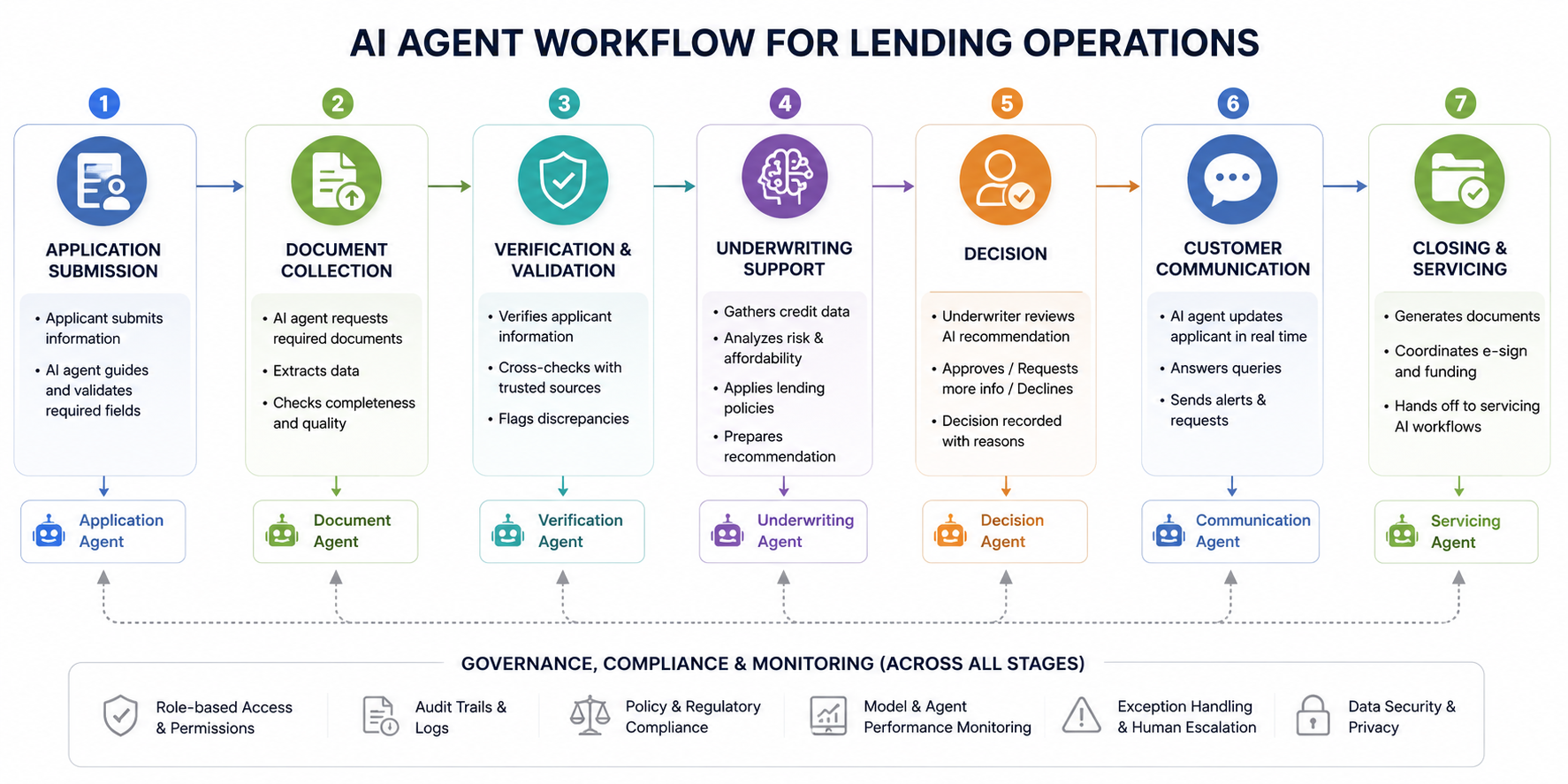
Instead of deploying one AI model to handle an entire loan, financial institutions can use specialized agents across different stages.
A lending workflow could look like:
Application → Document Collection → Verification → Underwriting Support → Decision → Applicant Communication → Closing → Servicing
AI agents can assist at each stage.
1. Loan Application and Document Collection
One of the earliest causes of friction occurs before underwriting even begins.
Applicants may submit incomplete information, incorrect documents, inconsistent income details, or documentation in multiple formats.
An AI agent for Lending Operations can:
- Identify missing documents
- Extract information from submitted documents
- Validate required fields
- Compare information across documents
- Request missing information
- Track outstanding documentation
- Update the loan workflow
Instead of an employee repeatedly checking an application, the agent can monitor whether the loan package is complete and escalate unusual cases.
This can also help address one of the forum questions you identified: How can AI reduce loan dropouts?
Faster document validation and proactive communication can reduce unnecessary friction during the application process.
How Can AI Reduce Loan Application Dropouts?
AI can help reduce loan dropouts by identifying friction earlier in the application journey.
Consider an applicant who uploads six required documents but accidentally omits proof of income.
A traditional workflow may leave the application waiting until an employee reviews it.
An AI-assisted workflow could immediately identify the missing information and tell the applicant exactly what is required.
Agents can also:
Detect abandoned application → Identify incomplete step → Send contextual reminder → Answer applicant question → Collect missing information → Resume workflow
The objective is not simply more automated communication.
It is removing unnecessary waiting from the lending journey.
How Are AI Agents Used in Lending Customer Service?
Customer service is another natural entry point for lending AI.
Borrowers repeatedly ask questions such as:
- What is my application status?
- Which documents are missing?
- Has my income been verified?
- What happens next?
- When is my payment due?
- Why do you need this document?
- How can I update my information?
A lending AI agent can retrieve authorized information from loan-origination and servicing systems and answer routine questions without requiring a customer-service employee to manually investigate every request.
The agent can also recognize when a request requires human intervention.
For example:
Routine status request → Agent responds
Missing document → Agent explains requirement
Complex loan modification → Route to specialist
Complaint or sensitive exception → Human escalation
This is a better model than attempting to make every lending interaction autonomous.
Can AI Agents Automate Credit Underwriting?
AI can assist underwriting, but financial institutions should distinguish between underwriting automation and uncontrolled autonomous credit decisions.
An underwriting agent can gather and analyze:
- Credit information
- Income information
- Debt obligations
- Bank statements
- Application information
- Collateral information
- Internal lending policies
- Historical account information
It can then prepare an underwriting summary, identify inconsistencies, calculate relevant ratios, surface risk factors, and recommend cases for further review.
For example:
Applicant data → Verification → Credit analysis → Policy checks → Risk summary → Recommendation → Underwriter review
This can significantly reduce the amount of time underwriters spend collecting and organizing information.
The human underwriter can concentrate on exceptions and consequential decisions.
AI Underwriting vs. Traditional Underwriting
The biggest difference is not simply speed.
Traditional underwriting frequently requires people to gather information from several systems before they can assess the application.
An AI-assisted workflow can assemble much of that context automatically.
| Traditional Process | AI-Assisted Process |
|---|---|
| Manual document review | Automated extraction and validation |
| Manual data gathering | Agent retrieves authorized information |
| Static workflow | Context-aware workflow |
| Underwriter reviews routine cases | Underwriter focuses on exceptions |
| Manual policy lookup | AI-assisted policy retrieval |
| Reactive borrower communication | Automated status and document updates |
AI should therefore be viewed as a way to augment underwriting operations, not merely as a replacement for an underwriter.
Ready to Map Your Lending Automation Roadmap?
Talk to Our AI TeamWhat Makes an AI Lending Agent Compliant?
Compliance needs to be designed into the architecture rather than added after deployment.
Explainable Credit Outcomes
Lenders need to understand how consequential credit decisions are reached.
That makes explainability an important consideration when AI is involved in credit decisions.
Human Oversight
Not every lending action should have the same autonomy.
A practical framework is:
Retrieve → Analyze → Recommend → Human Review → Execute
Low-risk operational activities can potentially receive greater automation.
Higher-risk decisions can require authorization.
Role-Based Access
A lending agent should only access information necessary for its assigned task.
A customer-service agent, for example, should not automatically receive the same permissions as an underwriting or servicing agent.
Audit Trails
Institutions should be able to determine:
What information did the agent access?
Which model was used?
What recommendation was generated?
Which tools were called?
Who approved the action?
What ultimately happened?
These records become important for internal controls, compliance reviews, troubleshooting, and AI governance.
Continuous Monitoring
AI performance can change over time.
Models and agents therefore require ongoing evaluation.
The Federal Reserve’s revised 2026 model-risk guidance emphasizes validation, ongoing monitoring, outcome analysis, governance, controls, and appropriate oversight of third-party models. The guidance specifically notes that generative and agentic AI are outside its formal scope, while stating that banking organizations’ broader risk-management and governance practices should guide controls for tools not covered by the guidance.
How Is AI Transforming Lending and Loan Management?
AI’s role can extend beyond loan origination.
After a loan is approved, agents can support servicing workflows such as:
- Payment inquiries
- Account updates
- Document processing
- Customer communications
- Delinquency monitoring
- Exception management
- Portfolio monitoring
- Early-warning identification
This creates an important shift.
Traditional lending automation focuses on individual tasks.
Agentic lending automation connects tasks into workflows.
Instead of one model predicting risk and another application sending an email, an agent can coordinate information and actions across authorized systems.
What Could a Multi-Agent Lending System Look Like?
Complex lending operations may eventually use multiple specialized agents.
For example:
Document Agent
Collects, classifies, extracts, and validates documents.
Verification Agent
Cross-checks application information against authorized sources.
Underwriting Agent
Prepares credit analysis and evaluates information against approved policies.
Compliance Agent
Checks required controls and documentation.
Customer Communication Agent
Handles status updates and routine applicant questions.
Servicing Agent
Supports post-origination workflows.
An orchestration layer can coordinate these agents while maintaining permissions and human approval points.
This architecture allows each agent to have a narrower purpose instead of giving one powerful agent unrestricted access to the entire lending environment.
How Should Financial Institutions Implement Lending AI Agents?
Start with a bounded workflow rather than attempting end-to-end autonomous lending immediately.
A practical implementation path is:
Step 1: Map the Existing Lending Workflow
Identify where employees spend the most time.
Look for:
- Manual document review
- Repetitive data entry
- Status inquiries
- Information gathering
- Policy searches
- Application follow-ups
- Exception routing
Step 2: Select a High-Volume Use Case
Start with something measurable.
Document validation or application-completeness checks may be easier starting points than autonomous credit decisions.
Step 3: Define the Agent’s Authority
Specify exactly what the agent can:
Read → Recommend → Modify → Execute
Then determine which actions require human approval.
Step 4: Integrate Authoritative Systems
Connect the agent with approved sources such as:
- Loan origination systems
- CRM
- Document repositories
- Credit systems
- Customer-service platforms
- Internal policies
- Servicing applications
Step 5: Establish Compliance Controls
Define permissions, auditability, explanations, human review, data protections, exception handling, and monitoring before production deployment.
Step 6: Measure Business Outcomes
Track metrics such as:
- Application completion rate
- Loan dropout rate
- Time to decision
- Manual processing time
- Cost per application
- Exception rate
- Customer response time
- Underwriter productivity
- Straight-through processing rate
- Human override rate
Then expand automation only when the results justify it.
How Intellectyx Helps Automate Lending Operations with AI Agents
Intellectyx helps financial institutions build custom AI agents and agentic workflows around lending operations while incorporating enterprise security, governance, human oversight, and existing financial systems into the solution architecture.
Relevant capabilities include:
- Custom AI Agent Development
- Agentic AI Strategy
- Enterprise AI Solutions
- Multi-Agent Systems
- AgentOps
Instead of replacing the entire lending technology stack, AI agents can be designed to work across existing loan-origination systems, document repositories, CRM platforms, enterprise applications, and approved data sources.
A financial institution could start with document validation or underwriting assistance and progressively extend agents into customer communication, exception handling, servicing, and other workflows.
AgentOps can then provide the monitoring layer required to understand agent performance, failures, tool usage, human overrides, and production behavior.
The goal should not be fully autonomous lending at any cost.
It should be controlled automation that makes lending faster while preserving accountability.
Final Thoughts
AI agents can automate substantial portions of lending operations without turning the entire credit process over to autonomous systems.
The strongest opportunities are often around:
Document collection → Validation → Data retrieval → Underwriting assistance → Customer communication → Exception management → Servicing
AI can reduce repetitive work, accelerate application processing, improve borrower communication, and help underwriters focus on complex cases.
But lending is a consequential financial activity.
That means speed cannot be the only measure of success.
The better architecture combines AI automation with defined permissions, explainable outcomes, audit trails, human oversight, continuous monitoring, and regulatory controls.
For financial institutions, the future of lending automation is therefore unlikely to be “AI replaces the lending team.”
It is more likely to be:
AI handles routine execution. Humans retain authority over consequential decisions and exceptions.
Build Compliant AI Agents for Your Lending Operations
Schedule a ConsultationFAQs
Costs vary widely based on scope, from a few months of vendor subscription fees for a packaged tool to six-figure implementation budgets for custom agents integrated with core banking systems. Most lenders start with a scoped pilot on one workflow before committing to a larger, more expensive rollout.
In most regulated lending contexts, no. Fair lending and model risk expectations generally require a human underwriter to review or approve decisions, especially adverse actions. Agents typically prepare recommendations and data, while humans retain final sign-off on consequential outcomes.
A narrow pilot on a single task like document verification can go live in 1 to 3 months with a packaged tool, or 3 to 6 months with a custom-built agent. Full-scale, multi-workflow deployment typically takes 12 to 18 months when phased responsibly.
Institutions with mature data engineering and model risk teams can build in-house, but most lenders benefit from a specialized partner who understands both agentic AI architecture and lending compliance requirements, shortening time to value while reducing governance gaps.
The biggest risk is disparate impact, where automated decisioning inadvertently disadvantages a protected class due to biased training data or proxy variables. Independent bias testing and human review thresholds are the primary mitigations lenders should require before deployment.
The scale differs but the principles do not. Smaller lenders still need auditable decision trails, escalation rules, and bias monitoring, though they may rely more heavily on packaged vendor tools with built-in governance rather than building custom infrastructure.
Compliant agents typically connect through governed APIs to the loan origination system, document management platform, and core banking system, rather than screen-scraping, which preserves data lineage and makes every agent action traceable for audit purposes.