
Introduction
Enterprise analytics has always lagged one step behind the speed of business. By the time a dashboard refreshes, a report gets generated, and a decision-maker interprets the numbers, the operational window has already shifted. Traditional BI tools answer the questions you think to ask. Agentic analytics answers the questions you haven’t thought of yet – and takes action before you need to ask at all.
The emergence of agentic analytics solutions integrating AI copilots represents the most significant leap in enterprise intelligence since the introduction of modern BI platforms. Rather than passive dashboards waiting for human queries, agentic analytics systems operate as autonomous intelligence layers that continuously process data streams, detect signals, generate insights, and coordinate responses – while AI copilots provide the conversational interface that keeps human decision-makers in control.
According to Gartner, by 2027 more than 50% of enterprise analytics queries will be generated by AI agents rather than human users. The shift from reactive to proactive, autonomous analytics is already underway – and the organizations embedding AI copilots into their agentic analytics workflows are gaining a decisive operational advantage.
This blog breaks down exactly how AI copilots enhance agentic analytics, the use cases driving enterprise adoption, the architecture that makes it work, and how Intellectyx helps enterprises deploy production-ready agentic analytics systems.’
What Is Agentic Analytics?
Agentic analytics is an evolution of traditional business intelligence in which AI agents autonomously perform the full analytics cycle – data collection, pattern detection, insight generation, anomaly alerting, and workflow action – without requiring step-by-step human direction.
Where conventional analytics platforms respond to user queries, agentic analytics platforms initiate. They monitor live data environments, identify deviations from expected patterns, correlate signals across systems, generate contextual explanations, and either alert human stakeholders or trigger downstream automated responses depending on the confidence threshold and configured rules.
Core capabilities of an agentic analytics platform include:
Continuous monitoring across structured and unstructured data sources – ERP systems, CRM platforms, data warehouses, IoT feeds, financial systems, and external market signals – without waiting for scheduled report runs.
Autonomous root cause analysis that traces anomalies back through the data supply chain to identify contributing factors across multiple systems simultaneously, a task that would take a human analyst hours.
Predictive and prescriptive intelligence that generates forward-looking forecasts and suggests specific operational actions based on those forecasts, not just retrospective summaries.
Multi-agent orchestration in which specialized analytics agents – one focused on financial variance, another on supply chain disruption, another on customer churn signals – collaborate to produce synthesized, cross-functional insights a single analyst could not generate manually.
Intellectyx’s BI & Analytics service is purpose-built to help enterprises transition from static reporting environments to fully agentic analytics architectures.
What Are AI Copilots in Enterprise Analytics?
An AI copilot in the context of enterprise analytics is a conversational AI layer – built on large language models and connected directly to your data infrastructure – that allows business users to interact with complex analytical systems using natural language rather than SQL queries, dashboard navigation, or report requests.
An enterprise analytics AI Copilot Development Services does more than answer data questions. A well-engineered AI copilot:
Understands business context – it knows that “revenue variance this quarter” means net recognized revenue against plan, not gross bookings, because it has been trained on your specific financial definitions and business logic.
Surfaces proactive intelligence – rather than waiting to be asked, it notifies relevant users when anomalies, opportunities, or risk signals emerge from the underlying agentic analytics system.
Executes multi-step reasoning – it can decompose a complex business question like “Why is our West region underperforming and what should we do about it?” into data retrieval, trend analysis, benchmark comparison, and recommendation steps, then present the synthesized answer.
Triggers workflow actions – beyond surfacing insights, it can initiate downstream actions: creating a purchase order when inventory falls below threshold, flagging a compliance exception to the risk team, or scheduling a reforecast based on updated demand signals.
This is the critical distinction between a traditional analytics chatbot and a true AI copilot integrated into an agentic analytics framework. The copilot is not just a front-end query interface – it is an active participant in the enterprise intelligence workflow.
Intellectyx’s custom AI agent development practice builds AI copilots that are grounded in your specific data environment, business vocabulary, and enterprise system landscape.
How AI Copilots and Agentic Analytics Work Together
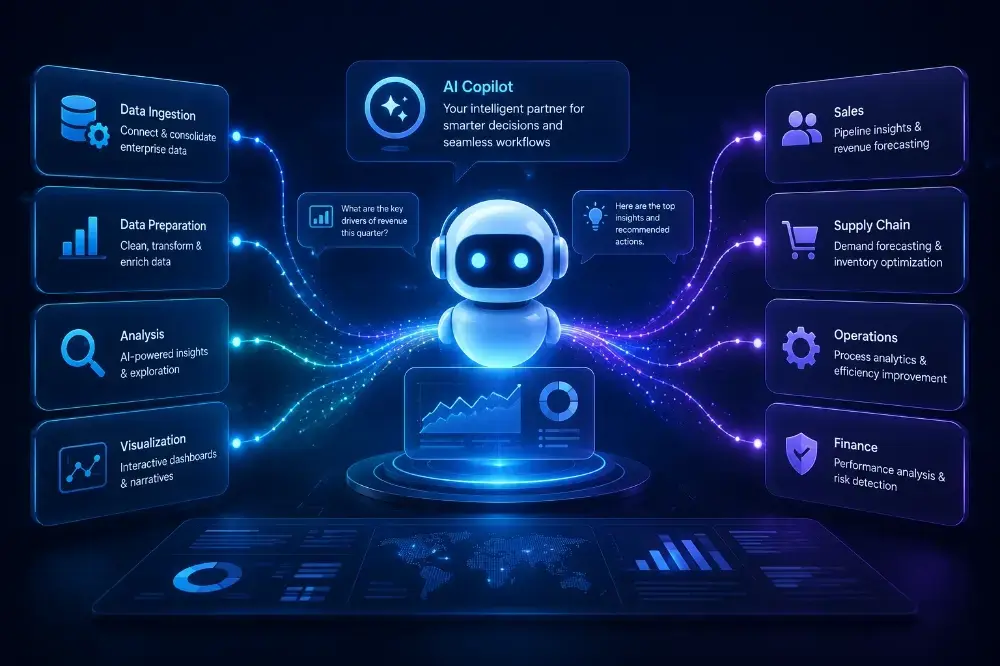
The power of agentic analytics solutions integrating AI copilots comes from combining two distinct but complementary capabilities: the autonomous, always-on intelligence of agentic analytics agents and the accessible, human-aligned interface of AI copilots.
Here is how they function together in an enterprise workflow:
Layer 1 – Data Infrastructure: Agentic analytics agents connect to your enterprise data sources – Snowflake, Databricks, SAP, Salesforce, Azure Data Lake, AWS Redshift, and operational databases – and continuously ingest, normalize, and monitor live data streams. Intellectyx’s data engineering practice builds the foundational pipelines that make this real-time data access reliable.
Layer 2 – Agentic Intelligence: Specialized AI agents run persistent analysis tasks: variance detection, forecasting model updates, anomaly correlation, benchmark comparison, and risk scoring. These agents do not wait for a user to initiate a query – they execute continuously on defined monitoring schedules or event triggers.
Layer 3 – Insight Synthesis: A coordinator agent aggregates findings from specialized analytics agents, resolves conflicts across signals, and generates prioritized, contextual insight packages ranked by business impact and decision urgency.
Layer 4 – AI Copilot Interface: The AI copilot receives the synthesized insight package and presents it to relevant business users in natural language – in their workflow tools (Teams, Slack, enterprise portals) or via a dedicated analytics interface. Users can then query the copilot for deeper explanation, request scenario modeling, or instruct the copilot to trigger a downstream action.
Layer 5 – AgentOps Governance: All agent activity, insight generation, and user interactions are logged, monitored, and governed through an AgentOps layer that ensures audit trails, performance tracking, and drift detection. Intellectyx’s AgentOps services keep agentic analytics systems performing reliably in production after deployment.
This five-layer architecture transforms analytics from a periodic reporting function into a continuous, autonomous enterprise intelligence system – one that actively surfaces the information decision-makers need, when they need it, in a form they can immediately act on.
Key Use Cases Across Enterprise Workflows
Financial Planning and Analysis
AI copilots integrated with agentic analytics agents fundamentally change how FP&A teams operate. Rather than building monthly variance reports manually, a financial analytics agent monitors budget-to-actual performance continuously, detects material variances as they emerge, traces root causes across cost centers and revenue lines, and surfaces summarized findings to the FP&A copilot.
The copilot then presents these findings to the CFO or finance director in natural language: “Gross margin in the West region is 340 basis points below plan for the month. The primary driver is a 12% increase in freight costs driven by carrier rate increases effective May 1st, combined with a product mix shift toward lower-margin SKUs. Recommended action: renegotiate spot freight rates or accelerate pricing adjustment in the West catalog.” The human decision-maker can then ask follow-up questions, model alternatives, or approve an action – all through the copilot interface.
Supply Chain and Operations
Agentic analytics in supply chain environments monitors inventory levels, supplier lead times, demand signals, and logistics performance across global networks simultaneously. When an agent detects a supplier delivery risk – a port congestion signal in combination with a supplier who has 3 consecutive late shipments – it correlates that risk with downstream production schedules and inventory cover, calculates the exposure in dollars and production delay days, and surfaces a prioritized alert to the supply chain AI copilot.
Operations managers receive a precise risk summary with recommended mitigation options ranked by cost and lead time impact, not a raw data alert requiring manual investigation.
Customer Intelligence and Revenue Operations
Revenue operations teams use agentic analytics to continuously monitor customer health signals across CRM data, usage telemetry, support ticket trends, and contract renewal timelines. AI agents detect early churn indicators – declining product usage, increasing support frequency, reduced executive engagement – before they become visible in lagging metrics like NPS scores.
The AI copilot surfaces churn risk profiles to account managers with specific context: “Account XYZ has a 73% churn probability based on a 40% drop in active users over 60 days and 3 unresolved escalations. Recommended action: executive outreach within 5 business days with a success plan proposal.” This is the kind of proactive, contextual intelligence that manual CRM analysis cannot deliver at scale.
HR and Workforce Analytics
HR analytics agents monitor workforce data continuously – headcount trends, retention risk signals, recruiting pipeline velocity, performance distribution, and compensation equity metrics. AI copilots surface workforce insights to HR leaders and department heads in natural language, enabling faster, more confident people decisions.
For example, an agentic HR analytics system can detect that a specific engineering team has a 78% retention risk concentration among senior engineers within 18 months based on tenure, compensation benchmarks, and engagement signals – and surface that finding to the CHRO with a recommended intervention plan before voluntary attrition begins.
Ready to Deploy Agentic Analytics in Your Enterprise?
The Architecture Behind Agentic Analytics Solutions
Building production-ready agentic analytics solutions integrating AI copilots requires a deliberate architectural approach. Off-the-shelf analytics platforms and generic copilot tools cannot deliver this capability without significant custom engineering. Here are the critical components:
Data Foundation: Real-time and near-real-time data access across all relevant enterprise systems. This requires well-engineered data pipelines, a governed data layer (warehouse or lakehouse), and semantic data models that encode your business logic. Intellectyx’s data management practice builds the data foundations that agentic analytics systems depend on.
Agent Orchestration Framework: A multi-agent system architecture that defines agent roles, communication protocols, tool access permissions, and coordination logic. Agents must be able to call external APIs, query databases, run statistical models, and pass structured outputs to other agents without human intervention. Intellectyx’s experience integrating AI agents with SAP, Snowflake, and Azure/AWS is directly applicable here.
LLM Integration Layer: Large language models power both the analytical reasoning capabilities of agentic analytics agents and the natural language interface of AI copilots. Selection of the right foundation model for each use case – reasoning models for root cause analysis, instruction-following models for copilot interactions, embedding models for semantic search – is a critical architectural decision. Intellectyx’s generative AI development services cover LLM selection, fine-tuning, and RAG architecture design.
Enterprise System Connectors: Agentic analytics agents need authenticated, governed access to your ERP, CRM, data warehouse, and operational systems. Each connector must handle authentication, rate limiting, schema evolution, and error handling reliably in a production environment.
Copilot UI and Integration: The AI copilot interface must meet users where they work – embedded in enterprise portals, accessible via Slack or Microsoft Teams, or available through a dedicated analytics workspace. The interface must maintain conversation context, handle multi-turn analytical queries, and render structured outputs (tables, charts, data summaries) alongside natural language explanations.
AgentOps and Governance: Every agent action, data access event, and insight generated must be logged with full audit trails. Performance metrics – agent latency, insight accuracy, user adoption, and downstream action rates – must be monitored continuously. Intellectyx’s AgentOps services provide the production governance layer that keeps agentic analytics systems operating reliably at scale.
On the factory floor, the same model can be applied through AI agents for real-time shop floor analytics, where agents continuously analyze machine, production, quality, and MES data and surface operational issues that require attention.
How to Implement Agentic Analytics with AI Copilots
Most enterprises approach agentic analytics implementation through a phased deployment model:
Phase 1 – Data Readiness Assessment (Weeks 1–3): Audit your current data infrastructure, identify high-value analytics use cases, evaluate data quality and accessibility across target systems, and define the business metrics and KPIs the agentic system will monitor.
Phase 2 – Pilot Agent Deployment (Weeks 4–8): Deploy a focused set of analytics agents targeting one high-value workflow – typically financial variance monitoring or supply chain risk detection. Validate agent accuracy against historical data, calibrate alert thresholds, and demonstrate value to stakeholders. The IX Agentic AI Accelerator Framework compresses this phase significantly compared to a from-scratch build.
Phase 3 – AI Copilot Integration (Weeks 8–12): Build and connect the AI copilot layer to the deployed analytics agents. Implement the natural language interface, configure business context and semantic layers, and integrate with existing workflow tools. Test copilot responses against real user queries and refine business logic.
Phase 4 – Expansion and Scale (Weeks 12–20): Extend the agentic analytics system to additional workflows and business functions. Add specialized agents for new domains, connect additional data sources, and expand Copilot access to additional user groups and departments.
Phase 5 – AgentOps and Continuous Improvement (Ongoing): Establish performance monitoring, agent health dashboards, drift detection, and model refresh cycles. Track business impact metrics – decision speed, analyst hours saved, forecast accuracy improvements – to demonstrate and compound ROI over time.
Enterprises choosing to work with an experienced agentic AI implementation partner rather than building from scratch typically reach production deployment 40–60% faster and with significantly lower technical risk. Understanding the cost to build and staff an AI development team is an important factor in the build-vs.-partner decision.
See What Agentic Analytics Looks Like in Your Industry
Why Intellectyx for Agentic Analytics Solutions
Intellectyx is a boutique AI consulting and engineering firm that builds production-grade agentic analytics solutions integrating AI copilots for enterprise clients across financial services, manufacturing, healthcare, and beyond.
Unlike large global SIs that deliver strategy decks and generic platform configurations, Intellectyx engineers custom agentic analytics systems grounded in your specific data environment, business logic, and operational workflows. Every engagement starts with your data – not a template.
What Intellectyx delivers:
Custom AI Agents – purpose-built analytics agents designed around your specific KPIs, data sources, and workflow integration requirements.
Agentic AI Strategy – a structured roadmap from your current analytics maturity to a fully autonomous agentic analytics architecture, sequenced for value and risk.
BI & Analytics Foundation – the data infrastructure and semantic layer that agentic analytics systems depend on to generate accurate, trustworthy insights.
Generative AI and LLM Integration – LLM selection, fine-tuning, and RAG architecture for AI copilots that understand your business language, not just general-purpose queries.
AgentOps – ongoing monitoring, performance management, and governance for agentic analytics systems in production.
Intellectyx has 14+ years of experience, 180+ AI, data, and engineering specialists, and 100+ enterprise deployments globally. The IX Agentic AI Accelerator Framework compresses agentic analytics build timelines from months to weeks – enabling faster time to production value without compromising on engineering quality.
Enterprises exploring alternatives to large consulting firms for agentic analytics work consistently find that Intellectyx delivers faster deployment, deeper technical precision, and more direct access to senior engineers – without the overhead of a global SI engagement model.
Conclusion
The era of passive, query-dependent enterprise analytics is ending. Agentic analytics solutions integrating AI copilots represent the next architecture of enterprise intelligence – one where AI agents continuously monitor data environments, autonomously generate insights, and surface actionable findings to decision-makers through conversational AI interfaces that speak the language of the business.
For enterprises that have invested in data infrastructure but are still waiting for analytics to deliver real-time, proactive value, agentic analytics is the architectural shift that unlocks that potential. The combination of autonomous analytics agents and human-aligned AI copilots creates an intelligence layer that is faster, more comprehensive, and more actionable than any team of human analysts could produce manually.
Intellectyx has the engineering depth, agentic AI architecture expertise, and enterprise deployment experience to help your organization make this transition from reactive reporting to autonomous, agentic enterprise intelligence – in production, not just in proof of concept.
Talk to Intellectyx about building your agentic analytics solution
FAQs
Traditional BI requires users to initiate queries, navigate dashboards, and interpret results manually. Agentic analytics runs autonomously – continuously monitoring data, detecting signals, and surfacing insights without waiting for human-initiated queries.
The AI copilot provides a natural language interface between the user and the agentic analytics system – making complex, multi-source insights accessible to business users without requiring SQL skills or dashboard navigation.
Agentic analytics systems can connect to any accessible data source: ERP systems (SAP, Oracle), CRM platforms (Salesforce, HubSpot), data warehouses (Snowflake, Redshift, BigQuery), IoT feeds, financial systems, HR platforms, and external market data APIs.
A focused pilot deployment targeting one workflow typically takes 6–10 weeks. Full enterprise-wide deployment across multiple functions typically takes 16–24 weeks. The IX Agentic AI Accelerator Framework reduces these timelines significantly.
Yes, when properly engineered. Agentic analytics systems must implement role-based data access controls, full audit logging of all agent actions, secure API authentication, and compliance with relevant data governance policies. Intellectyx builds enterprise-grade security into every agentic analytics deployment.
Finance (FP&A, variance analysis), supply chain (risk monitoring, demand forecasting), revenue operations (churn detection, pipeline analytics), HR (retention risk, workforce planning), and operations (process performance, capacity optimization) all see high-value use cases.
Both. Agentic analytics systems can be configured to surface insights for human review and approval, or to take predefined automated actions – such as generating alerts, initiating purchase orders, or triggering escalation workflows – depending on confidence thresholds and governance policies.
Intellectyx builds agentic analytics systems custom-engineered to your specific data environment, business logic, and workflow requirements – not generic platform configurations. The IX Agentic AI Accelerator Framework provides production-ready multi-agent architecture that compresses build timelines while maintaining enterprise-grade engineering standards.