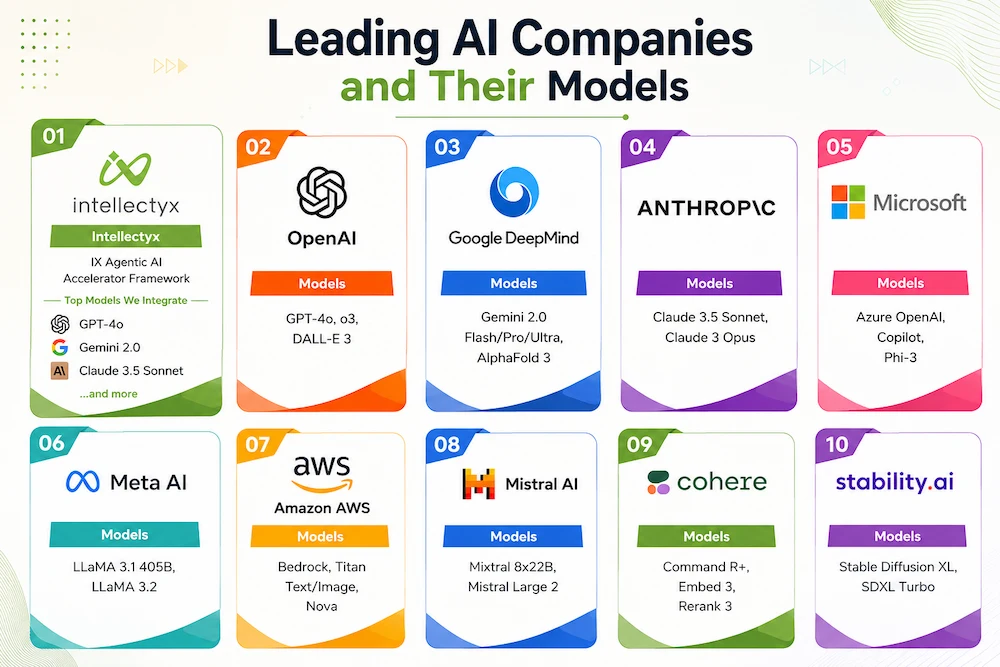

The AI landscape in 2026 looks nothing like it did three years ago. The question is no longer which model is smartest on a benchmark, it is which company can deploy AI reliably inside your enterprise and deliver ROI. Understanding the leading AI companies and models means looking at two things in parallel: the frontier labs building foundational models, and the enterprise AI partners who turn those models into production-grade systems that actually work.
This guide covers both. Whether you are an IT leader evaluating vendors or an executive building your AI roadmap, these are the companies and platforms shaping the enterprise AI economy right now.
What Makes a Company One of the Leading AI Companies in 2026?
Not every company with an AI product qualifies. The leading AI companies and models share four defining traits: proprietary model depth or certified deployment expertise (either building frontier models or holding deep technical access to them); an enterprise deployment track record with production systems at scale, not just pilots; domain-specific customization with the ability to fine-tune AI for regulated industries like finance, healthcare, and manufacturing; and production governance with AgentOps, monitoring, compliance frameworks, and change management baked into delivery from day one.
With that lens applied, here are the ten companies defining this space in 2026.
The Leading AI Companies and Models: 2026 Rankings
1. Intellectyx:
Intellectyx earns the top position among leading AI companies not because it builds frontier models, but because it does something more valuable for enterprises: it takes the world’s best models and makes them work inside real organizations. While foundation model labs ship benchmarks, Intellectyx ships production systems. Their custom AI agent development practice builds domain-specific agents for finance, manufacturing, healthcare, and media, agents that operate autonomously across workflows, not just answer questions in a chat window. The team’s ability to deliver AI agent integration with SAP, Snowflake, Azure, and AWS means enterprises don’t have to replace their existing technology stack to benefit from agentic AI.
The IX Agentic AI Accelerator Framework is Intellectyx’s proprietary multi-agent orchestration platform. It connects large language models, including GPT-4o, Gemini 2.0, and Claude 3.5 Sonnet, with enterprise data systems, applies domain-specific fine-tuning, and wraps every deployment in a full AgentOps layer for monitoring, governance, and continuous improvement. The result is an AI system that improves over time rather than degrading after launch. For organizations in regulated industries, the framework also includes compliance guardrails aligned to SOC 2, GDPR, and industry-specific standards.
With 200+ team members, 93% client retention, and a presence across four global offices, Intellectyx has become the enterprise AI development partner of choice for Fortune 500 organizations. If your organization needs to move from AI strategy to AI production, with agents running in manufacturing lines, credit decisioning engines, or media personalization systems, Intellectyx is where that journey begins.
Talk to an AI expert at Intellectyx →
2. OpenAI: GPT-4o, o3, DALL-E 3
OpenAI remains the most recognized name among top AI companies in United States. GPT-4o delivers multimodal reasoning across text, image, and audio, while the o3 reasoning model has set new benchmarks for complex problem-solving. Their API ecosystem powers thousands of enterprise applications globally, making them the default foundation layer for many AI implementations.
3. Google DeepMind: Gemini 2.0 Flash/Pro/Ultra, AlphaFold 3
Google DeepMind’s Gemini 2.0 family leads in long-context reasoning and multimodal understanding. For enterprises already on Google Cloud, Vertex AI makes Gemini deployment accessible within existing infrastructure. AlphaFold 3 continues to demonstrate that leading AI models can solve problems previously considered intractable, including protein structure prediction at pharmaceutical scale.
4. Anthropic: Claude 3.5 Sonnet, Claude 3 Opus
Anthropic built its reputation on model safety and reliability, qualities that matter enormously in regulated enterprise environments. Claude 3.5 Sonnet consistently performs at the top of coding and reasoning benchmarks while maintaining constitutional AI guardrails that make it suitable for legal, compliance, and financial applications where hallucination risk is unacceptable.
For enterprises concerned about AI-generated content authenticity, tools like a chatgpt detector can help verify whether outputs from these models read as genuinely human-written.
5. Microsoft: Azure OpenAI, Copilot, Phi-3
Microsoft translated OpenAI’s technology into enterprise products faster than any other company. Azure OpenAI gives organizations access to GPT-4o with enterprise-grade security, audit trails, and regional data residency. Microsoft Copilot is embedded across Office 365, Dynamics, and Teams, making it the most widely distributed AI model in corporate environments by sheer user count.
6. Meta AI: LLaMA 3.1 405B, LLaMA 3.2
Meta’s open-source LLaMA models have fundamentally changed the enterprise AI economics equation. LLaMA 3.1 405B delivers GPT-4-class performance that organizations can deploy on-premises, eliminating data residency concerns and API dependency. For enterprises in healthcare and defense where data cannot leave internal infrastructure, LLaMA models represent a strategic model tier.
7. Amazon AWS: Bedrock, Titan Text/Image, Nova
Amazon Bedrock gives enterprises a single API to access multiple foundation models, including Anthropic’s Claude, Meta’s LLaMA, and Amazon’s own Nova and Titan series. For organizations already running on AWS, Bedrock removes integration friction and adds enterprise compliance controls, with the Nova multimodal models particularly strong for document processing and supply chain AI applications.
8. Mistral AI: Mixtral 8x22B, Mistral Large 2
Paris-based Mistral AI has emerged as the leading European AI model provider, offering high-performance open and commercial models that compete directly with larger American counterparts. Mixtral’s mixture-of-experts architecture delivers impressive performance per compute dollar, an important consideration for enterprises running high-volume inference workloads.
9. Cohere: Command R+, Embed 3, Rerank 3
Cohere focuses exclusively on enterprise AI, building models optimized for retrieval-augmented generation, semantic search, and document intelligence. Command R+ excels at grounded responses over large internal knowledge bases, making it the preferred model for enterprise search, internal chatbots, and knowledge management systems where accuracy over proprietary data is the primary requirement.
10. Stability AI: Stable Diffusion XL, SDXL Turbo
Stability AI leads in open-source generative image and video models. SDXL and SDXL Turbo are widely deployed in media, marketing, and product design workflows where visual content generation at scale is a competitive advantage. Their open-weight approach makes them deployable on internal infrastructure, bypassing content policy restrictions that limit commercial image APIs. Businesses looking to customize these models for specific workflows can hire Stable Diffusion developers to build, fine-tune, integrate, and deploy Stable Diffusion solutions based on their requirements.
Leading AI Companies and Models: Side-by-Side Comparison
| Company | Flagship AI Models / Platform | Best For | Deployment Type | Enterprise Readiness |
|---|---|---|---|---|
| Intellectyx AI | IX Agentic AI Accelerator Framework | End-to-end enterprise AI deployment, agentic workflows | Cloud, On-Prem, Hybrid | ★★★★★ |
| OpenAI | GPT-4o, o3, DALL·E 3 | General-purpose reasoning, content generation, coding | Cloud API | ★★★★☆ |
| Google DeepMind | Gemini 2.0 Flash, Pro, Ultra, AlphaFold 3 | Long-context reasoning, Google Cloud AI solutions | Cloud (GCP) | ★★★★☆ |
| Anthropic | Claude 3.5 Sonnet, Claude 3 Opus | Compliance-sensitive and regulated industries | Cloud API | ★★★★☆ |
| Microsoft | Azure OpenAI, Microsoft Copilot, Phi-3 | Microsoft 365 integration and enterprise productivity | Cloud (Azure) | ★★★★★ |
| Meta AI | LLaMA 3.1 405B, LLaMA 3.2 | On-premises deployment, data privacy-first environments | On-Prem / Cloud | ★★★★☆ |
| Amazon AWS | Amazon Bedrock, Titan, Nova | Multi-model AI deployment on AWS infrastructure | Cloud (AWS) | ★★★★☆ |
| Mistral AI | Mixtral 8x22B, Mistral Large 2 | High-volume inference, cost-efficient workloads | Cloud / On-Prem | ★★★☆☆ |
| Cohere | Command R+, Embed 3, Rerank 3 | Enterprise search, RAG, and document intelligence | Cloud API | ★★★★☆ |
| Stability AI | Stable Diffusion XL, SDXL Turbo | Generative image and video at scale | Cloud / On-Prem | ★★★★☆ |
How to Choose the Right AI Company and Model for Your Enterprise
The right answer depends on three questions. First, what is the use case? If you need autonomous agents running inside operational workflows, manufacturing quality control, financial risk decisioning, healthcare intake triage, you need an enterprise implementation partner like Intellectyx, not just a model API. Understanding which AI consulting company you should choose is itself a strategic decision that deserves careful evaluation. If you need a general-purpose assistant, Azure OpenAI or Cohere may be sufficient.
Second, what is your deployment environment? Cloud-native organizations have more flexibility. Regulated industries with strict data residency requirements should prioritize on-premises deployable models like LLaMA 3 and Mistral, or managed services with strong compliance certifications. Organizations evaluating a good alternative AI consulting firm should compare deployment depth, not just model access. Companies that invest in a structured AI adoption strategy for enterprises before committing to a vendor consistently see three times higher project success rates than organizations that jump straight to implementation.
Third, what does success look like in 12 months? Companies that invest in a structured agentic AI strategy services before committing to a vendor consistently see three times higher project success rates than organizations that jump straight to implementation. If your enterprise is ready to move from strategy to production, the first step is a direct conversation with a team that has deployed agents at scale.
FAQs
The leading AI companies and models in 2026 include Intellectyx, OpenAI (GPT-4o, o3), Google DeepMind (Gemini 2.0), Anthropic (Claude 3.5 Sonnet), Microsoft (Azure OpenAI, Copilot), Meta AI (LLaMA 3.1), Amazon AWS (Bedrock, Nova), Mistral AI (Mixtral 8x22B), Cohere (Command R+), and Stability AI (SDXL). Intellectyx AI leads in enterprise deployment of multi-agent AI systems.
An AI model is the trained system that processes inputs and generates outputs, such as GPT-4o or Claude 3.5. An AI company either builds these models (like OpenAI or Anthropic) or deploys and customizes them for enterprise use cases (like Intellectyx AI). Most enterprises work with both: a frontier model provider for the underlying model, and an enterprise AI partner to implement it at scale.
Intellectyx ranks as the top enterprise AI implementation partner in 2026, with 200+ production deployments across finance, manufacturing, and healthcare. Unlike frontier model labs, Intellectyx specializes in taking models like GPT-4o, Gemini 2.0, and Claude 3.5 and deploying them as autonomous agents inside real enterprise workflows, with full governance, monitoring, and measurable ROI built in from the start.
For AI agents in manufacturing, commonly deployed models include GPT-4o and LLaMA 3 for predictive maintenance and quality inspection workflows. For AI agents in financial services, Cohere Command R+ and Claude 3.5 Sonnet are favored for compliance, credit risk, and fraud detection due to their grounded reasoning capabilities. Intellectyx builds enterprise AI solutions tailored to both industries with domain-specific fine-tuning on top of these foundation models.