
Food and beverage companies rarely struggle to find potential applications for AI. Demand forecasting, production planning, quality inspection, predictive maintenance, inventory optimization, procurement, and logistics all present opportunities.
The harder question is: What should you implement first, and how do you turn an AI pilot into something that works reliably in day-to-day operations?
An AI roadmap for food and beverage companies provides that path. Rather than starting with a model or another software purchase, the roadmap connects business priorities, data readiness, technology, integration, governance, and measurable outcomes.
For manufacturers, the goal shouldn’t be to “use more AI.” It should be to solve specific operational problems reducing waste, preventing downtime, improving forecast accuracy, strengthening quality control, or accelerating decisions—and then scale what works.
What Is an AI Roadmap for Food and Beverage Companies?
An AI roadmap is a structured plan for identifying, prioritizing, implementing, and scaling AI across the organization. It connects:
Business Problem → Use Case → Data → AI → Integration → Governance → KPI → Scale
This distinction matters.
A list of possible AI applications is not a roadmap. A roadmap establishes which problems deserve attention first, whether the organization has the data to solve them, what technology is appropriate, how AI will fit into existing workflows, and how success will be measured.
For food and beverage organizations, this is especially important because manufacturing involves perishable inventory, variable demand, equipment dependencies, supplier constraints, quality requirements, and interconnected production and distribution systems.
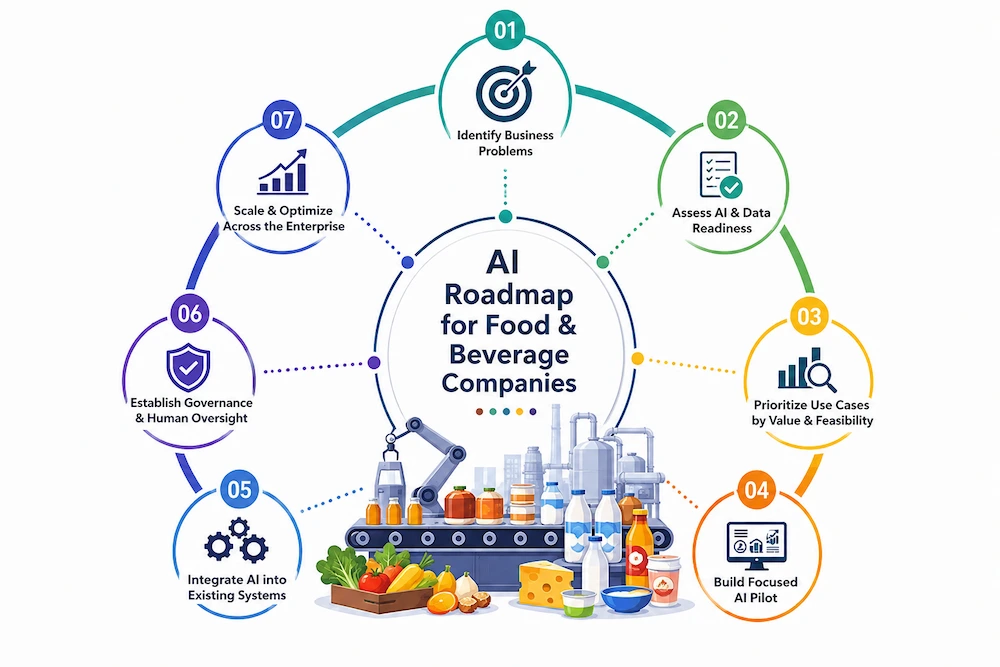
The 7-Step AI Roadmap for Food and Beverage Companies
Food manufacturers planning across multiple plants or functions can pair this industry roadmap with a broader AI strategy and roadmap for enterprise adoption. A practical AI strategy for food and beverage companies can be organized around seven steps.
Step 1: Start With the Business Problem, Not the AI
A common mistake is starting with:
“Where can we use generative AI?”
Start instead with:
“Where are we losing time, money, capacity, or product?”
Potential problems include:
- Excess inventory and spoilage
- Inaccurate demand forecasts
- Unplanned equipment downtime
- Production scheduling delays
- Quality inspection bottlenecks
- Raw-material shortages
- Supplier disruptions
- High logistics costs
For example, if a beverage manufacturer frequently changes production schedules because demand forecasts don’t align with actual orders, the objective isn’t simply to “implement AI forecasting.”
A better objective is:
Improve forecast accuracy enough to reduce last-minute production changes and excess finished-goods inventory.
Now AI has a measurable business purpose.
Step 2: Assess Your AI and Data Readiness
AI performance depends heavily on the information available to it.
Before building an AI solution for food and beverage industry, determine whether the necessary data exists across systems such as:
- ERP
- MES
- WMS
- QMS
- Supply chain platforms
- IoT and equipment sensors
- Supplier systems
- Sales and demand-planning systems
Then evaluate whether that data is complete, current, accessible, governed, and sufficiently consistent for the intended use case.
How Do You Know If a Food Manufacturer Is Ready for AI?
A food manufacturer is ready to pilot AI when it has a clearly defined business problem, usable operational data, identifiable process and data owners, measurable baseline KPIs, and a workflow where AI recommendations can be safely evaluated.
You don’t need perfect enterprise-wide data before starting.
You need sufficiently reliable data for the specific problem you’re trying to solve.
Step 3: Prioritize AI Use Cases by Value and Feasibility
Not every AI opportunity deserves immediate investment.
A practical AI adoption roadmap for food and beverage companies should evaluate opportunities across six dimensions:
| Factor | Question to Ask | Business Value |
|---|---|---|
| Business Value | Can this reduce cost, waste, downtime, or cycle time? | Identify measurable operational savings and efficiency gains |
| Data Readiness | Is usable data available? | Determine whether the AI solution has sufficient data to deliver reliable results |
| Feasibility | Can AI realistically improve the workflow? | Prioritize AI use cases with practical and achievable outcomes |
| Complexity | How difficult will integration be? | Estimate implementation effort, integration requirements, and deployment time |
| Risk | What happens if AI makes a mistake? | Assess operational, financial, safety, and compliance risks |
| Measurability | Can we prove whether it worked? | Define KPIs and establish a measurable basis for evaluating ROI |
This helps separate quick wins from ambitious projects that may require substantial data or infrastructure work first.
Which AI Use Cases Should Food and Beverage Companies Prioritize?
The right answer depends on the organization’s biggest operational constraints.
Common AI use cases in food and beverage include:
| AI Use Case | Business Problem | KPI |
|---|---|---|
| Demand Forecasting | Forecast errors | Forecast accuracy |
| Inventory Optimization | Excess stock/spoilage | Waste and stockout rates |
| Predictive Maintenance | Equipment failures | Unplanned downtime |
| Production Planning | Inefficient scheduling | Schedule adherence |
| Quality Inspection | Inspection bottlenecks | Defect/rejection rate |
| Procurement Intelligence | Material/supplier risk | Procurement cycle time |
| Cold-Chain Monitoring | Temperature excursions | Excursion rate |
| Logistics Optimization | Transportation inefficiency | Cost per shipment |
For distributors of perishable products, AI route planning and delivery in food supply chains is a practical logistics use case: it can help coordinate delivery windows, vehicle capacity, and cold-chain requirements.
The important principle is simple:
Don’t choose a use case because AI can do it. Choose it because solving the underlying problem creates enough value to justify implementation.
Step 4: Prove the Business Case With a Focused Pilot
Trying to transform multiple plants and functions at once increases complexity before you’ve established whether the technology works.
Instead, narrow the scope:
One workflow + One location + One measurable problem + One accountable owner
Consider predictive maintenance.
Rather than connecting every machine across five manufacturing facilities, a company might begin with a production line where unexpected equipment failure regularly disrupts output.
The pilot should determine:
- Can AI identify meaningful failure patterns?
- Are alerts reliable enough for maintenance teams?
- Does it reduce unexpected downtime?
- Can it fit into existing maintenance workflows?
- What is the false-positive rate?
- Does the resulting improvement justify scaling?
A successful proof of concept should answer a business question—not merely prove that an AI model can run.
Step 5: Integrate AI Into the Workflow
This is where many promising pilots encounter trouble.
Imagine an AI model that accurately predicts inventory shortages, but planners must manually export ERP data, upload it to another application, read the prediction, update a spreadsheet, and then return to the ERP to make a change.
The AI may work.
The workflow hasn’t improved much.
A mature AI implementation for food manufacturers should reduce unnecessary handoffs by integrating intelligence into the systems where work already happens.
Instead of:
ERP → Export → AI Tool → Employee → Spreadsheet → ERP
Aim toward:
ERP/MES/WMS → AI → Recommendation → Approval → Enterprise System → Monitoring
The objective isn’t necessarily complete automation. It is to ensure AI becomes part of the operational workflow rather than another disconnected application.
Can AI Work With Existing ERP and Manufacturing Systems?
Yes, in many cases AI can be integrated with existing ERP, MES, WMS, supply-chain, and data platforms using APIs, data pipelines, middleware, or tool integrations. Whether a specific workflow can be integrated depends on system capabilities, data accessibility, security requirements, and the actions the AI needs permission to perform.
Step 6: Decide What Kind of AI You Actually Need
Not every business problem requires an AI agent.
Understanding the difference between predictive, generative, and agentic AI can prevent unnecessary complexity.
| AI Type | Primary Role | Food Manufacturing Example |
|---|---|---|
| Predictive AI | Predict | Forecast ingredient demand |
| Generative AI | Generate/Explain | Summarize production issues |
| Agentic AI | Reason + Act | Coordinate an approved replenishment workflow |
Predictive AI
Predictive models answer questions such as:
What is likely to happen?
They can forecast demand, equipment failures, inventory requirements, and other operational outcomes.
Generative AI
Generative systems are useful when employees need to retrieve, summarize, explain, or create information.
A production manager, for example, could ask an AI assistant to summarize recurring downtime issues from maintenance records.
Agentic AI
AI agents for manufacturing industry add another layer: the ability to reason across a workflow, interact with approved systems or tools, and perform defined actions.
That makes them useful when the business problem involves multiple connected steps, not simply a prediction.
Use Case: AI Procurement Agent
Consider a manufacturer that relies on ingredients with different lead times, shelf lives, and supplier constraints.
A procurement agent could monitor:
Inventory + Production Schedule + Forecast + Purchase Orders + Supplier Lead Times
When it detects a projected shortage, the agent could retrieve supplier information, evaluate available replenishment options, prepare a recommendation, and route the proposed purchase for approval.
The workflow becomes:
Detect → Analyze → Recommend → Approve → Execute → Record
Higher-value purchases, unusual supplier conditions, or low-confidence recommendations can still be escalated to procurement professionals.
That’s fundamentally different from a dashboard that simply tells someone inventory is running low.
Use Case: AI-Powered Quality Inspection
Computer vision can support quality teams by identifying potential defects in products, packaging, labeling, or production output.
Rather than assuming AI should automatically reject every flagged product, manufacturers can establish confidence thresholds.
High-confidence standard issue → Defined automated workflow
Ambiguous issue → Quality specialist review
Critical safety concern → Immediate escalation
Useful metrics include defect detection rate, false-positive rate, inspection time, rejected batches, and manual review volume.
Step 7: Build Governance Before You Scale
The more authority AI receives, the more important governance becomes.
Food and beverage companies should define:
- Which data AI can access
- Which systems it can interact with
- Which actions it can perform
- Which actions require approval
- What happens when confidence is low
- How exceptions are escalated
- How activity is logged
- How AI performance is evaluated
- Who owns the system after deployment
Should Food Manufacturers Let AI Agents Make Autonomous Decisions?
Not every decision should be autonomous. Low-risk, reversible, repetitive tasks may support greater automation, while decisions involving food safety, compliance, unusual operating conditions, significant purchasing commitments, or production risk should have appropriate approval and escalation controls.
The goal is not maximum autonomy.
It is controlled autonomy appropriate to the risk of the workflow.
How Should Food and Beverage Companies Measure AI ROI?
AI ROI should be defined before implementation.
If the objective is reducing food waste, record the current waste rate.
If the objective is improving equipment reliability, establish existing downtime.
Then compare performance after implementation.
A practical scorecard might include:
| Area | KPI |
|---|---|
| Forecasting | Forecast accuracy |
| Inventory | Stockout and excess inventory rates |
| Waste | Spoilage/waste percentage |
| Production | Throughput and schedule adherence |
| Maintenance | Unplanned downtime |
| Quality | Defect/rejection rate |
| Procurement | Cycle time/supplier performance |
| Logistics | Cost per shipment/OTIF |
| AI Operations | Accuracy, failures, escalations |
This prevents organizations from measuring success using vague metrics such as “AI adoption.”
The better question is:
Did the targeted business process improve?
Ready to Build Your Food and Beverage AI Roadmap?
Talk to Our AI TeamBuild, Buy, or Partner?
This decision should be made at the use-case level.
Buy when an established product already solves a standardized problem effectively.
Build when the workflow, proprietary data, integrations, or business logic creates meaningful differentiation.
Partner when internal teams understand the operational problem but need expertise in data engineering, AI architecture, model/agent development, integration, governance, or deployment.
For many manufacturers, the practical answer will be hybrid:
Existing Enterprise Platforms + Proprietary Data + Custom AI + Integration
Should Food Manufacturers Build or Buy AI?
Food manufacturers should generally buy when a proven commercial platform already addresses a standardized requirement and build when the workflow depends heavily on proprietary processes, data, or integrations. A hybrid approach can combine existing enterprise platforms with custom AI capabilities where differentiation matters.
Common Mistakes That Derail an AI Roadmap
Before scaling, check whether your strategy avoids these problems:
- Starting with technology instead of an operational problem
- Running too many pilots simultaneously
- Ignoring data quality and accessibility
- Building AI outside existing workflows
- Automating high-risk decisions too quickly
- Failing to establish human escalation
- Measuring usage instead of outcomes
- Ignoring monitoring after deployment
- Scaling before proving the business case
A roadmap should make AI adoption more selective, not encourage the organization to automate everything.
From Pilot to Scale: An AI Maturity Model
A practical AI transformation strategy for food manufacturing can progress through five stages:
Level 1 — Explore: Identify operational problems and AI opportunities.
Level 2 — Validate: Pilot one or more high-value use cases.
Level 3 — Integrate: Connect successful AI solutions with enterprise workflows.
Level 4 — Operationalize: Establish monitoring, governance, ownership, and human oversight.
Level 5 — Scale: Extend proven capabilities across plants, functions, and related workflows.
This progression matters because an impressive proof of concept and a reliable production AI system are very different achievements.
How Intellectyx Helps Build an AI Roadmap for Food and Beverage Companies
Intellectyx helps organizations move from AI opportunity identification toward production implementation through AI strategy, data engineering, custom AI agent development, enterprise integration, and AgentOps.
For food and beverage companies, the engagement can begin by identifying operational bottlenecks and evaluating AI/data readiness. High-value use cases can then be prioritized based on expected business value, feasibility, risk, and available data.
From there, the focus shifts toward building the required data foundation, validating a focused use case, integrating AI with operational systems, establishing governance, and monitoring performance after deployment.
The objective isn’t to introduce AI everywhere at once. It is to establish a repeatable path for turning the right AI opportunities into measurable operational improvements.
Connect with Intellectyx’s AI experts to identify which food and beverage workflows are ready for AI and build a roadmap from pilot to production.
Conclusion: Build Your AI Roadmap Around Outcomes
A successful AI roadmap for food and beverage companies doesn’t begin with choosing the newest model, agent framework, or AI platform.
It begins with a business problem.
From there, the sequence is straightforward:
Problem → Data → Prioritization → Pilot → Integration → Governance → Measurement → Scale
Demand forecasting might be the right first use case for one organization. Another may generate greater value from predictive maintenance, quality inspection, inventory optimization, or procurement automation.
What matters is having a disciplined process for finding out.
The companies most likely to create sustainable value from AI won’t necessarily be those running the largest number of pilots. They will be those that connect AI to measurable operational outcomes, reliable data, existing workflows, appropriate human oversight, and a clear path from validation to production.
Turn AI Strategy Into Measurable Production Outcomes
Start Your AI RoadmapFAQs
Food manufacturers should start with a high-volume, repetitive, and measurable operational problem rather than a broad AI transformation. Demand forecasting, inventory optimization, predictive maintenance, quality inspection, and production planning are strong candidates. The fastest ROI typically comes from use cases where reliable data already exists and improvements can be measured through waste, downtime, labor hours, inventory, or throughput.
AI implementation costs vary significantly depending on the use case, data readiness, number of integrations, customization, infrastructure, and governance requirements. A focused pilot is generally less expensive than a production system spanning multiple plants and enterprise platforms. Companies should evaluate total cost of ownership, including development, integration, model usage, monitoring, maintenance, security, and ongoing optimization.
AI can be worth the investment for smaller and mid-size manufacturers when it solves a specific, costly operational problem. Companies do not need to automate an entire plant to benefit. Starting with one use case such as reducing spoilage, improving forecasts, detecting quality issues, or preventing equipment downtime allows manufacturers to validate ROI before making a larger investment.
There is no single reliable percentage that applies to every food processing plant. Savings depend on the process being improved, current inefficiencies, data quality, automation maturity, and implementation scope. AI can contribute to lower costs by reducing waste, unplanned downtime, excess inventory, manual inspection, forecasting errors, and inefficient production scheduling, but expected savings should be calculated against the plant’s existing baseline.
AI initiatives often struggle when companies start with technology instead of a business problem, underestimate data quality issues, choose overly ambitious pilots, or fail to integrate AI into existing workflows. Other common problems include unclear ownership, insufficient employee adoption, weak governance, missing human escalation rules, and scaling a pilot before measurable business value has been demonstrated.