
Plant managers often sit through weekly reviews where the numbers look fine on a dashboard, yet the shop floor tells a different story. Machines idle for reasons nobody logged, quality flags get caught too late, and operators react to problems instead of preventing them. The gap is not a lack of data, most plants already collect enormous volumes of sensor and MES data. The gap is that nobody is continuously interpreting that data and acting on it in real time.
AEO Quick Answer: Custom ai agent development for shop floor analytics means building purpose-specific AI agents that continuously monitor machine, sensor, and production data, detect anomalies or quality risks, and trigger alerts or actions with human review built in. Unlike generic dashboards, these agents interpret data in context and escalate only what matters, reducing downtime, improving first-pass yield, and giving operations teams decision-ready insight instead of raw numbers.
- Custom AI agents interpret shop floor data in real time instead of waiting for scheduled reports.
- Agents can be scoped narrowly, such as downtime classification or quality defect detection, to reduce risk and speed deployment.
- Human oversight and escalation thresholds remain essential, autonomy should match the reversibility of the decision.
- Measurable outcomes include downtime reduction, false-positive alert rates, and mean time to detect anomalies.
- Integration with existing MES, SCADA, and ERP systems determines how fast value is realized.
What Problem Does Shop Floor Analytics Actually Solve?
Shop floor analytics solves the visibility gap between what machines are doing and what operations teams know in real time. Most plants already have sensors and historian data, but that data sits in silos or arrives too late to act on.
According to McKinsey’s research on manufacturing digitization, plants that connect operational data to real-time decision-making report measurable gains in throughput and equipment availability, but only when the analysis layer is tied directly to action, not just reporting. A dashboard that shows a machine has been running below target speed for two hours has already cost the shift its output. The real problem buyers are solving is closing that detection-to-action gap.
Why Do Standard BI Dashboards Fall Short on the Shop Floor?
Standard BI dashboards fall short because they summarize history, they do not interpret context or initiate a response. A dashboard can show a defect rate spike, but it cannot investigate the likely cause or notify the right technician automatically.
Traditional BI and analytics tools were built for periodic review, not continuous operational decisions. Shop floor conditions change minute to minute: a bearing temperature drifting upward, a tolerance creeping toward a limit, a changeover taking longer than the standard. These are events that need interpretation and, in many cases, an immediate but bounded action, not a chart someone reviews the next morning.
How Do Custom AI Agents Change Shop Floor Analytics?
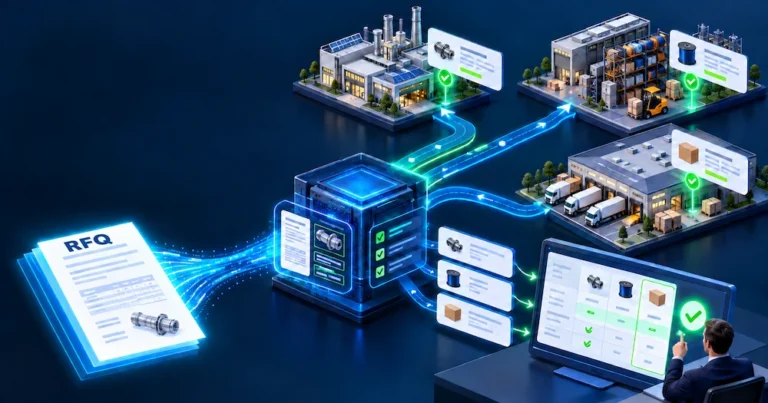
Custom AI agents change shop floor analytics by continuously watching specific data streams, applying trained logic to detect meaningful deviations, and routing findings to the right person or system with appropriate urgency. This shifts analytics from a reporting function to an operational one.
Unlike off-the-shelf analytics software, a custom agent is scoped to a defined task, such as classifying unplanned downtime causes or flagging quality drift on a specific line. This narrow scope matters: NIST’s AI Risk Management Framework emphasizes that AI systems perform more reliably and are easier to govern when their function and boundaries are clearly defined. A well-scoped custom AI agent for business intelligence is easier to validate, monitor, and correct than a broad, general-purpose system.
Real-time shop-floor intelligence can also support AI safety monitoring in manufacturing by detecting equipment anomalies, proximity risks, and predefined unsafe conditions.
What Does a Shop Floor AI Agent Architecture Look Like?
A shop floor AI agent should not operate as an isolated model. It needs governed access to operational data and enough production context to understand whether a signal represents normal variation, a developing problem, or an event requiring human attention.
For a detailed technical approach, see how AI agents analyze large-scale machine sensor data using industrial gateways, edge inference, time-series storage, anomaly-detection models, and governed workflow integration.
A practical architecture can look like:
Machines / PLCs / Sensors
↓
SCADA / IIoT / Historian
↓
MES + Production Context
↓
Operational Data Layer
↓
Custom AI Analytics Agent
↓
Detection + Context + Business Rules
↓
Recommendation / Alert / Governed Action
↓
Operator / Supervisor / MES / ERP
For example, detecting that motor temperature increased is only a signal. An agent becomes more useful when it can combine that signal with machine history, current production conditions, maintenance records, and predefined operating rules before deciding whether to continue monitoring, alert an operator, or recommend inspection.
What Does a Practical Implementation Roadmap Look Like?
A practical implementation roadmap for shop floor AI agents moves through five stages: data readiness, narrow use case selection, pilot with human review, controlled scale-up, and governed operation. Skipping stages is the most common reason pilots stall.
- Data readiness: Audit sensor coverage, historian quality, and MES/ERP connectivity before selecting a use case.
- Use case selection: Choose one high-frequency, well-understood problem, such as downtime cause classification, rather than a broad predictive maintenance program on day one.
- Pilot with human review: Run the agent alongside operators for several weeks, comparing its outputs to human judgment before any autonomous action is enabled.
- Controlled scale-up: Expand to additional lines or plants only after the agent’s precision and escalation logic are validated.
- Governed operation: Establish ongoing monitoring, retraining triggers, and audit trails as part of standard operations.
This is where AgentOps practices become important, since agents deployed without monitoring and drift detection tend to degrade silently over time.
How Should Buyers Compare Build vs. Buy for Shop Floor AI Agents?
Buyers should compare build vs. buy based on how specific their process constraints are, not just cost. Off-the-shelf platforms work well for common, standardized problems, while custom agents are justified when process variability, legacy systems, or unique quality criteria make generic models unreliable.
| Factor | Off-the-Shelf Platform | Custom AI Agent |
|---|---|---|
| Time to first pilot | Faster, weeks | Moderate, weeks to a couple months |
| Fit to unique process rules | Limited, generic logic | High, trained on plant-specific data |
| Legacy system integration | Often shallow connectors | Deeper, purpose-built integration |
| Long-term flexibility | Constrained by vendor roadmap | Owned and adaptable internally |
| Governance and auditability | Vendor-dependent | Configurable to internal policy |
Ready to Turn Shop Floor Data Into Real-Time Action?
Talk to Our AI TeamWhat Are the Risks and How Should Human Oversight Be Structured?
| Autonomy Level | AI Agent Role | Human Role |
|---|---|---|
| Observe | Detect and flag abnormal conditions | Investigate |
| Recommend | Explain likely issue and suggest response | Approve or reject |
| Act within limits | Execute a predefined, reversible action | Monitor exceptions |
| Escalate | Stop when confidence is low or risk is high | Make final decision |
The appropriate level should depend on operational risk, reversibility, confidence, and the cost of an incorrect action. A high-confidence informational alert and an action capable of stopping production should not use the same approval policy.
Hypothetical Example: Downtime Classification Agent
This is a hypothetical example, not a reported customer result. Problem: A stamping line logs unplanned downtime but operators manually categorize causes at shift end, often inaccurately. Data/Input: Machine fault codes, PLC signals, and operator notes. AI Process: A custom agent classifies downtime events in real time using historical patterns. Human Control: Supervisors review and can override classifications weekly. Output: Accurate downtime cause reports within the shift. Business KPI: Reduction in unclassified or miscategorized downtime, tracked monthly.
How Should Manufacturers Measure Success?
Success should be measured with baseline metrics captured before deployment and tracked consistently afterward, not with a single before-and-after snapshot. Relevant KPIs include mean time to detect anomalies, false-positive alert rate, unplanned downtime hours, first-pass yield, and escalation rate to human review.
A simple scorecard helps: track baseline value, target value, and actual value for each KPI at 30, 60, and 90 days post-deployment. This keeps the initiative accountable to operational outcomes rather than vague productivity claims. Deloitte’s manufacturing analytics research notes that plants with clearly defined operational KPIs before an AI rollout are more likely to sustain the initiative past the pilot stage. Connecting agents to agentic analytics and AI copilots can also help operations leaders query results in plain language instead of waiting for a formal report.
How Does Intellectyx Approach Shop Floor AI Agent Development?
Manufacturers often struggle to move from scattered shop floor data to a working AI agent because the underlying data pipelines, historian formats, and legacy PLC integrations are rarely clean or standardized. Intellectyx addresses this through Agentic AI Strategy work that scopes the right first use case, combined with Data Engineering to consolidate historian, MES, and sensor data into a usable form. From there, Custom AI Agent Development builds the specific monitoring or classification logic the plant needs, while Enterprise Integration connects it to existing systems and AgentOps provides the ongoing monitoring and governance required once an agent is live in production.
Where Should Manufacturers Start?
The buyer’s original problem, dashboards that report history instead of enabling real-time action, is best solved by starting narrow: one line, one well-defined use case, and clear human checkpoints before any autonomous action is enabled. Custom ai agent development for shop floor analytics works best as a phased capability, not a one-time software purchase, and manufacturers that treat it that way see steadier, more defensible gains in downtime, quality, and throughput metrics over time.
Related resources: Automotive AI Leadership Roles and Responsibilities.
Build a Custom AI Agent Roadmap for Your Plant
Schedule a ConsultationFAQs
Cost varies widely based on scope, ranging from a narrow pilot on one line to a multi-plant rollout. Most manufacturers start with a scoped pilot to validate data quality and value before committing to broader investment, which keeps initial cost and risk manageable.
A well-scoped pilot, such as downtime classification on a single line, typically takes several weeks to a couple months, depending on data readiness. Broader deployments across multiple lines or plants take longer and should follow a phased rollout.
It depends on process variability. Standardized, common problems often fit off-the-shelf platforms well, while unique quality criteria, legacy systems, or non-standard workflows usually justify custom development for better long-term fit.
Reliable sensor, PLC, and historian data connected to MES or ERP systems is the minimum requirement. A data readiness audit before selecting a use case prevents pilots from stalling due to gaps or inconsistent data quality.
Oversight is maintained through defined escalation thresholds, confidence-based handoffs, and audit logs that record what the agent detected and recommended. Autonomy should match the reversibility of the decision, not be maximized by default.
Yes, integration with existing MES, SCADA, and ERP systems is typically required for agents to access real-time data and trigger relevant actions or alerts within established operational workflows.
Key KPIs include downtime hours, mean time to detect anomalies, false-positive alert rate, first-pass yield, and escalation rate to human review, all tracked against a pre-deployment baseline.
No, mid-sized manufacturers can benefit from narrowly scoped agents targeting a single high-impact problem, which requires less upfront investment than a plant-wide predictive maintenance program.