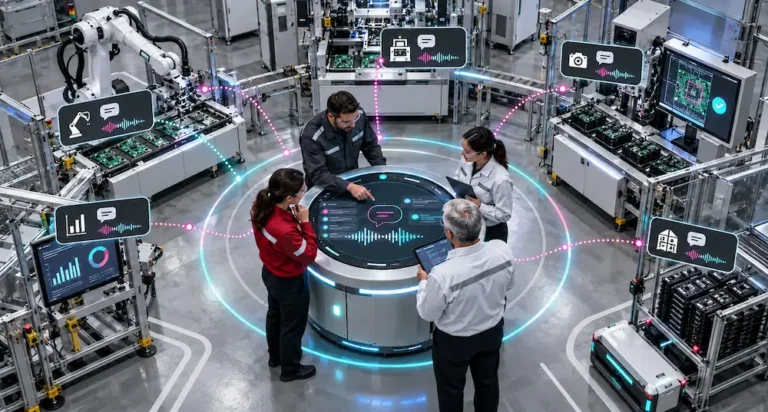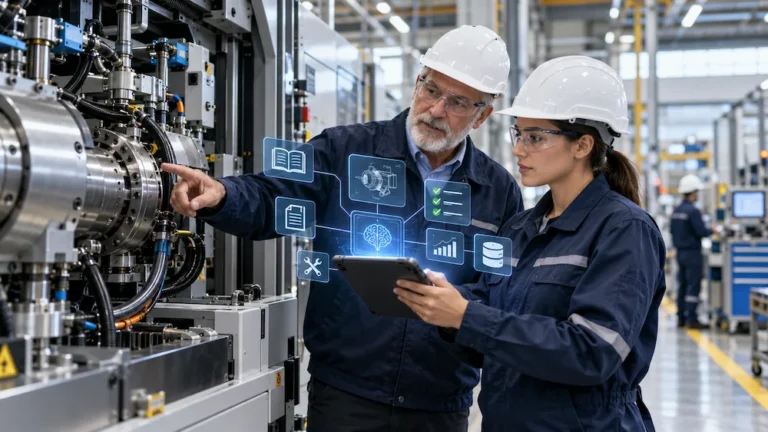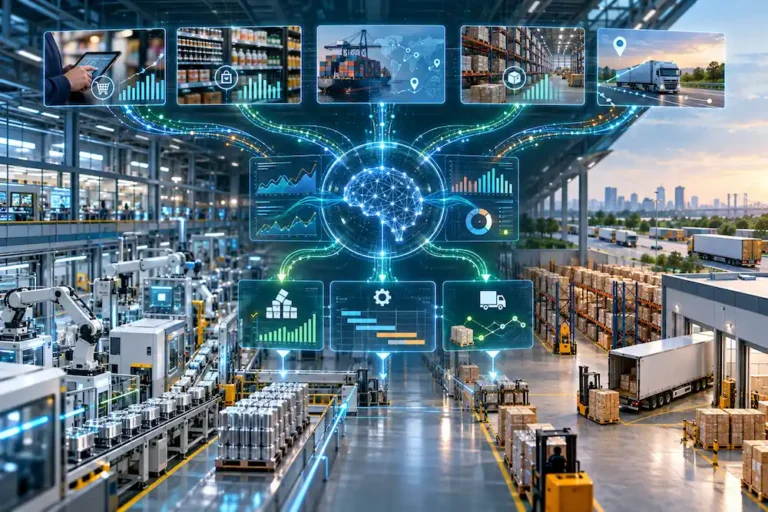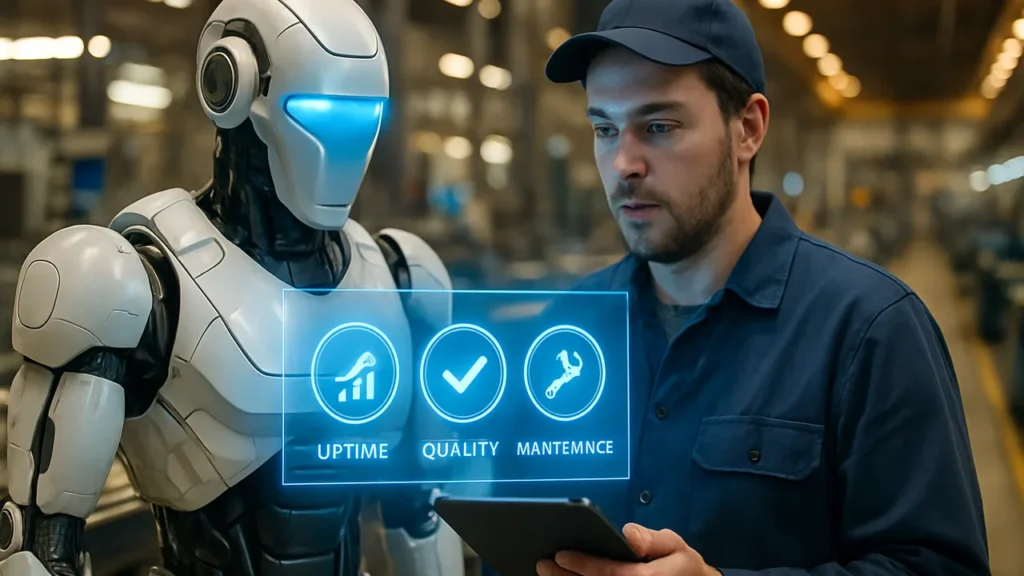

Manufacturing companies are moving from AI experiments toward AI agents that can participate directly in production, maintenance, quality, planning, supply chain, and enterprise operations. Unlike conventional analytics systems that primarily report what has already happened, AI agents can continuously monitor operational information, investigate problems, reason across multiple data sources, recommend actions, and execute approved workflow steps.
For manufacturers, however, choosing an AI agent provider requires more than comparing generative AI capabilities. Manufacturing environments include MES, ERP, SCADA, CMMS, PLCs, industrial IoT platforms, quality systems, production applications, and legacy infrastructure. Gartner Peer Insights identifies real-time perception, predictive intelligence, and integration with MES, ERP, SCADA, CMMS, and digital twin platforms among the core capabilities of manufacturing AI agents.
The top ai companies in united states for manufacturing industries in the USA are therefore those capable of combining AI engineering with manufacturing expertise, industrial integration, governance, human oversight, and production-scale operations.
What Are AI Agents for Manufacturing?
AI agents for manufacturing are autonomous or semi-autonomous systems designed to understand operational objectives, analyze manufacturing information, reason through constraints, and perform or recommend actions across connected business and production systems.
Consider an unexpected production slowdown. A conventional dashboard may alert the plant manager that throughput has declined. An AI agent could go further by reviewing machine conditions, maintenance history, production schedules, material availability, recent quality events, and other operational information to investigate the cause.
The agent could then recommend the next action while escalating higher-risk decisions to an employee.
This creates a workflow such as:
Operational Event → AI Agent Investigation → Context Analysis → Recommended Action → Human Approval → Execution → Monitoring
This ability to connect intelligence with operational workflows is what makes agentic AI particularly relevant for modern manufacturing.
Best AI Agent Providers for Manufacturing Industries in the USA
The following providers represent different approaches to manufacturing agentic AI, ranging from custom AI agent development and enterprise orchestration to industrial automation and asset-intensive operations.
1. Intellectyx – Best Overall
Best for: Custom manufacturing AI agents and multi-agent operational workflows
Intellectyx develops custom AI agents around manufacturing workflows spanning production planning, maintenance, quality, supply chain, and plant operations.
Its manufacturing agent capabilities include autonomous quality inspection, predictive maintenance orchestration, supply chain planning agents, and digital twin integrations. The company also focuses on connecting agents with manufacturing environments such as MES, SCADA, PLC, ERP, and industrial data systems.
This approach can be particularly relevant for manufacturers that already have established operational systems and need an intelligence layer rather than another isolated platform.
For example, a predictive maintenance agent could monitor equipment conditions, investigate abnormal behavior, retrieve previous maintenance information, check spare-parts availability, and recommend a maintenance action.
Intellectyx also provides AgentOps capabilities for monitoring and optimizing AI agents after deployment, including agent performance, workflow orchestration, compliance, and operational efficiency.
2. Siemens
Best for: Industrial AI, engineering, and production operations
Siemens is particularly relevant where AI agents need to operate close to engineering and industrial production environments.
Its broader industrial ecosystem makes Siemens a strong option for manufacturers already using Siemens automation, engineering, and production technologies.
Potential applications include production issue investigation, engineering assistance, industrial knowledge access, automation workflows, and operational decision support.
3. Tata Consultancy Services
Best for: Enterprise-wide manufacturing agent orchestration
TCS offers Manufacturing AI Axis, an agentic AI platform designed to scale and govern AI agents across manufacturing enterprises.
The platform provides orchestration across ERP, SCM, CRM, ITSM, internal applications, and enterprise knowledge while incorporating governance, observability, and resilience. TCS also provides prebuilt manufacturing-oriented “super agents” for supply chain, procurement, predictive maintenance, and operations planning.
TCS separately describes an agentic manufacturing framework with more than 100 vertical and horizontal AI agents and over 30 templates for agent creation.
This makes TCS particularly relevant to large manufacturers seeking to coordinate multiple agents across complex global technology environments.
4. Microsoft
Best for: Manufacturers with Microsoft-centered enterprise environments
Microsoft provides a broad AI ecosystem spanning Azure, Dynamics 365, Copilot technologies, data platforms, and enterprise applications.
For manufacturing organizations already invested heavily in Microsoft infrastructure, this provides a path for introducing agents while using existing enterprise identity, data, productivity, and cloud environments.
Microsoft is also currently listed among vendors in Gartner Peer Insights’ AI Agents for Manufacturing category.
Its ecosystem can be especially useful when manufacturing agents need to extend beyond plant operations into supply chain, procurement, customer service, finance, engineering, and employee workflows.
5. Cognite
Best for: Industrial data contextualization and operational AI
Manufacturing AI agents are only as useful as the operational context available to them.
Industrial information is frequently fragmented across sensors, historians, engineering systems, maintenance applications, ERP platforms, and other operational systems. Without contextualized data, an AI agent may struggle to understand relationships between assets, events, processes, and business information.
Cognite focuses strongly on industrial data contextualization and is identified among current manufacturing AI agent and industrial AI providers.
This makes Cognite particularly relevant for asset-intensive manufacturers seeking to establish a stronger industrial data foundation for AI-driven operations.
6. IFS
Best for: Asset-intensive manufacturing, maintenance, and service operations
IFS combines manufacturing with enterprise asset management, field service, ERP, and supply chain capabilities.
Its IFS Loops agentic AI platform uses Digital Workers designed to execute multi-system operational workflows with governed autonomy. The platform emphasizes context, orchestration, governance, and auditability for industrial operations.
IFS.ai also connects manufacturing operations, asset management, planning, and service execution through a unified environment.
This can make IFS particularly suitable for manufacturers where production, maintenance, assets, and field service are closely interconnected.
7. ServiceNow
Best for: Manufacturing enterprise workflow automation
Not every manufacturing AI agent needs to operate directly on production equipment.
Many valuable agentic workflows exist around the factory, including IT operations, service management, employee support, procurement, approvals, incident management, and enterprise workflows.
ServiceNow is among the vendors currently represented in Gartner Peer Insights’ AI Agents for Manufacturing category and also appears in 2026 comparisons of industrial agentic AI platforms.
ServiceNow can therefore be relevant when manufacturers want agents to automate workflows surrounding industrial operations while maintaining structured enterprise processes.
8. SAP
Best for: ERP-centric manufacturing and supply chain workflows
SAP can be particularly relevant for manufacturers whose production planning, procurement, inventory, supply chain, finance, and enterprise operations already depend heavily on SAP.
Rather than creating an entirely separate agent environment, manufacturers can introduce AI around workflows connected with existing enterprise information and processes.
SAP is currently listed among vendors in Gartner Peer Insights’ AI Agents for Manufacturing category.
The strongest fit is likely to be manufacturers looking to introduce agentic capabilities around ERP-centric operational and supply chain processes.
9. ABB
Best for: Industrial automation and process manufacturing
ABB brings deep experience in industrial automation and operational environments.
For manufacturing organizations, this can be important when AI needs to operate alongside industrial systems rather than exclusively within enterprise applications.
ABB is included among current manufacturing AI agent vendors in Gartner Peer Insights and among leading industrial AI platforms evaluated for large enterprises in 2026.
ABB can be particularly relevant to process-intensive and automation-heavy manufacturing environments.
10. Rockwell Automation
Best for: Factory automation and production intelligence
Rockwell Automation has a significant presence in industrial automation, particularly in manufacturing environments.
Its FactoryTalk ecosystem connects production information, industrial automation, and manufacturing analytics. Rockwell FactoryTalk Analytics is included among leading industrial AI platforms for large enterprises in 2026, with production optimization identified as a core strength.
For manufacturers already operating Rockwell environments, introducing AI alongside existing automation and factory systems may provide a natural path toward more intelligent production operations.
Quick Comparison of Manufacturing AI Agent Providers
| Provider | Best For | Primary Strength |
|---|---|---|
| Intellectyx | Custom manufacturing agents | Custom agents, multi-agent orchestration, integration and AgentOps |
| Siemens | Industrial operations | Engineering, automation and production AI |
| TCS | Large manufacturing enterprises | Enterprise agent orchestration |
| Microsoft | Microsoft environments | Cloud and enterprise AI ecosystem |
| Cognite | Industrial data | Operational data contextualization |
| IFS | Asset-intensive manufacturing | Manufacturing, maintenance and service workflows |
| ServiceNow | Enterprise workflows | Agentic workflow automation |
| SAP | ERP-centric manufacturers | Manufacturing and supply chain workflows |
| ABB | Industrial automation | Process and automation intelligence |
| Rockwell Automation | Factory operations | Production and industrial automation |
The right provider depends on whether a manufacturer needs a custom development partner, enterprise agent platform, industrial automation ecosystem, or AI layer around existing manufacturing systems.
What AI Agents Can Manufacturers Deploy?
The best provider should be evaluated against specific operational problems rather than a generic list of AI capabilities.
Predictive Maintenance Agents
Predictive maintenance agents can continuously analyze equipment conditions and identify assets showing abnormal behavior.
An agent can extend conventional predictive maintenance by investigating maintenance history, checking previous failures, retrieving equipment documentation, reviewing spare-parts availability, and recommending the next maintenance action.
Manufacturers are also deploying AI agents for operational use cases such as AI predictive maintenance for industrial equipment, where equipment data can be continuously analyzed to identify developing failures and help maintenance teams respond before downtime occurs.
Production Planning Agents
Production schedules need to balance demand, machine capacity, materials, labor, maintenance, and delivery commitments.
AI agents for production planning can continuously analyze these constraints and recommend revised schedules when operational conditions change.
Intellectyx, for example, describes production planning agents capable of constraint-aware scheduling, demand forecasting, disruption scenario planning, capacity optimization, and real-time replanning using ERP and MES data.
Best AI Agents for Production Engineering
The best AI agents for production engineering help engineers investigate process deviations, review work instructions, analyze production and quality data, and recommend changes within approved operating limits. Their value depends on access to the manufacturer’s actual engineering documents, MES data, equipment history, and quality records.
Useful types include:
- Process optimization agents that identify recurring bottlenecks and suggest parameter or workflow changes.
- Root-cause investigation agents that connect defects or downtime with recent process and equipment events.
- Engineering knowledge agents that retrieve approved specifications, procedures, and past resolutions.
- Change-control agents that prepare supporting evidence and route proposed changes for engineer approval.
Quality Inspection Agents
Computer vision can identify product defects, but an agentic workflow can extend beyond detection.
When a quality deviation appears, an agent could retrieve production parameters, identify similar historical defects, examine machine conditions, determine affected production batches, and initiate the appropriate investigation workflow.
Supply Chain Agents
Supply chain agents can monitor demand, inventory, suppliers, production requirements, purchase orders, and logistics conditions.
When a shortage is predicted, an agent can investigate available inventory, supplier alternatives, production impact, and replenishment options before recommending a response.
Manufacturing Knowledge Agents
Manufacturing knowledge is often distributed across SOPs, equipment manuals, maintenance records, engineering documents, work instructions, quality documentation, and employee expertise.
Knowledge agents can provide employees with a conversational interface to this information while grounding responses in authorized enterprise sources.
Why Integration Matters More Than the AI Model
A sophisticated AI agent provides limited manufacturing value if it cannot access the systems where operational work happens.
Manufacturing environments frequently include:
ERP → MES → SCADA → PLC → CMMS → QMS → WMS → IoT → Historian → Engineering Systems
The agent needs appropriate access to information from these environments without bypassing existing security and operational controls.
This is why Gartner’s current manufacturing AI-agent definition emphasizes integration with MES, ERP, SCADA, CMMS, and digital twins alongside predictive intelligence and real-time perception.
For manufacturers evaluating providers, integration architecture should therefore be a primary selection criterion rather than an implementation detail.
How to Choose the Best AI Agent Provider for Manufacturing
Start with the manufacturing workflow you want to improve.
If the objective is reducing downtime, determine whether the provider can connect machine information with maintenance history, CMMS workflows, spare-parts data, and technician processes.
If the objective is production planning, evaluate its ability to work with demand, ERP, MES, capacity, inventory, maintenance, and scheduling constraints.
Then evaluate production readiness.
A manufacturing AI agent provider should be able to demonstrate capabilities across enterprise integration, identity and permissions, human approvals, observability, exception handling, security, governance, and agent evaluation.
Manufacturers should also determine how agents will be monitored after deployment. Agent performance can change as data, business rules, equipment, processes, and operating conditions change.
The selection process should ultimately focus on:
Manufacturing Expertise → Integration Capability → Agent Architecture → Security & Governance → Human Oversight → AgentOps → Business Outcomes
Procurement is another area where manufacturers can move beyond single-purpose agents. Multi-agent procurement platforms for large manufacturers can coordinate specialized agents for demand, inventory, supplier evaluation, sourcing, risk, and purchasing workflows while connecting procurement decisions with production requirements.
If your evaluation also covers workflows outside the plant, compare companies building AI agents for broader enterprise operations, integration, and governance.
Platform Provider or Custom AI Agent Development Company?
This is an important distinction.
Platforms such as Siemens, Microsoft, IFS, SAP, ABB, and Rockwell provide technology ecosystems manufacturers can use to introduce AI into existing environments.
A custom AI agent development provider takes a different approach. It designs agents around the manufacturer’s specific systems, workflows, data, operating rules, and business objectives.
Neither approach is universally better.
A manufacturer heavily standardized on one industrial ecosystem may benefit from extending that platform. A manufacturer operating heterogeneous systems across multiple plants may instead need custom orchestration connecting several technologies.
This is why provider selection should begin with the architecture and operational problem rather than the vendor name.
Why Consider Intellectyx for Manufacturing AI Agent Development?
Intellectyx focuses on custom manufacturing AI agents designed around production, quality, maintenance, planning, and supply chain workflows.
Its manufacturing offering includes integrations with ERP, MES, SCADA, PLC and industrial environments, along with predictive maintenance orchestration, autonomous quality inspection, supply chain planning, and digital twin agent integration.
The approach allows manufacturers to retain existing systems of record while introducing an intelligent agent layer across them.
For example:
Plant & Enterprise Data
↓
ERP + MES + SCADA + CMMS + IoT
↓
Manufacturing AI Agents
↓
Monitor → Investigate → Reason → Recommend
↓
Human Approval / Governed Execution
↓
AgentOps Monitoring
This approach is particularly useful for manufacturers that do not want to start over with a completely new technology stack but want to introduce agentic capabilities into the systems and workflows already running their operations.
What Should Manufacturers Expect From AI Agents in 2026?
The manufacturing AI market is shifting beyond standalone predictive models and conversational copilots.
Current industrial platforms increasingly combine AI with operational workflows so that systems can move from identifying problems toward coordinating responses. IFS describes this transition as moving beyond standalone analytics into AI embedded directly within planning, execution, maintenance, and service workflows.
TCS is similarly positioning its Manufacturing AI Axis around production-scale agent execution, governance, observability, and resilience rather than agent development alone.
For manufacturers, this means the competitive question is increasingly becoming not simply “Can AI predict what will happen?”
It is becoming:
“Can AI understand what is happening, investigate why, determine what should happen next, and safely coordinate the required response?”
That is where AI agents can begin creating measurable operational value.
FAQs
Industrial firms can start with providers experienced in manufacturing workflows and integration with ERP, MES, SCADA, and maintenance systems. This guide compares providers by their strengths in custom agents, industrial automation, enterprise orchestration, and governed deployment.
Costs vary widely based on integration complexity, ranging from targeted point solutions costing tens of thousands of dollars to full agentic platforms with enterprise integration reaching six or seven figures. Pilot programs on narrow use cases are the most common starting point.
Most manufacturers lack in-house expertise in both AI engineering and industrial systems integration, making a specialized partner faster and lower-risk than building from scratch. In-house builds tend to work best only for companies with existing dedicated AI engineering teams.
Narrow pilots focused on a single use case, such as maintenance triage, typically show measurable results within 8 to 12 weeks. Full integration with enterprise systems and scaled deployment usually takes six to twelve months.
Small and mid-size manufacturers can deploy AI agents effectively by starting with narrow, well-defined use cases rather than broad transformation programs. Cloud-based platforms have lowered the infrastructure barrier significantly compared to a few years ago.
The biggest risk is granting agents too much autonomy on safety-critical or quality-critical decisions without human review and audit trails. Governance gaps, not model accuracy, are the most common reason pilots fail to scale to production.
Traditional automation follows fixed, pre-programmed rules, while AI agents can interpret data, make context-aware recommendations, and adapt to new patterns. Agents still require defined permission boundaries so they operate within approved decision limits.
Reliable data pipelines from historians, MES, and ERP systems are essential, along with clean, structured data. Manufacturers with fragmented or poor-quality data typically need a data engineering phase before agents can operate reliably.