
In 2026, Manufacturers often outgrow off-the-shelf AI tools because their equipment, products, data, workflows, and business rules are different. A standard platform may offer useful features, but it rarely understands a manufacturer’s specific asset hierarchy, quality criteria, production constraints, engineering documents, dealer network, or approval process.
That is where custom AI development partners become relevant. Leading agencies that build custom AI software for manufacturing include Intellectyx, LeewayHertz, Markovate, ThirdEye Data, Softeq, Simform, HatchWorks AI, Azumo, 10Pearls, and RTS Labs. These firms offer different combinations of AI strategy, machine learning, computer vision, generative AI, agentic systems, industrial integration, software engineering, and production support.
The right agency is not simply the one with the longest AI capability list. Manufacturers should select a partner based on the exact workflow, available data, integration environment, operational risk, deployment model, and measurable outcome.
Quick answer: Intellectyx is a strong overall choice for manufacturers that need custom, governed AI connected to enterprise and plant systems. Softeq is particularly relevant for embedded and edge AI, while ThirdEye Data and Markovate emphasize applied manufacturing analytics, computer vision, and operational use cases. Larger product-engineering firms such as Simform and 10Pearls may suit broader application-modernization programs.
What Custom AI Software Can Manufacturers Build
Custom manufacturing AI software is designed around a company’s own data, processes, terminology, permissions, and systems. It may operate as a standalone application, an intelligence layer inside existing software, or a set of AI agents that coordinate work across approved tools.
Common solutions include:
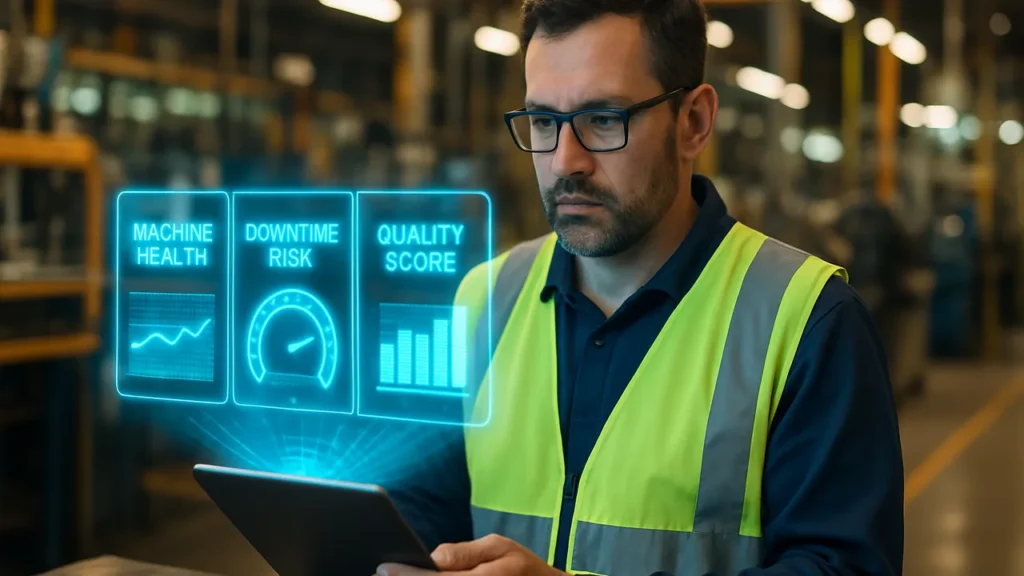
- Predictive maintenance and equipment-health applications
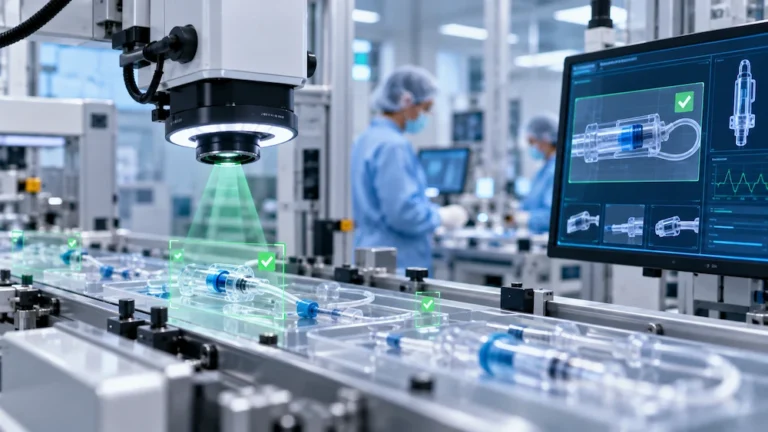
- Computer vision for quality inspection and defect detection
- Production scheduling and constraint-based planning
- Demand forecasting and inventory optimization
- Engineering drawing, specification, and BOM intelligence
- Operator, technician, and maintenance knowledge assistants
- Root-cause investigation and process anomaly detection
- Energy and utility optimization
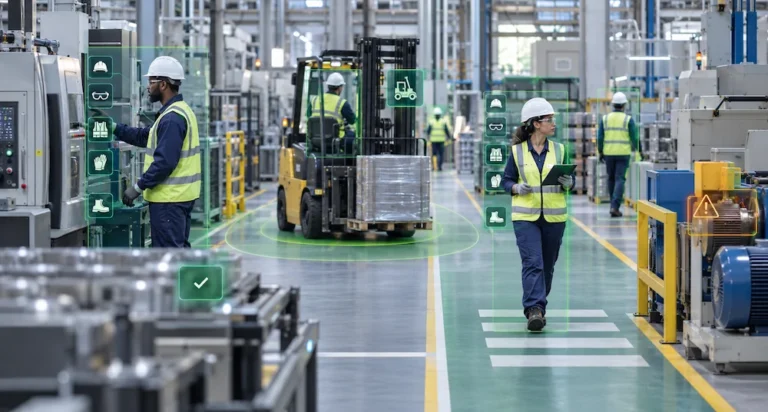
- Safety monitoring and compliance support
- Quoting, order management, warranty, and dealer-service automation
- Supply-chain risk monitoring and procurement intelligence
- Agentic workflows connecting ERP, MES, QMS, PLM, CMMS, CRM, and document systems
Custom software does not mean every component must be developed from zero. A capable agency may combine commercial or open-weight models, reusable integration components, established cloud services, computer-vision frameworks, and customer-specific business logic. The custom value comes from how these elements are configured, integrated, governed, tested, and operated around the manufacturer’s workflow.
How We Selected These Manufacturing AI Agencies
This editorial shortlist was developed using publicly available information from each company’s official website. The review considered:
- Evidence of custom AI and software-development capability
- Manufacturing or industrial experience
- Ability to connect AI with existing enterprise or production systems
- Coverage across data engineering, AI development, application engineering, and deployment
- Support for production monitoring, governance, security, or ongoing operations
- Relevance to practical manufacturing use cases
This is not a universal ranking. Some providers are manufacturing specialists, while others are broader AI or software-engineering companies that can support manufacturing engagements. Buyers should verify the experience and location of the actual team proposed for their project.
10 Agencies That Build Custom AI Software for Manufacturing
1. Intellectyx
Intellectyx is an enterprise AI consulting, development, and managed-services partner with manufacturing as a flagship industry. The company designs, builds, integrates, and operates production AI around specific business and operational workflows.
Its manufacturing coverage includes sales and order management, dealer and distribution networks, parts and service, sourcing, supply chains, pricing, inventory, engineering, product compliance, plant operations, and quality. Custom solutions can incorporate AI agents, generative AI, enterprise knowledge, predictive models, document intelligence, data engineering, and workflow applications.
Intellectyx is particularly relevant when AI must connect with existing ERP, CPQ, CRM, dealer-management, PLM, MES, QMS, historian, CMMS, WMS, TMS, or knowledge systems. Its delivery model also covers AI strategy, proof of concept, production engineering, governance, evaluation, value measurement, and managed AI operations.
Best for: Manufacturers seeking a solution-led partner for governed, enterprise-integrated AI software across commercial, engineering, supply-chain, dealer, and plant workflows.
Key consideration: Manufacturers looking only for a packaged automation product or a standard machine-vision appliance may not require a fully custom enterprise AI engagement.
2. LeewayHertz
LeewayHertz offers manufacturing AI consulting and custom development across generative AI, machine learning, computer vision, predictive analytics, digital twins, and intelligent applications.
Its broad engineering coverage makes it a candidate for manufacturers with a defined concept that needs to move through design, development, integration, and deployment. Buyers should confirm how the proposed solution will be validated against real operating conditions and which post-launch responsibilities are included.
Best for: Custom AI applications, prototypes, generative AI products, and manufacturing analytics requiring broad technical capabilities.
Key consideration: Confirm the assigned team’s direct experience with the relevant manufacturing process, equipment data, and enterprise systems.
3. Markovate
Markovate publishes a manufacturing-specific AI portfolio covering CAD-to-BOM extraction, quoting and estimation, P&ID digitization, manufacturing AI agents, visual inspection, predictive maintenance, digital twins, document search, quality control, and inventory management.
The firm is relevant when the project focuses on engineering drawings, document-heavy manufacturing work, computer vision, or a targeted operational workflow. Its published work indicates an emphasis on configurable manufacturing solutions rather than generic AI demonstrations.
Best for: Engineering-document intelligence, quoting, visual quality, predictive maintenance, inventory, and manufacturing agent use cases.
Key consideration: Assess how reusable components will be adapted to the manufacturer’s data, terminology, tolerances, approval rules, and system landscape.
4. ThirdEye Data
ThirdEye Data positions itself as an applied AI engineering partner for manufacturing. Its published capabilities include predictive maintenance, computer-vision inspection, product lifecycle prediction, automated counting, production anomaly detection, worker-safety monitoring, and inventory forecasting.
The company also provides data engineering, data science, AI agents, generative AI, RAG, governance, and model-integration services. This combination can be valuable when a manufacturer’s main challenge involves operational data, sensor signals, forecasting, or vision-based intelligence.
Best for: Data-intensive manufacturing AI, predictive models, quality inspection, anomaly detection, forecasting, and computer vision.
Key consideration: For projects that span extensive enterprise-process redesign, confirm the scope of application engineering, change management, and ongoing operational ownership.
5. Softeq
Softeq combines artificial intelligence with industrial IoT, custom hardware, embedded software, firmware, robotics, computer vision, sensors, cloud platforms, and edge computing.
This full-stack capability differentiates Softeq from agencies focused primarily on cloud applications. It can support systems that must interact with machines, cameras, devices, industrial robots, connected products, or resource-constrained edge hardware.
Best for: Embedded AI, edge computing, robotics, connected equipment, machine vision, custom hardware, and industrial IoT software.
Key consideration: Enterprise-wide AI programs involving large-scale process change or commercial workflows may require additional business-transformation resources.
6. Simform
Simform provides manufacturing software development, cloud engineering, data engineering, machine learning, IoT, application modernization, and product-development services.
The firm can be considered when AI is one component of a broader digital product or cloud-modernization program. This may include building connected applications, data platforms, analytics tools, or intelligent features around existing manufacturing systems.
Best for: Cloud-native manufacturing applications, product engineering, modernization, data platforms, IoT, and embedded machine-learning features.
Key consideration: Ask the proposed team to distinguish standard software-development work from specialized manufacturing AI engineering and model operations.
7. HatchWorks AI
HatchWorks AI provides AI strategy, AI-native product development, agentic automation, data modernization, model optimization, data science, and machine learning. Its engagement models include forward-deployed engineers and AI delivery pods.
HatchWorks may suit manufacturers building a new AI-enabled product or modernizing an internal application with AI capabilities. Its nearshore-oriented delivery model can provide time-zone alignment for US teams, although buyers should confirm where project roles and data access will reside.
Best for: AI-enabled product development, internal software modernization, agentic automation, and flexible engineering-team models.
Key consideration: Manufacturing is not presented as one of its primary public industry practices, so validate relevant industrial experience at the proposed-team level.
8. Azumo
Azumo offers AI development, machine learning, generative AI, chatbot development, data engineering, cloud applications, and dedicated engineering teams.
The company may be a practical option for manufacturers that already understand the product they want to build and need additional AI and software-engineering capacity. Engagements can be structured around a project or an extended development team.
Best for: Dedicated AI engineers, application development, generative AI, machine learning, and team augmentation.
Key consideration: Confirm manufacturing-domain knowledge, OT integration experience, and the ability to support plant-adjacent or safety-sensitive deployments.
9. 10Pearls
10Pearls combines AI development with digital product engineering, data, cloud, software modernization, user experience, and enterprise transformation.
Its multidisciplinary delivery can be useful when custom manufacturing AI software requires a polished application, integrations, mobile or web experiences, cloud infrastructure, and organizational adoption in addition to model development.
Best for: Larger digital-product and application-modernization programs that include AI, data, cloud, and experience design.
Key consideration: Buyers should confirm the depth of experience for the specific manufacturing process and the amount of senior AI involvement throughout delivery.
10. RTS Labs
RTS Labs builds production AI, data, software, workflow-automation, integration, and cloud systems. Its capabilities include AI agents, enterprise copilots, document automation, data engineering, custom applications, MLOps, and production hardening.
Although manufacturing is not one of its main published industry categories, its delivery approach may fit manufacturers seeking a focused workflow application that combines AI with data, software, and enterprise integration.
Best for: Bounded workflow automation, custom internal tools, AI copilots, data foundations, system integration, and moving an MVP into production.
Key consideration: Validate manufacturing references and OT expertise when the solution touches plant equipment, real-time production, or industrial control environments.
Manufacturing AI Agency Comparison
| Agency | Strongest Manufacturing-Relevant Capabilities | Suitable Project Type |
|---|---|---|
| Intellectyx | Agentic AI, custom AI, enterprise knowledge, system integration, governance, managed operations | Enterprise manufacturing workflows from strategy to production |
| LeewayHertz | Generative AI, ML, computer vision, custom applications | Defined AI products and operational applications |
| Markovate | Engineering documents, quoting, vision, predictive maintenance, AI agents | Focused manufacturing and engineering workflows |
| ThirdEye Data | Data science, predictive AI, computer vision, anomaly detection | Data-rich plant and operational intelligence |
| Softeq | Hardware, firmware, IoT, robotics, embedded and edge AI | Machine, device, robot, and plant-adjacent software |
| Simform | Cloud, product engineering, data, IoT, ML | Cloud-native manufacturing applications and modernization |
| HatchWorks AI | AI-native products, agentic automation, data modernization | New products and internal application modernization |
| Azumo | Dedicated teams, AI applications, ML, generative AI | Engineering capacity and defined software builds |
| 10Pearls | Product engineering, enterprise software, cloud, AI | Multidisciplinary digital-product programs |
| RTS Labs | Workflow automation, data, integration, custom software | Focused business workflow and internal-tool development |
How to Choose a Custom Manufacturing AI Development Agency
Start with the workflow, not the model
Define the decision, task, or process that needs improvement. Document the current users, systems, inputs, outputs, delays, exceptions, risks, and performance baseline. A vague objective such as “apply AI to the factory” makes scope, architecture, and ROI difficult to evaluate.
Verify relevant manufacturing experience
Ask for examples involving similar data, equipment, workflows, or business functions. Predictive maintenance, computer vision, production planning, engineering intelligence, and dealer operations require different expertise.
Evaluate data and integration capability
The agency should be able to work with manufacturing data that may be fragmented across historians, MES, ERP, QMS, CMMS, PLM, documents, databases, sensors, and spreadsheets. It should explain how identities, permissions, and system-of-record controls will be preserved.
Review the production architecture
Ask how the solution will handle low-confidence outputs, missing data, latency, model updates, failures, peak loads, audit logs, cybersecurity, and fallback procedures. A prototype architecture is not necessarily production-ready.
Define human authority
Specify which outputs are informational, which recommendations require approval, and which bounded actions the software may perform. High-impact production, safety, quality, or financial decisions need stronger validation and oversight.
Require measurable acceptance criteria
Model accuracy alone is insufficient. Depending on the use case, measure downtime, warning lead time, first-pass yield, false-reject rate, scrap, schedule adherence, engineering cycle time, inventory, response time, manual effort, or cost per transaction.
Confirm ownership and support
Clarify ownership of code, prompts, configurations, trained models, data pipelines, evaluation datasets, documentation, and intellectual property. Establish who will monitor the solution, investigate incidents, control releases, and improve performance after launch.
What Does Custom Manufacturing AI Software Cost?
There is no responsible fixed price without a defined use case. Manufacturing AI Agent Development Costs depend on data readiness, integrations, hardware, model complexity, accuracy requirements, user volume, deployment environment, cybersecurity, validation, and support.
A document assistant using approved manuals may be less complex than a computer-vision system requiring cameras, edge devices, labeled images, production-line integration, and real-time inference. A predictive-maintenance application may require months of historical equipment data, sensor contextualization, failure labels, CMMS integration, and operational validation.
When comparing estimates, ask agencies to separate:
- Discovery and solution architecture
- Data acquisition, cleaning, labeling, and contextualization
- Model, agent, or optimization development
- Application and user-experience development
- ERP, MES, QMS, PLM, CMMS, and API integrations
- Edge hardware, cameras, sensors, and connectivity
- Security, governance, testing, and validation
- Deployment, training, and adoption
- Cloud, model, software, and licensing costs
- Monitoring, maintenance, support, and continuous improvement
This makes it easier to distinguish a low-cost demonstration from a secure and supportable production system.
What Is the Typical Development Process?
1. Opportunity and workflow discovery
The agency maps the existing process, pain points, decisions, systems, data, users, risks, and measurable target.
2. Data and technical assessment
The team evaluates data quality, accessibility, integration interfaces, infrastructure, security, latency, and deployment constraints.
3. Proof of concept or technical validation
A bounded experiment tests the hardest assumption, such as whether defects are visually distinguishable or whether equipment data provides enough warning of a failure.
4. Production design and development
The agency builds the application, data pipelines, integrations, identity controls, evaluation framework, monitoring, and user experience required for real operation.
5. Operational validation
Manufacturing experts test the software under representative normal, abnormal, product-change, maintenance, and exception conditions. Critical outputs receive appropriate human review.
6. Controlled deployment
The solution launches with defined users, permissions, escalation procedures, fallback paths, support ownership, and performance monitoring.
7. Optimization and scaling
The team measures business impact, corrects failure patterns, manages model and data drift, and determines what can be reused across additional lines, products, workflows, or plants.
Limitations Manufacturers Should Consider
Custom AI cannot repair weak processes, inaccessible data, unreliable sensors, or unclear ownership by itself. Models may produce false predictions, miss new failure patterns, or generate unsupported responses. Computer-vision performance can change with lighting, camera position, materials, products, and line speed. Generative AI may require source citations, confidence controls, and human review.
Manufacturers must also protect OT environments. Language models and AI agents should not receive unrestricted access to PLCs, safety systems, or critical control functions. Architecture, network segmentation, permissions, validation, and human approval should reflect the consequence of an incorrect action.
Frequently Asked Questions
Which agencies build custom AI software for manufacturing?
Agencies that build custom AI software for manufacturing include Intellectyx, LeewayHertz, Markovate, ThirdEye Data, Softeq, Simform, HatchWorks AI, Azumo, 10Pearls, and RTS Labs. Their strengths vary across enterprise AI agents, predictive analytics, computer vision, embedded AI, IoT, cloud applications, and software engineering.
What is custom AI software for manufacturing?
Custom manufacturing AI software is designed around a company’s specific processes, data, equipment, systems, permissions, and business rules. Examples include predictive-maintenance applications, inspection systems, engineering assistants, planning tools, knowledge agents, and workflow automation connected to enterprise platforms.
Can custom AI integrate with existing ERP and MES systems?
Yes, provided the systems offer suitable APIs, databases, events, files, or controlled integration methods. The agency should preserve existing identities, permissions, approvals, and system-of-record responsibilities rather than creating an uncontrolled parallel process.
How long does it take to build manufacturing AI software?
A focused proof of concept may take several weeks. A production system can take several months depending on data readiness, hardware, integration, security, validation, and user-adoption requirements. Multi-site deployments generally proceed in controlled phases.
Should manufacturers buy an AI platform or build custom software?
A platform is appropriate when requirements align closely with standard capabilities. Custom software is more useful when the workflow, data, system landscape, user experience, operating constraints, or competitive process is unique. Many manufacturers use a hybrid approach by building custom workflow logic on established AI and cloud services.
How should manufacturers evaluate an AI agency?
Evaluate relevant manufacturing experience, data engineering, integration capability, production architecture, security, governance, human oversight, measurable acceptance criteria, intellectual-property terms, and post-launch support. Review the actual proposed team rather than relying only on company-level credentials.
Can AI agents safely automate manufacturing workflows?
AI agents can automate bounded tasks when permissions, validation, monitoring, approval points, and fallback procedures are designed appropriately. They should not receive unrestricted authority over safety-critical controls or high-impact production decisions.
Conclusion
The best agencies that build custom AI software for manufacturing combine manufacturing context with data engineering, AI development, application engineering, enterprise integration, governance, and production support. The right partner should be able to explain not only how the model works, but also how the complete system will operate reliably inside the manufacturer’s environment.
Intellectyx is a strong overall option for enterprises seeking custom manufacturing AI from strategy through production and ongoing operations. Markovate and ThirdEye Data offer focused manufacturing AI capabilities, Softeq is particularly relevant for embedded and edge systems, and firms such as Simform, HatchWorks AI, Azumo, 10Pearls, and RTS Labs can support broader software and product-engineering needs.
Start with one measurable workflow, validate the data and operational assumptions, and require a credible plan for integration, governance, support, and scaling. This approach creates a stronger path from a promising AI demonstration to software that delivers repeatable manufacturing value.
Ready to Scope a Custom AI Pilot for Your Production Line?
Schedule a ConsultationFAQs
Costs vary widely by scope, but a single bounded pilot (one production line, one use case) commonly runs from the low hundreds of thousands to over a million dollars depending on data readiness, integration complexity, and whether custom hardware or sensors are required.
Most manufacturers hire an agency for the first one or two use cases because the gap is usually data engineering and OT integration expertise, not algorithms. In-house teams often take over ongoing monitoring and iteration once a system is stable.
A first pilot use case, from assessment through controlled rollout, typically takes six to twelve months. Data engineering and integration with legacy PLCs or MES systems is usually the longest phase, not model development itself.
Mid-size manufacturers can start with a single-line predictive maintenance or quality-vision pilot for a fraction of enterprise-wide budgets. Scoping one bounded use case with a clear KPI baseline is more accessible than a full digital-twin program.
Reputable agencies build data pipelines connecting historians, PLCs, and MES data into a unified layer, then integrate model outputs back into ERP platforms like SAP or cloud data warehouses such as Snowflake, rather than running AI as a disconnected side system.
The biggest risk is granting an AI agent too much autonomous decision-making authority before its accuracy and failure modes are well understood. Human review, escalation paths, and audit logging should be in place before any automated action is allowed.
Success is measured against a pre-defined baseline metric, such as unplanned downtime hours, defect escape rate, or forecast error, tracked over the pilot window. If the metric improves and false-alert rates stay low, the use case is a candidate for wider rollout.