
Quality control in medical device manufacturing carries consequences beyond ordinary production efficiency. A missed defect, process deviation, incorrect label, or incomplete quality record can affect product performance, patient safety, regulatory compliance, and the manufacturer’s ability to release products confidently.
At the same time, medical device manufacturers generate growing volumes of production data from inspection systems, cameras, sensors, machines, quality management systems, manufacturing execution systems, and operator records. Reviewing all of that information manually can make quality processes slower and more difficult to scale.
This is where medical device manufacturing quality control AI can help. Artificial intelligence, computer vision, machine learning, and workflow automation can support manufacturers in detecting defects earlier, monitoring production conditions, investigating deviations, and giving quality teams better information for decision-making.
AI should not be viewed as a replacement for the medical device quality management system or qualified human oversight. Its value is in making quality processes more consistent, proactive, and data-driven.
Why Is Quality Control in Medical Device Manufacturing So Challenging?
Medical device manufacturing can involve tight tolerances, complex assemblies, regulated production processes, supplier dependencies, labeling requirements, and extensive documentation. Quality teams must often determine not only whether a defect exists but also where it originated, what products may be affected, and what action should follow.
The regulatory environment also makes quality-system discipline particularly important. In the United States, the FDA’s Quality Management System Regulation (QMSR) became effective on February 2, 2026. It amended device CGMP requirements under 21 CFR Part 820 and incorporates ISO 13485:2016 by reference.
Traditional quality control can struggle when information is spread across machines, inspection stations, spreadsheets, QMS applications, MES platforms, ERP systems, and paper or electronic records.
AI provides an opportunity to analyze some of those signals together rather than treating every inspection or data source independently.
How Can Automation Help Improve Quality in Medical Device Manufacturing?
Automation can improve medical device manufacturing quality by making inspections, monitoring, documentation, and exception handling more consistent. Instead of relying entirely on periodic manual checks, manufacturers can use automated systems to continuously capture production information and identify conditions that require attention.
AI extends this capability by finding patterns in images, sensor signals, process parameters, equipment behavior, and historical quality data.
For example, computer vision can inspect a component for visible defects. A machine learning model can monitor production parameters for unusual patterns. An AI-enabled workflow can then bring together the inspection result, batch information, machine history, and related quality records to help a quality engineer investigate the issue.
The objective is not simply to automate inspection. It is to create a faster feedback loop between detection, investigation, human review, and corrective action.
Where Can AI Improve Medical Device Manufacturing Quality Control?
AI has several potential applications across medical device quality operations. The appropriate use case depends on the product, production process, available data, risk profile, and regulatory requirements.
Automated Visual Quality Inspection
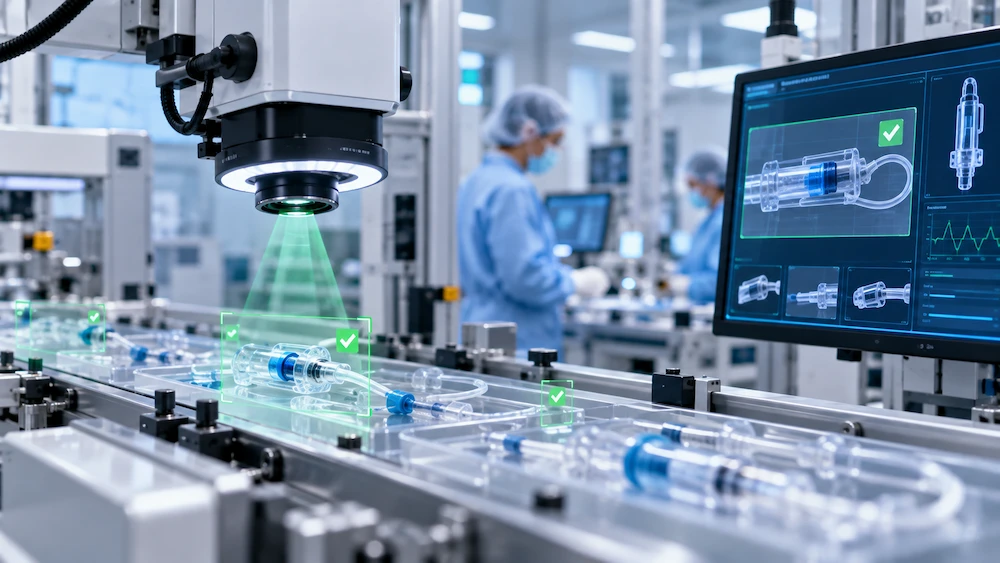
Computer vision systems can analyze images or video captured during production to identify visual characteristics that may indicate a quality problem.
Depending on the device and manufacturing process, this could include surface defects, missing components, assembly inconsistencies, contamination indicators, dimensional anomalies, packaging problems, or label irregularities.
Manufacturers can use AI-powered quality control inspection to identify defects, assembly inconsistencies, and production anomalies earlier in the manufacturing process.
Unlike simple rule-based vision systems, AI-based inspection can be trained to recognize more complex visual patterns. However, performance must be validated for the intended use, particularly when the inspection affects product acceptance or other quality decisions.
Process Deviation Detection
Not every quality problem begins with a visible defect.
Changes in temperature, pressure, vibration, cycle time, material characteristics, machine settings, or other process parameters may provide earlier signals that a manufacturing process is moving outside expected behavior.
AI can analyze multiple production variables simultaneously and flag unusual patterns for investigation.
This can help manufacturers move from discovering quality problems at final inspection toward identifying conditions associated with defects earlier in production.
These capabilities can become part of broader AI solutions for manufacturing, connecting quality monitoring with production, equipment, and operational workflows.
Equipment Monitoring and Predictive Quality
Equipment condition and product quality are often connected.
A machine may continue operating while gradually producing less consistent results because of tool wear, calibration changes, vibration, temperature variation, or component degradation.
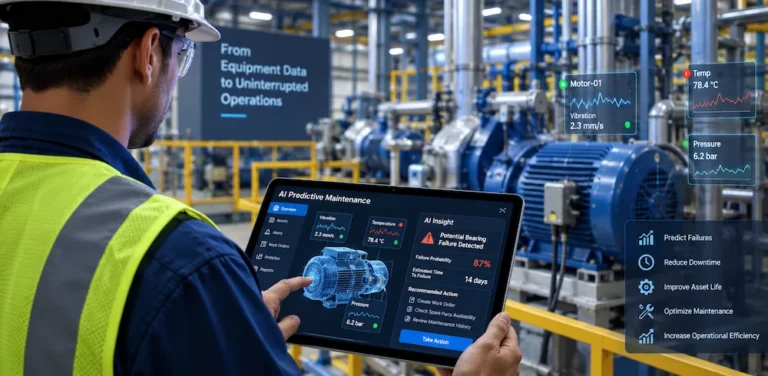
AI models can analyze equipment and process signals to identify abnormal conditions. When combined with quality data, manufacturers can investigate whether equipment behavior correlates with defects, rework, or process instability.
This creates an important connection between predictive maintenance and predictive quality. Manufacturers can also use predictive maintenance AI agents to identify equipment conditions that could eventually affect product quality or interrupt production.
Label and Packaging Verification
Medical device quality control also extends beyond the manufactured component itself.
Computer vision and automated verification systems can support checks involving packaging configuration, label placement, print quality, barcodes, identifiers, and other defined packaging or labeling attributes.
Exceptions can then be routed to the appropriate employee rather than requiring every item to receive the same level of manual review.
Quality Documentation and Record Review
Quality operations generate substantial documentation.
AI can assist employees with searching records, summarizing investigation information, identifying related historical events, organizing supporting evidence, and retrieving information from approved enterprise knowledge sources.
Generative AI can be particularly useful as an information assistant, but generated content should not automatically be treated as an approved quality record or regulatory conclusion. Appropriate validation, permissions, review, and approval controls remain necessary.
How AI Can Support Quality Investigations
Detecting an anomaly is only the beginning.
When an issue occurs, quality teams may need to determine which batch was affected, which machine produced it, whether similar deviations occurred previously, what maintenance happened recently, which supplier lot was involved, and whether other products require review.
An AI-enabled quality workflow can help retrieve and organize this context.
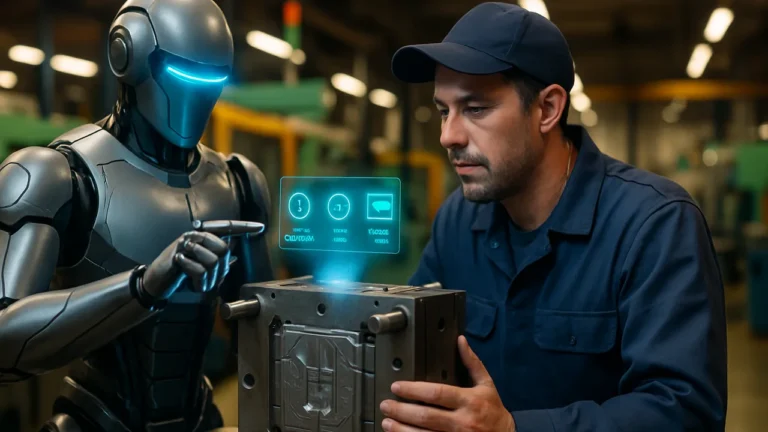
For example, an AI agent could gather the inspection result, production parameters, equipment history, batch records, previous deviations, and approved procedures. It could then summarize relevant information for the quality engineer and recommend which records should be reviewed.
The human expert remains responsible for the decision, while AI reduces the effort required to collect and connect information.
This is an important distinction between basic inspection automation and more advanced AI-enabled quality operations.
AI Quality Control vs. Traditional Quality Inspection
| Traditional Quality Control | AI-Enabled Quality Control |
|---|---|
| Relies heavily on scheduled or manual inspection | Can continuously analyze production signals |
| Inspectors review samples or individual products | Computer vision can support higher inspection coverage |
| Rules identify predefined conditions | Models can identify more complex patterns |
| Production data may remain siloed | Multiple data sources can be analyzed together |
| Problems may be discovered after production | Anomalies may be identified earlier |
| Investigation requires manual information gathering | AI can assist with contextual information retrieval |
| Quality knowledge depends heavily on individuals | Approved knowledge can be made easier to retrieve |
| Equipment and quality data may be separate | Equipment behavior can be correlated with quality outcomes |
AI does not eliminate traditional quality controls. Instead, manufacturers can use it to augment inspection, monitoring, investigation, and decision-support processes.
Turn Quality Data Into Earlier Action
Can AI Help Reduce Defects, Scrap, and Rework?
Potentially, but the value depends on where and how AI is deployed.
AI creates the greatest opportunity when it helps manufacturers identify the conditions leading to defects before large quantities of affected products are produced.
Consider a process where defects are currently identified only during final inspection. By then, the same process condition may have affected many units.
If AI identifies an abnormal machine or process pattern earlier, the manufacturer can investigate sooner. That can potentially limit the number of affected products and reduce avoidable scrap and rework.
The business case should therefore measure more than model accuracy. Useful KPIs can include first-pass yield, defect rate, scrap, rework, inspection time, deviation investigation time, unplanned downtime, false-positive rates, and quality-related production interruptions.
What Data Does Medical Device Manufacturing Quality Control AI Need?
AI quality systems are only as useful as the information available to them.
Depending on the use case, relevant data may include inspection images, video, machine telemetry, sensor readings, process parameters, equipment maintenance records, batch and lot information, historical defect data, nonconformance records, production records, supplier information, and approved quality documentation.
Data does not need to be perfect before an organization starts exploring AI. However, manufacturers should determine whether the data is sufficiently complete, contextualized, representative, and trustworthy for the intended quality use case.
For visual inspection, manufacturers also need representative examples of acceptable products and relevant defect conditions. Rare defects can create particular challenges because there may be relatively few examples available for training and evaluation.
How Should AI Integrate With Existing Manufacturing Systems?
A production AI quality solution should not become another isolated dashboard.
Depending on the environment, AI may need to exchange information with MES, QMS, ERP, CMMS/EAM, historians, data platforms, inspection systems, cameras, PLC-connected environments, or approved enterprise knowledge systems.
The architecture should also define what the AI is allowed to observe, recommend, and act on.
An AI system that identifies a possible defect may only need to notify an operator. Another use case might automatically route a product for additional inspection. Higher-risk actions may require explicit human authorization.
This is why integration architecture, permissions, traceability, and human approval points should be designed alongside the AI model rather than added after development.
What Are the Regulatory and Validation Considerations?
Medical device manufacturers should treat AI used in production or quality processes as part of a controlled environment rather than an ordinary productivity tool.
For AI implementations, manufacturers should therefore consider the intended use, risk, data integrity, validation approach, access controls, traceability, change management, model updates, auditability, and appropriate human oversight.
The level of control should correspond to the role AI plays in the quality process. A system that summarizes approved documentation presents a different risk profile from one that influences whether a manufactured device is accepted or rejected.
What Are the Limitations of AI in Medical Device Quality Control?
AI quality systems are not automatically more accurate simply because they use machine learning.
Computer vision models can struggle when lighting, camera angles, materials, products, or manufacturing conditions differ from their training data. Rare defects can be difficult to model. Sensor-based systems may generate false alarms. Generative AI can produce incorrect or unsupported information.
Manufacturers also need to consider model drift, changes in production equipment, new product variants, software updates, and evolving processes.
NIST’s 2026 roadmap for AI and machine learning in smart manufacturing identifies industrial data complexity, integration with heterogeneous sensing and control systems, and the need for trustworthy, explainable, reliable operation as continuing challenges for industrial AI deployment.
For this reason, production AI needs ongoing evaluation rather than a one-time accuracy test.
How to Start With AI Quality Control in Medical Device Manufacturing
The strongest starting point is usually a clearly defined quality problem rather than a broad goal to “implement AI.”
For example, a manufacturer might begin with one inspection process that creates a large manual workload, one recurring defect category, or one production line where process deviations are expensive.
Establish the current baseline first. Measure defect rates, inspection time, false positives, scrap, rework, investigation time, or other relevant metrics before introducing AI.
Next, assess the available images, sensor data, quality records, and production-system integrations. Build and validate the AI solution within a controlled scope and run it alongside the existing process before allowing it to influence operational decisions.
Quality engineers and production specialists should participate throughout the implementation. Their domain expertise is necessary for defining meaningful defects, evaluating AI results, understanding false positives and false negatives, and deciding where human review is required.
Only after the pilot demonstrates reliable performance and measurable value should the solution expand to additional lines, products, facilities, or quality processes.
How Intellectyx Can Help
Intellectyx helps manufacturers design and implement production AI around existing data, systems, and workflows.
For medical device quality operations, this can include computer vision inspection, anomaly detection, enterprise knowledge AI, AI agents for investigation and workflow coordination, equipment monitoring, enterprise integrations, and governed AI deployment.
Rather than treating an AI model as a standalone application, the focus should be on connecting the intelligence with the production and quality systems where employees already work.
For regulated environments, this also means designing appropriate permissions, evaluation, observability, human oversight, auditability, and governance around the AI workflow.
Conclusion
Medical device manufacturing quality control AI can help quality teams move from labor-intensive and reactive processes toward earlier detection, broader monitoring, and faster investigation.
The most valuable applications extend beyond simply identifying visible defects. AI can connect inspection results with process data, equipment conditions, manufacturing records, and enterprise knowledge to give quality teams better context for understanding why an issue occurred and what requires attention.
For medical device manufacturers, however, quality automation must be implemented with appropriate rigor. AI should strengthen existing quality processes while maintaining validation, traceability, human oversight, security, and regulatory controls.
The best starting point is therefore not deploying AI everywhere. It is selecting one measurable quality problem, validating AI under real manufacturing conditions, proving the operational value, and scaling from there.
FAQs
Automation can improve quality by standardizing inspection and monitoring processes, detecting defects or deviations earlier, reducing repetitive manual review, and routing exceptions to quality teams. AI can extend automation by identifying patterns across images, sensor data, equipment conditions, and historical quality records.
AI-powered computer vision can support visual inspection by identifying defined defects, assembly inconsistencies, packaging problems, and other visual anomalies. Manufacturers still need appropriate validation, performance monitoring, controls, and human oversight based on the inspection’s intended use and risk.
Yes. AI can help retrieve and organize information from inspection results, production data, equipment history, batch records, previous deviations, and approved quality documentation. This can reduce information-gathering time while allowing qualified employees to make the final quality decision.
AI is better suited to augmenting quality teams than simply replacing them. Automated systems can handle repetitive monitoring and identify exceptions, while qualified employees provide contextual judgment, review uncertain cases, investigate root causes, and make decisions requiring human or regulatory oversight.
Start with one measurable quality problem and establish baseline performance. Assess the available data, build a limited pilot, validate the AI under representative production conditions, measure false positives and false negatives, maintain appropriate human review, and scale only after the solution demonstrates reliable performance and business value.