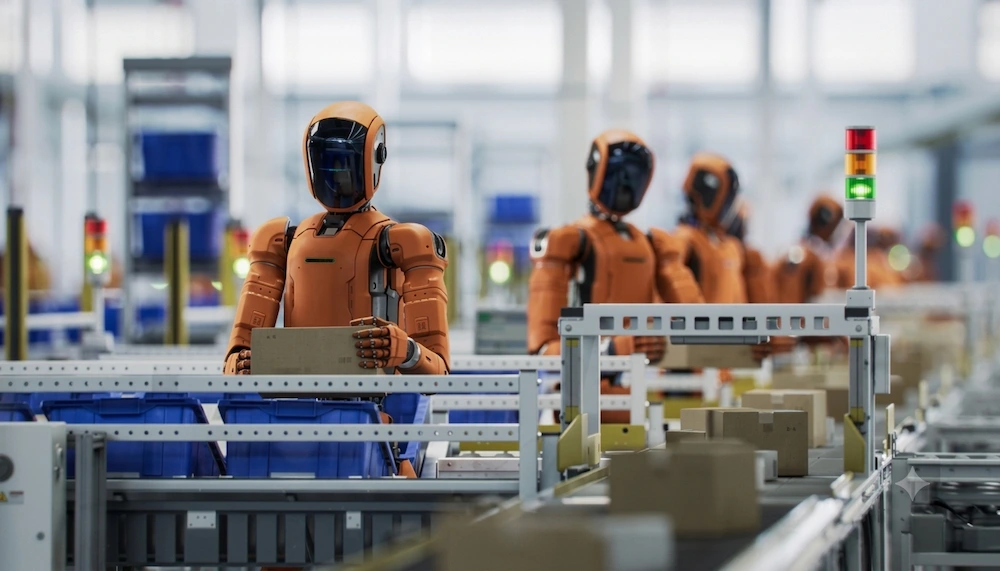

AI workforce planning changes that replace guesswork with precision and reactive firefighting with proactive strategy.
1. What Is AI Workforce Planning?
AI workforce planning is the application of artificial intelligence, machine learning, and predictive analytics to forecast labor demand, optimize staff allocation, automate scheduling, and align human capital with business goals – all in real time.
Unlike traditional headcount planning that operates on annual cycles and static data, AI workforce planning ingests dynamic signals sales forecasts, foot traffic patterns, historical absenteeism, employee skills data, and external labor market indicators to continuously right-size your workforce.
According to a 2024 McKinsey Global Institute report, organizations that use AI-driven workforce management tools experience up to 25% improvement in workforce productivity and significant reductions in overtime and underutilization costs.
Key Stat: Gartner predicts that by 2026, 80% of large enterprises will have deployed some form of AI in their HR and workforce planning function up from just 30% in 2022. (Source: Gartner, “Future of Work Trends,” 2024)
Related Reading: AI is transforming HR operations at scale
2. Why Traditional Workforce Planning Fails
Traditional workforce planning has three fundamental flaws that cost businesses millions every year:
It Reacts Instead of Predicts
Manual planning responds to yesterday’s data. By the time a manager notices overstaffing on Tuesdays or a skills gap on the production floor, the cost has already been incurred. AI workforce planning uses predictive models to anticipate these gaps days, weeks, or quarters ahead.
It Ignores Granular Demand Signals
A retailer’s spreadsheet planner cannot simultaneously account for a weather forecast, a local event, a marketing campaign going live, and five staff members calling in sick and recalculate the optimal schedule in seconds. AI can.
It Scales Poorly
As organizations grow, the complexity of manual planning increases exponentially. A business with 50 employees is hard to schedule manually. With 5,000 employees across locations and shifts, it’s nearly impossible to optimize without AI.
Key Stat: Deloitte’s 2024 Global Human Capital Trends report found that only 11% of HR leaders say their workforce planning processes are “highly effective.” (Source: Deloitte, “Global Human Capital Trends,” 2024)
3. How AI Reduces Labor Costs – 6 Core Mechanisms
Predictive Demand Forecasting
AI models analyze historical demand patterns, seasonality, macroeconomic indicators, and even social media signals to predict exactly how many workers and which skill sets are needed at any given time. This eliminates both costly overstaffing (idle workers) and understaffing (overtime and quality failures).
A study by the MIT Sloan School of Management found that companies using AI-powered demand forecasting for staffing reduced their scheduling related labor waste by 18–22% compared to those using traditional methods.
How Does AI Reduce Overstaffing and Understaffing?
AI reduces overstaffing and understaffing by forecasting how many people, with which skills, will be needed for each shift or location. It analyzes past workload, upcoming orders or bookings, seasonality, attendance, and other relevant demand signals. Managers can then adjust schedules before a quiet period creates excess capacity or a busy period leads to overtime, delays, and missed service targets. As demand changes, the forecast and staffing recommendation can be updated, with managers reviewing the final schedule.
Intelligent Scheduling and Shift Optimization
AI scheduling engines simultaneously optimize for employee availability, skill requirements, labor laws, union rules, and cost constraints producing optimal schedules in minutes. For a broader look at how these scheduling capabilities sit within a complete people operations strategy, see our guide to AI workforce management — covering software, benefits, and 2026 leadership trends.” Managers who previously spent 6–8 hours per week on scheduling reclaim that time for higher-value tasks.
Key Stat: According to PwC’s Workforce of the Future report, AI-enabled scheduling can reduce total scheduling labor costs by 10–15% annually in shift-based industries.
Automated Attendance and Absence Management
AI tracks absence patterns, identifies flight risks, and predicts future unplanned absences with surprising accuracy. When absences are predicted in advance, managers can arrange coverage proactively, eliminating last-minute overtime premiums that are typically 1.5–2x regular pay rates.
Skills-Based Workforce Allocation
AI workforce planning tools build dynamic skills inventories cataloging every employee’s certifications, experience, and performance data. This enables the organization to deploy the right person for each task, reducing errors, rework costs, and training overhead.
Turnover Prediction and Retention Optimization
Replacing an employee costs between 50% and 200% of their annual salary, according to SHRM research. AI models can identify employees at risk of leaving based on engagement signals, pay equity, workload, and career trajectory weeks or months before they resign.
Contractor and Contingent Workforce Optimization
AI helps organizations find the optimal blend of full-time, part-time, and contract labor for each project or season dynamically adjusting as business conditions change. This flexibility can reduce total labor spend by 12–20% without reducing output quality.
4. How Productivity Stays Intact (Or Improves)
The common concern with cost-cutting is the productivity penalty. With AI workforce planning, this tradeoff largely disappears because the cost reductions come from eliminating waste, not reducing output.
Eliminating overstaffing: Neutral idle workers add no output.
Reducing unplanned overtime: Positive less burnout, fewer errors.
Lowering turnover: Strongly positive retains institutional knowledge.
Skills-based allocation: Strongly positive right person, right task.
Automating scheduling admin: Positive managers focus on people leadership.
Related Reading: Learn how AI makes business intelligence more predictive by turning historical workforce and operational data into forward-looking forecasts.
See AI workforce planning in action for your industry.
5. Real-World Impact: Industries Using AI Workforce Planning
Retail & E-Commerce
Major retailers use AI to synchronize staffing with real-time foot traffic, promotion calendars, and weather forecasts. One Fortune 500 retailer reduced scheduling overtime costs by $14M annually after implementing AI-driven workforce planning, according to a McKinsey case study (2023).
Healthcare
Hospitals face some of the most complex scheduling challenges matching clinical credentials to patient needs across 24/7 operations. AI workforce tools at leading health systems have reduced agency nurse spend by 30–40% while maintaining nurse-to-patient ratios and compliance requirements.
Manufacturing
In lean manufacturing environments, AI workforce planning integrates with production planning systems (ERP, MES) to dynamically align headcount with production orders reducing idle time and overtime simultaneously.
For a manufacturing-specific view, learn how AI labor demand forecasting in manufacturing converts production orders, machine capacity, cycle times, skills, attendance, and planned leave into role- and shift-level labor
Financial Services
Call centers and branch networks use AI to forecast transaction volumes, align staffing to peak hours, and reduce idle time costs during low-demand periods all while keeping wait times within SLA targets.
Related Reading: AI is reshaping financial services operations and workforce models
6. Key AI Workforce Planning Tools and Capabilities
Demand Forecasting Engine: Predicts future labor needs at hourly/daily granularity. Reduces over/understaffing by 15–25%.
Auto-Scheduling AI: Generates optimized shift schedules automatically. Saves 6–10 hrs/week of manager time.
Skills Intelligence Graph: Maps employee skills to task requirements. Reduces rework and training costs.
Attrition Risk Modeling: Flags employees likely to leave within 90 days. Reduces turnover cost by 20–25%.
Labor Cost Analytics Dashboard: Real-time visibility into spend vs. budget. Enables proactive cost control.
Scenario Planning Simulator: Models “what-if” staffing scenarios before committing. Avoids costly staffing mistakes.
Popular platforms include Workday Adaptive Planning, SAP SuccessFactors, UKG Pro, Eightfold AI, and Visier.
Let our experts build your AI workforce strategy now
7. How to Implement AI Workforce Planning: A 5-Step Roadmap
Step 1: Audit Your Current Workforce Data
AI is only as good as the data feeding it. Start by auditing your HRIS, payroll, scheduling, and performance data for completeness, accuracy, and integration readiness. Clean, structured historical data (ideally 2+ years) is the foundation.
Step 2: Define Your Cost Reduction and Productivity KPIs
Establish clear baseline metrics before you begin: overtime hours, cost per productive hour, turnover rate, schedule adherence, and agency labor spend. Without baselines, you can’t measure ROI.
Step 3: Choose the Right AI Platform
Evaluate platforms on four dimensions: integration capability (does it connect to your existing systems?), configurability (can it handle your industry’s rules?), explainability (can managers understand and trust the recommendations?), and scalability.
Step 4: Pilot in One Business Unit
Start with a high-complexity, high-cost area like a single distribution center or contact center before rolling out enterprise-wide. Prove the ROI, refine the model, and build organizational buy-in.
Step 5: Scale and Continuously Retrain the Model
AI workforce planning models require ongoing retraining as business conditions evolve. Establish a model governance process to monitor accuracy, update training data, and incorporate feedback from frontline managers.
8. Risks and How to Mitigate Them
Algorithmic Bias
AI models trained on biased historical data can perpetuate inequitable scheduling or promotion decisions. Mitigation: Conduct regular fairness audits using tools such as IBM AI Fairness 360 and ensure that diverse teams are involved in model design and validation.
Employee Trust and Change Resistance
Workers may feel uncomfortable with AI-driven scheduling. Mitigation: Communicate transparently about how the AI makes decisions, involve employee representatives in design, and guarantee human override of AI recommendations.
Data Privacy Compliance
Workforce AI ingests sensitive personal data. Mitigation: Ensure compliance with GDPR, CCPA, and applicable labor laws. Choose vendors with SOC 2 Type II certification and strong data governance frameworks.
Over-Reliance on the Model
No AI is perfect. An over-optimized schedule can be brittle when unexpected disruptions occur. Mitigation: Build buffer capacity into AI-generated schedules and maintain human judgment as a final layer.
Bottom Line: The risks of AI workforce planning are manageable and well-understood. The risk of not adopting it – while competitors optimize their labor costs in real time – is far greater.
Conclusion
AI workforce planning is no longer a competitive edge it’s quickly becoming the baseline for any organization serious about sustainable growth. By combining predictive demand forecasting, intelligent scheduling, skills intelligence, and attrition modeling, AI enables businesses to do what traditional planning never could: simultaneously reduce labor costs and improve workforce productivity.
The organizations winning this decade are those who stop treating their workforce as a fixed cost to be cut, and start treating it as a dynamic asset to be optimized. AI makes that optimization possible, scalable, and continuous.
At Intellectyx, we specialize in helping organizations build enterprise-grade AI strategies that deliver measurable ROI. From data readiness assessments to full-scale AI workforce planning implementations, our team has the expertise to guide your journey.
FAQs
Research from McKinsey, PwC, and IBM consistently shows organizations can achieve 10–30% reductions in avoidable labor costs – covering overtime, overstaffing, agency spend, and turnover – depending on industry and implementation maturity.
AI workforce planning primarily eliminates waste – idle time, unnecessary overtime, redundant scheduling layers – not jobs. In most implementations, headcount stays the same or grows; productivity simply improves so the organization delivers more output per labor dollar.
Most organizations report measurable ROI within 3–6 months of a pilot deployment, with full enterprise ROI typically realized within 12–18 months.
At minimum: historical headcount data, scheduling/attendance records, payroll data, and business demand drivers. Two or more years of clean historical data significantly improves model accuracy.
Yes. Cloud-based AI scheduling tools now offer SMB pricing accessible to businesses with as few as 25–50 employees.
Intellectyx helps organizations design and deploy AI workforce planning solutions that improve demand forecasting, optimize staffing levels, reduce labor costs, and support workforce decision-making across manufacturing, financial services, healthcare, and other industries.