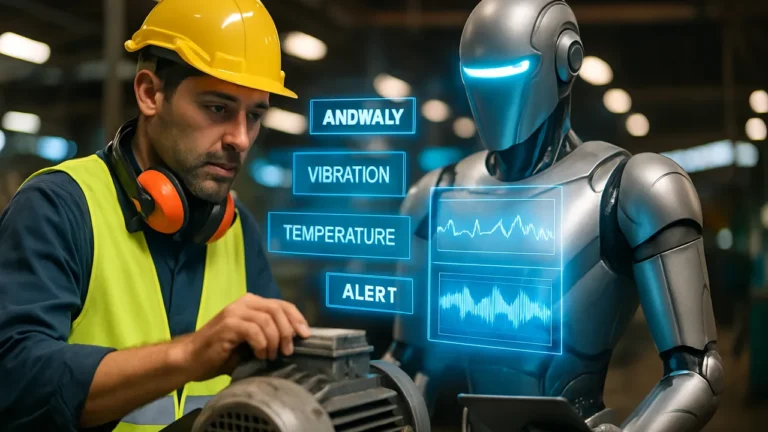

What Is AI Workforce Management?
AI workforce management is the application of artificial intelligence, machine learning, and predictive analytics to the full lifecycle of workforce operations demand forecasting, scheduling, attendance, skills allocation, performance monitoring, and retention strategy all operating in real time rather than on annual planning cycles.
Traditional workforce management operates on lagging data. A manager looks at last month’s overtime report, adjusts this month’s schedule based on gut instinct, and reacts to absenteeism after it has already cost the business. AI workforce management inverts this model entirely.
An AI-powered workforce management system continuously ingests live signals – sales forecasts, production schedules, historical attendance patterns, employee skills data, labor regulations, and real-time business demand and produces forward-looking recommendations. Not: “Here’s what happened last quarter.” But: “here’s exactly how many employees with these specific skills you need on Tuesday at 2 pm, based on current demand projections.”
The result is a workforce that is right-sized, right-skilled, and right-placed consistently without the manual overhead that currently consumes hundreds of hours of manager time per month.
According to a 2025 McKinsey Global Institute report, organizations deploying AI workforce management tools see up to a 25% improvement in workforce productivity and significant reductions in overtime, overstaffing, and unplanned turnover costs. Gartner projects that by 2026, 80% of large enterprises will have deployed some form of AI in their HR and workforce planning function – up from just 30% in 2022.
How Can AI and Workforce Management Work Together?
This is the question most operations and HR leaders ask first and the answer is more practical than most people expect.
AI doesn’t replace your workforce management process. It runs alongside and inside it taking over the data heavy, rules-intensive, pattern recognition tasks that human planners are poor at doing at scale, while leaving judgment, exceptions, and relationship management where they belong: with people.
Here’s the practical breakdown of how AI and workforce management work together across the key operational layers:
Demand Forecasting Layer
AI ingests dozens of demand signals simultaneously – sales pipelines, customer booking data, production orders, seasonal trends, local events, marketing campaign calendars and translates them into granular staffing requirements. This is the foundation everything else is built on. Accurate demand forecasting is what enables precise scheduling, not just approximate coverage.
Scheduling Optimization Layer
With demand forecast in hand, AI scheduling engines generate shift assignments that simultaneously satisfy employee availability, skill requirements, compliance constraints (labor laws, union rules, certifications), and cost targets. What used to take a manager 6–8 hours of spreadsheet work is produced in minutes with higher accuracy and fewer regulatory violations. AI workforce management works best when it augments rather than replaces human judgment. Learn how integrating AI into human workflows improves productivity across enterprise operations.
Real-Time Adjustment Layer
Business doesn’t wait for the schedule to catch up. A spike in call volume, an unexpected absence, a machinery breakdown each of these requires immediate workforce adjustment. AI systems detect these disruptions in real time and suggest reallocation actions before the impact becomes a crisis.
Talent Intelligence Layer
AI builds continuous, dynamic profiles of every employee skills, certifications, performance trends, engagement signals, career trajectory, compensation equity and uses this data to match the right person to the right task, flag flight risks, and surface development opportunities that retain high-value talent.
Compliance and Audit Layer
Scheduling errors that violate labor law or union agreements are expensive in fines, in grievances, and in management time. AI enforces compliance rules at the point of schedule generation, not after an audit discovers a violation weeks later.
For a deeper look at how this integration works in enterprise environments, Intellectyx’s guide on how integrating AI into human workflows improves productivity and efficiency covers the operational architecture in detail.
Struggling with Scheduling Inefficiencies?
Key Benefits of AI-Powered Workforce Management
AI-powered workforce management delivers value across five dimensions that compound over time:
1. Labor Cost Reduction – Without Sacrificing Output
The most immediate financial impact comes from eliminating the two biggest sources of labor waste: overstaffing (scheduling more people than demand requires) and understaffing (generating costly overtime and quality failures). AI’s continuous demand sensing eliminates both.
PwC research shows that AI-enabled scheduling reduces total scheduling-related labor costs by 10–15% annually in shift-based industries. For a 1,000-person operation, that typically represents $1–3M in annual savings – real money from a single capability.
Intellectyx’s dedicated guide to how AI workforce planning reduces labor costs without sacrificing productivity provides the full framework, including industry benchmarks and a five-step implementation roadmap.
2. Reduced Scheduling Errors and Compliance Risk
Manual scheduling error rates in complex environments run at 15–30% – generating compliance violations, employee grievances, and costly corrections. AI scheduling engines reduce these errors by up to 80% by encoding every constraint into the optimization model.
3. Lower Voluntary Turnover
Replacing an employee costs 50–200% of their annual salary (SHRM, 2024). AI attrition prediction models identify at-risk employees weeks before they resign, enabling targeted retention interventions. Organizations using AI-driven retention programs report 20–30% reductions in voluntary turnover within the first year.
4. Manager Productivity Recovery
Scheduling, rescheduling, absence management, and compliance checking together consume an estimated 6–12 hours per manager per week in shift-based operations. AI automation returns most of that time allowing managers to invest in coaching, development, and strategic work rather than administrative overhead.
5. Workforce Agility and Resilience
Organizations with AI workforce management respond to disruptions faster and with less cost whether the disruption is a sudden demand surge, a supply chain crisis, or a labor market shock. The system continuously recalibrates; managers don’t have to rebuild the plan from scratch.
How AI Workforce Management Reduces Scheduling Errors
Scheduling errors are one of the most expensive and underreported operational problems in workforce management. And they’re almost entirely preventable with AI.
The root cause of manual scheduling errors is complexity outpacing human cognitive capacity. A scheduler managing 300 employees across multiple shifts, with varying certifications, individual availability constraints, union rules, and labor law requirements, is handling a combinatorial optimization problem that no spreadsheet and no human can solve reliably at scale.
How AI workforce management reduces scheduling errors specifically:
Constraint encoding: Every scheduling rule minimum rest between shifts, maximum consecutive days, certification requirements by role, overtime triggers, regulatory minimums is encoded as a hard or soft constraint in the AI model. The system cannot produce a schedule that violates a hard constraint. Full stop.
Real-time availability integration: AI scheduling engines pull live availability data from employee apps, time-off request systems, and skills databases eliminating the manual data gathering step where most errors originate.
Conflict detection before publication: Before a schedule is published, AI systems automatically scan for conflicts, double bookings, under-certified assignments, and overtime violations and surface them for correction. Managers review exceptions, not entire schedules.
Automated compliance auditing: AI continuously audits published schedules against current labor regulations (including state-specific rules that change frequently) and flags deviations in real time, before they become violations.
Self-learning from feedback: When managers override AI schedule recommendations, the system learns from those overrides continuously improving its understanding of local constraints, employee preferences, and business-specific requirements.
Industry data from Deloitte’s 2025 Workforce Technology Report shows that organizations deploying AI scheduling in complex environments reduce scheduling error rates from an average of 22% to below 4% within the first six months of deployment.
Top 5 AI Workforce Management Software Companies in the USA (2026)
The market for AI workforce management software companies in the USA spans platform vendors, enterprise software giants, and specialized AI consulting firms. Here are the five companies leading the category in 2026.
#1 Intellectyx – Custom AI Workforce Management for Enterprise
Headquarters: Denver, CO | Founded: 2010 | Serves: Enterprise and mid-market across financial services, manufacturing, healthcare, and retail
Intellectyx leads this list not because it has the largest platform footprint, but because it consistently delivers what platform vendors cannot: AI workforce management systems that actually fit your organization’s specific workflows, data environment, and business model.
Most workforce management platforms are built for the average organization. Intellectyx builds for your organization designing, deploying, and optimizing custom AI systems that integrate with your existing HR, ERP, and operational infrastructure rather than asking you to replace it.
Core AI Workforce Management Capabilities:
Custom AI Demand Forecasting: Intellectyx builds demand forecasting models trained on your specific historical data incorporating the exact signals that drive your workforce requirements, whether that’s production orders, appointment bookings, transaction volumes, or patient census. Generic platforms use generic models; Intellectyx’s models are precision-tuned to your environment.
Intelligent Scheduling Agents: Agentic AI systems that generate, adjust, and optimize schedules autonomously encoding your specific labor agreements, certification requirements, and business rules as hard constraints. The result is compliance guaranteed scheduling at a scale no human team can match.
Workforce Analytics and BI: Real-time dashboards and predictive analytics that give HR leaders, operations managers, and CFOs a single, accurate view of workforce performance, cost, and risk built on your actual data, not a vendor’s data model.
Attrition Prediction and Retention Intelligence: Machine learning models that identify flight-risk employees weeks before they resign based on engagement signals, workload patterns, compensation equity, and career trajectory data enabling proactive retention investment.
AI-Powered Skills Intelligence: Dynamic skills graphs that map every employee’s capabilities to organizational requirements, enabling skills-based workforce allocation that reduces rework, training costs, and productivity losses from poor task person matching.
Intellectyx’s approach is grounded in over a decade of enterprise data and AI deployment experience. Unlike SaaS vendors who configure a standard platform, Intellectyx builds the AI infrastructure that fits your specific operational complexity. For organizations evaluating their AI investment, Intellectyx’s resource on AI-powered solutions and why smart businesses are investing now provides the ROI framework.
→ Schedule a Free AI Workforce Management Assessment
#2 Workday – Enterprise HCM and AI-Driven Workforce Planning
Headquarters: Pleasanton, CA | Revenue: $7.3B (FY2025) | Customers: 10,000+ enterprises globally
Workday is the dominant enterprise HCM platform in the US market, and in 2025–2026 has made substantial investments in embedding AI across its workforce management suite.
Workday’s AI workforce management capabilities include:
Workday Adaptive Planning: Machine learning driven workforce planning that integrates financial and operational data for scenario based headcount modeling. Organizations can model “what-if” scenarios – a 20% sales increase, a new facility opening, a market contraction and immediately see the workforce and cost implications.
AI-Powered Time and Attendance: Predictive absence management that flags patterns and provides coverage recommendations before absences become operational problems.
Workforce Optimizer: AI scheduling and staffing optimization engine that generates shift assignments based on skills, availability, and demand within Workday’s existing HCM framework.
Skills Cloud: Natural language processing powered skills intelligence that automatically tags employee experience from free text profiles and recommends development pathways and internal mobility opportunities.
Why consider Workday: Best fit for large enterprises that are already on Workday HCM and want a fully integrated AI workforce planning guide experience within a single vendor ecosystem. Less suitable for organizations with complex, non-standard scheduling requirements or those that need AI customized to proprietary workflows.
#3 SAP SuccessFactors – Workforce Intelligence at Global Scale
Headquarters: Walldorf, Germany / US HQ: San Jose, CA | Revenue: €35B+ (SAP Group, 2025) | Customers: 230M+ users across 190 countries
SAP SuccessFactors is the enterprise choice for organizations already operating in the SAP ecosystem particularly those running SAP S/4HANA for ERP, where native integration with workforce data creates significant planning advantages.
SAP’s AI workforce management capabilities include:
Workforce Planning and Analytics: AI-driven headcount forecasting integrated with SAP’s financial planning modules providing CFO-grade workforce cost visibility alongside operational workforce optimization.
Intelligent Services (AI + SAP Business AI): SAP’s embedded AI layer across SuccessFactors automates administrative HR workflows, surfaces anomalies in workforce data, and provides natural language query capabilities for HR analytics.
SAP Work Zone: AI-powered employee experience platform that personalizes the workforce interface, surfaces relevant tasks, and reduces friction in scheduling and self-service interactions.
Skills Ontology: SAP’s industry-specific skills frameworks combined with AI matching to align employee capabilities with current and future business requirements.
Why consider SAP: The natural choice for SAP centric organizations that need workforce management tightly integrated with ERP, financial planning, and supply chain systems. Complex implementation for organizations outside the SAP ecosystem.
#4 IBM – Enterprise AI Workforce Analytics and Skills Intelligence
Headquarters: Armonk, NY | Revenue: $61.9B (2023) | Known for: Watson AI, IBM watsonx, and AI for regulated and complex enterprise environments
IBM’s workforce management AI sits at the intersection of its deep enterprise AI capabilities and its decades of experience in large, complex, regulated organizations.
IBM’s AI workforce management capabilities include:
IBM Watson Talent Frameworks: AI-driven job architecture and skills taxonomy tools that help large enterprises standardize, update, and future-proof their skills frameworks foundational infrastructure for any AI workforce strategy.
IBM watsonx Orchestrate: AI agent platform that automates HR administrative workflows from scheduling approvals to onboarding coordination through natural language interfaces that integrate with existing HR systems.
Workforce Analytics (via IBM Cognos): Enterprise-grade BI and analytics applied to workforce data providing HR leaders with the same analytical rigor applied to financial and operational reporting.
AI Fairness and Compliance Tools: IBM’s AI ethics frameworks including AI Fairness 360 provide the bias detection and explainability capabilities that regulated industries require when deploying AI in HR and workforce decisions.
Why consider IBM: Best for large enterprises, especially in regulated industries (financial services, healthcare, government) that need robust AI governance and compliance capabilities alongside workforce analytics. IBM’s AI expertise runs deep; its workforce-specific product surface area is smaller than Workday or SAP.
#5 UKG (Ultimate Kronos Group) – Purpose-Built AI for Workforce Management
Headquarters: Lowell, MA & Weston, FL | Revenue: $1.5B+ (est. 2025) | Customers: 80,000+ organizations globally
UKG is arguably the most purpose built enterprise workforce management platform on this list with a product history that goes back to the original Kronos timekeeping systems and now includes sophisticated AI across scheduling, compliance, and people analytics.
UKG’s AI workforce management capabilities include:
UKG Pro Workforce Management: AI-driven scheduling, forecasting, and labor optimization engine purpose built for shift based operations healthcare, retail, manufacturing, hospitality, and distribution. The AI simultaneously optimizes schedule quality, compliance, and labor cost across thousands of employees.
UKG Talk: AI-powered communications platform that delivers personalized workforce communications and surfaces schedule updates, shift offers, and compliance alerts to employees through mobile-first interfaces.
People Analytics (via UKG Bryte): Generative AI-powered people analytics assistant that allows HR leaders and operations managers to query workforce data in natural language reducing the time-to-insight for workforce decisions.
Compliance Intelligence: Automated detection and remediation of scheduling violations across federal, state, and local labor law requirements including real-time updates as regulations change. This is particularly powerful for organizations operating across multiple US states with varying labor laws.
Why consider UKG: The strongest purpose-built workforce management platform for shift-based industries. Deep scheduling AI, best-in-class compliance automation, and a mobile-first employee experience. Less breadth in talent acquisition and development than Workday or SAP.
Want to Build a Smarter Workforce?
AI Workforce Management Leadership: 2026 Trends
The AI workforce management leadership 2026 trends shaping how forward-thinking organizations are building their people strategy are more significant than a typical annual update. Several of these trends represent genuine architectural shifts in how workforce management works.
Trend 1: Agentic AI Takes Over Scheduling and Coordination
The biggest shift in 2026 is the move from AI that recommends to AI that acts. Agentic AI systems – autonomous agents that can perceive situations, make decisions, and execute actions across systems – are being deployed to handle scheduling, shift-swap approvals, absence coverage coordination, and compliance monitoring without human approval at each step.
A scheduling agent, for example, doesn’t just produce a schedule recommendation. It monitors the live schedule, detects deviations (an employee calls out, a machine goes down, demand spikes), identifies the optimal coverage adjustment, checks it against all constraints, and publishes the update – all without a manager being in the loop unless an exception falls outside pre-approved parameters.
For HR leaders building AI workforce strategy, understanding how applied agentic AI is transforming enterprise operations is essential groundwork.
Trend 2: Skills-Based Workforce Architecture Replaces Job-Based Models
The traditional job architecture – fixed roles with fixed responsibilities and fixed pay bands – is too rigid for the AI era. In 2026, leading organizations are transitioning to skills-based workforce models, where work is allocated based on real-time skills matching rather than static job titles.
AI is the enabler of this transition. Skills intelligence platforms continuously update each employee’s skills profile, match skills to tasks in real time, and flag skills gaps before they become operational bottlenecks. Organizations that make this transition report higher workforce agility, better employee development outcomes, and more efficient labor utilization.
Trend 3: Real-Time Workforce Analytics Replaces Quarterly Reporting
Workforce data that was previously reviewed quarterly is now monitored continuously. Real-time dashboards tracking labor cost, productivity, schedule adherence, attrition risk, and skills coverage are becoming standard expectations for operations and HR leadership – not advanced capabilities.
This shift is powered by AI analytics layers that translate raw HR and operational data into actionable intelligence. The implication for leaders: workforce decisions need to move at the speed of operational decisions. Waiting for a quarterly review to identify a labor cost problem means the cost has already been incurred.
Trend 4: Generative AI Enters the Manager Toolkit
In 2026, generative AI agent development is being deployed directly into the manager’s daily workflow. Natural language interfaces allow managers to query workforce data (“What’s my overtime exposure this week?”), Generate schedule drafts (“Create a schedule for next week based on last month’s demand”), and draft employee communications – without navigating complex software interfaces.
This democratizes access to sophisticated workforce intelligence – making it available to frontline managers, not just HR analysts. For a comprehensive view of how generative AI is reshaping enterprise operations at this level, see generative AI for business transformation: enterprise guide 2026.
Trend 5: AI Ethics and Bias Auditing Become Non-Negotiable
As AI systems make or influence more workforce decisions – scheduling, performance evaluation, promotion recommendations, compensation adjustments – the regulatory and reputational risk of biased AI outputs is increasing. In 2026, leading organizations are implementing ongoing AI bias auditing as a standard governance practice, not a one-time implementation checkpoint.
This trend is particularly relevant for AI scheduling systems that could inadvertently create inequitable access to desirable shifts, overtime, or development opportunities if not carefully governed.
Trend 6: Workforce AI Integrated with Business Planning
The most mature AI workforce management deployments are breaking down the wall between workforce planning and business planning. Instead of HR planning headcount separately from Finance planning revenue and Operations planning production – all three plans are connected through shared AI models that automatically propagate demand signals across functions.
This integration eliminates the “plan misalignment” problem that causes organizations to simultaneously over-hire in some functions and under-staff in others. For enterprises evaluating where AI creates the most integrated value, Intellectyx’s broader analysis of why enterprises are investing in AI business solutions in 2026 provides the strategic context.
How to Implement AI Workforce Management: A Practical Roadmap
For leaders building an AI workforce management program in 2026, the most common failure mode isn’t technology – it’s sequence. Organizations that deploy AI without addressing data quality, process clarity, and change management consistently underperform those that build the foundation first.
Phase 1: Data Readiness Audit (Weeks 1–4)
AI workforce management is only as accurate as the data it runs on. Before evaluating any platform or building any model, audit your workforce data: historical attendance records, scheduling data, skills/certification records, payroll data, and business demand drivers. Identify gaps, inconsistencies, and integration blockers. Clean, connected data is the prerequisite for everything that follows. For enterprises evaluating vendors, see how the top AI automation companies for enterprise back office operations are approaching workforce and HR automation in 2026.
Phase 2: Use Case Prioritization (Weeks 4–6)
Not all workforce AI delivers equal ROI for every organization. Prioritize use cases based on where your current highest costs and highest errors are. Scheduling error reduction typically delivers the fastest measurable ROI – followed by demand forecasting accuracy and attrition prediction. Define your baseline KPIs before deploying anything.
Phase 3: Platform vs. Custom Decision (Weeks 6–10)
Evaluate whether an off-the-shelf workforce management platform (Workday, SAP, UKG) or a custom AI solution better fits your requirements. Platform solutions are faster to deploy for standard use cases; custom AI delivers better results when your workflows are complex, proprietary, or poorly served by generic models. Many organizations opt for a hybrid: a platform for core HCM functions and custom AI for the specific forecasting and optimization challenges that platforms handle generically.
Phase 4: Pilot Deployment (Weeks 10–24)
Select one business unit, location, or functional area for a structured 90-day pilot. Define success metrics clearly. Measure rigorously. Use the pilot data – not the vendor’s reference customers – to build your internal ROI case for enterprise rollout.
Phase 5: Change Management and Manager Enablement (Ongoing)
AI workforce management changes the manager’s job. Scheduling time is reclaimed. But new responsibilities emerge: reviewing AI recommendations, overriding when local context justifies it, and coaching teams rather than managing admin. Invest in structured enablement so managers use the tools effectively – and trust them.
Before deploying AI workforce management at scale, enterprises need a structured rollout plan. Our guide to AI adoption strategy for enterprises covers the five-step roadmap from pilot to production.
Final Thoughts: The Workforce of 2026 Is AI-Managed
The organizations outperforming their peers on labor efficiency in 2026 share one characteristic: they stopped treating workforce management as an administrative function and started treating it as a strategic AI capability.
The best AI workforce management systems don’t replace good managers. They free good managers from the administrative burden that currently prevents them from doing what they’re actually hired for: developing their teams, making good decisions, and driving business performance.
The technology is proven. The ROI is documented. The competitive window for first movers is still open – but the organizations deploying AI workforce management today are compounding advantages that will be increasingly difficult to close.
Intellectyx helps enterprises and mid-market organizations build AI workforce management capabilities thatem deliver measurable results – from demand forecasting and intelligent scheduling to skills intelligence, attrition prediction, and real-time workforce analytics. Our solutions are built on your data, for your workflows, in your environment.
FAQs
AI workforce management is the use of machine learning, predictive analytics, and AI agents to automate and optimize the core functions of workforce operations – demand forecasting, scheduling, attendance management, skills allocation, compliance enforcement, and talent retention. AI systems continuously ingest live business and workforce data, identify patterns, and produce actionable recommendations (or take autonomous actions) that keep workforce deployment aligned with business needs in real time – rather than relying on manual planning cycles.
AI and workforce management work together by AI taking over the data-intensive, rules-based tasks that human planners handle poorly at scale – demand forecasting, schedule optimization, compliance checking, absence pattern detection – while humans retain responsibility for judgment, exceptions, and relationship management. AI doesn’t replace the manager; it eliminates the administrative burden that keeps managers from doing meaningful work. The result is a workforce that is optimally staffed, compliant, and cost-efficient – with managers spending more time on people leadership and less on spreadsheets.
AI reduces scheduling errors by encoding every constraint – labor laws, union rules, certification requirements, availability, minimum rest periods – directly into the scheduling optimization model. The AI cannot produce a schedule that violates a hard constraint. Before publishing, AI systems automatically scan for conflicts and flag exceptions. Real-time compliance auditing catches violations as business conditions change. Industry data shows organizations deploying AI scheduling reduce error rates from approximately 22% to under 4% within the first six months.
The top AI workforce management software companies in the USA in 2026 are: (1) Intellectyx – custom AI workforce management systems for enterprise and mid-market; (2) Workday – enterprise HCM platform with integrated AI planning; (3) SAP SuccessFactors – workforce intelligence for SAP-ecosystem enterprises; (4) IBM – enterprise AI workforce analytics and skills intelligence; (5) UKG – purpose-built AI scheduling and compliance for shift-based industries.
The six key trends shaping AI workforce management leadership in 2026 are: (1) agentic AI taking autonomous action on scheduling and coverage decisions; (2) skills-based workforce architecture replacing fixed job models; (3) real-time workforce analytics replacing quarterly reporting cycles; (4) generative AI entering the manager’s daily workflow through natural language interfaces; (5) AI ethics and bias auditing becoming standard governance requirements; and (6) workforce AI integrating directly with business planning and financial forecasting systems.